Stuart Kelly considers the responses of South African writers to apartheid, and looks at how a new generation of novelists is depicting the challenges facing the country today
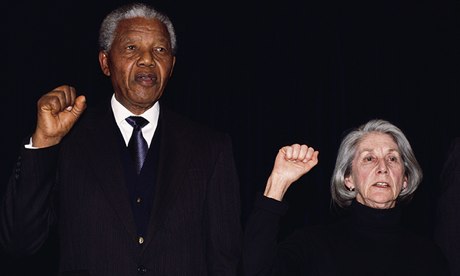
United voice … Nelson Mandela and Nadine Gordimer sing the national liberation anthem in Johannesburg in 1993. Photograph: Louise Gubb/Corbis Saba
It is impossible to write about contemporary South African literature without writing about apartheid. In terms of both reading and writing, the racist regime was like an eye infection, distorting what could be seen. Apartheid literally means "the state of being apart", and a sense of "apartness" characterised South African writing not just when the National Party was in power, but to the present day. Yet responding to the conditions of apartheid unified South African literature, completed the polyglot jigsaw puzzle, made up of English speakers, Afrikaans speakers and speakers of Zulu, Xhosa, Sotho, Pedi, Tswana, Venda, Siswati, Tsonga and Ndebele.
When Nadine Gordimer became the first South African writer to win the Nobel prize for literature in 1991 (three years before the end of apartheid, but during FW de Klerk's initial stages of dismantling the regime's legally enshrined racism), her citation by the judges expertly avoided explicitly linking her laureateship to her public and literary opposition to the National Party's policies. Instead they praised her as a novelist "who through her magnificent epic writing has – in the words of Alfred Nobel – been of very great benefit to humanity". The citation, like many others from the Nobel committee, was more politic than political; a gesture of international appreciation that nevertheless shied away from supporting her activism.
More

When Nadine Gordimer became the first South African writer to win the Nobel prize for literature in 1991 (three years before the end of apartheid, but during FW de Klerk's initial stages of dismantling the regime's legally enshrined racism), her citation by the judges expertly avoided explicitly linking her laureateship to her public and literary opposition to the National Party's policies. Instead they praised her as a novelist "who through her magnificent epic writing has – in the words of Alfred Nobel – been of very great benefit to humanity". The citation, like many others from the Nobel committee, was more politic than political; a gesture of international appreciation that nevertheless shied away from supporting her activism.
More


No comments:
Post a Comment