Tuesday, January 31, 2012

Perhaps the Greatest Comics Book Store in the World


Publishing Perspectives

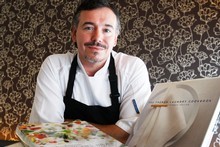
"People don’t revere the old comics enough," says Manuel Morin (above), owner of Paris' BD Spirit, which offers 50-80,000 titles, many of them collectors items.
Link here for story.


DISCUSSION:
What Makes a Great Comic Book Store?
The one thing a great comics book store must do -- unlike a bookstore -- is ensure you never forget your in a comic book store.

The Clark explores the art of copying ~ "Copycat: Reproducing Works of Art"


Art Knowledge News - Posted: 29 Jan 2012 0
artwork: Eugène Delacroix - "Lion Devouring a Horse", 1844 - Lithograph on chine collé on paper - © Sterling and Francine Clark Art Institute, Williamstown, Massachusetts

WILLIAMSTOWN, MA.- The Sterling and Francine Clark Art Institute opened its latest exhibition, Copycat: Reproducing Works of Art, on January 29. Exploring the line between innovation and imitation, the exhibition features 50 prints and photographs that are both original works of art and repetitions of drawings, prints, paintings, sculptures, and architecture created by other artists. The exhibition highlights the complex process of copying by studying replications of many rarely seen works from the Clark’s permanent collection, including those by Albrecht Dürer, Paul Cézanne, Eugène Delacroix, Rembrandt van Rijn, Roger Fenton, and Édouard Manet, among others. The exhibition also marks the first public presentation of one of the Clark’s recent acquisitions, Jean Dughet’s series The Seven Sacraments. Copycat will be on view in the Clark’s Manton Research Center building through April 1st.

Monday, January 30, 2012

WHITE CLOUD WORLDS - NZ Science Fiction and Fantasy Art Exhibition and Book

White Cloud Worlds is a never-before seen collection of science fiction and fantasy artwork from New Zealand, 'The Land of the Long White Cloud'.
Embark upon a journey of exploration into a wealth of visually rich worlds and imaginings, conjured to life by 27 established and emerging artists.
The artists are profiled with a selection of their art accompanied by text written in their own unique voice, sharing their origins, inspirations and a rare glimpse into how they work.
White Cloud Worlds includes written contributions from some of the world’s most celebrated leaders in the fields of science  fiction and fantasy art, such as Guillermo Del Toro, Richard Taylor,  Alan Lee and John Howe. 
This book honours the imaginations of the artists it showcases  and gives readers a unique opportunity to be a part of their worlds.

White Cloud Worlds is published by Harper Collins.It is  also available in a special slipcase edition which includes a limited edition signed print by one of the artists.

The White Cloud Worlds exhibition will open at the Lopdell House Gallery in Titirangi, Auckland on February 16th and will run through until the 15th of April.

‘A Wrinkle in Time’ and Its Sci-Fi Heroine

By PAMELA PAUL - The New York Times - Published: January 27, 2012

Bookish girls tend to mark phases of their lives by periods of intense literary character identification. Schoolgirls of the ’70s had their Deenie and Sally J. Freedman and Margaret moments, muddling through adolescence in the guise of one Judy Blume heroine or another. And for almost a century and a half, girls have fluctuated between seasons of Amy and Meg and Jo March, imagining themselves alternately with blond corkscrew curls, eldest sister wisdom or writerly ambitions.

But for those who came of age anytime during the past half-century, the most startling transformation occurred upon reading Madeleine L’Engle’s Newbery Medal-winning classic, “A Wrinkle in Time,” which celebrates its 50th anniversary this year. It was under L’Engle’s influence that we willed ourselves to be like Meg Murry, the awkward girl who suffered through flyaway hair, braces and glasses but who was also and to a much greater degree concerned with the extent of her own intelligence, the whereabouts of her missing scientist father, the looming threat of conformity and, ultimately, the fate of the universe.
Meg Murry, in short, was a departure from the typical “girls’ book” protagonist — as wonderful as many of those varied characters are. Meg was a heroine of science fiction.
In 1962, when “A Wrinkle in Time,” after 26 rejections, was acquired by John Farrar at Farrar, Straus & Giroux, science fiction by women and aimed at female readers was a rarity. The genre was thought to be down-market and not up to the standards of children’s literature — the stuff of pulp and comic books for errant schoolboys. Even today, girls and grown women are not generally fans. Half of 18- to 24-year-old men say that science fiction is their favorite type of book, compared with only one-fourth of young women, according to a 2010 study by the Codex Group, a consulting firm to the publishing industry. And while a sizable portion of men continue to read science fiction throughout their lives, women don’t. Thirty-two percent of adult male book buyers are science-fiction fans compared with only 12 percent of women. When Joanna Russ, one of the few successful female science-fiction writers, died last year, her obituary in The New York Times referred to her as a writer who helped “deliver science fiction into the hands of the most alien creatures the genre had yet seen — women.”   

THE SISTERS BROTHERS

So many people enthused to me about this book, it received so many positive reviews, and it was short-listed for the Man Booker Prize, so in the end while on holiday I got myself a copy and read it. And I have to say I loved it.
From the terrific cover and great title to the captivating story I was enchanted; and even though the story is about a couple of hired killers,and is set in California during the gold rushes of the 1850's, it had me laughing out loud on several occasions.
I reckon the Cohen Brothers could make it into a great movie - that would have a nice ring to it - Cohen Brothers make the Sisters Brothers!
Allen & Unwin - $36.99

A local politician, a music reviewer and an author walk into a bar…

Sound like the beginning of a good story?
Come along to True Stories Told Live on Monday 13 February and hear some fantastic stories, told by local politician Ray Ahipene-Mercer, renowned music store owner and reviewer Colin Morris, and authors Barbara Else, Fleur Beale (left), Catherine Robertson, with two artistic friends.

True Stories Told Live events brim with live, unrehearsed tales, told by people with a flair for storytelling. Stories make us laugh, cry and crinkle our foreheads – there is no better way to energise a quiet Monday evening.
The event, with the theme of family holidays, will raise funds for the Book Council’s Writers in Schools programme, which has been bringing books, authors and children together since 1973.
Education Manager Sarah Forster says ‘Family holidays bring out the best and the worst in people. Prepare to be enthralled and dismayed at the antics of these brilliant creative people.’
'At True Stories Told Live, the story must have a beginning, middle and an end, and it must be true, but that’s all’, says the Book Council’s Susanna Andrew.
Andrew says that past True Stories events prove that something happens in the exchange of a story. ‘What makes these events so special is not just the confessional quality of the performance. It's also the suspension of judgement that's required, a critical faculty we would normally employ, consciously or not, when we embark on a novel, start a film, or sit down in the theatre.’

Tickets are $15 for members of the Book Council, or $20 for non-members.
Go to www.bookcouncil.org.nz to book your tickets and learn more about us.

True Stories Told Live – Family Holidays
Where: Meow Café, 9 Edward St, Wellington
When: 6.15pm, Monday 13 February


Waitangi Day launch for Gavin Bishop's 'The House that Jack Built' in English and Te Reo Maori

Gecko Press is pleased to launch a new edition of The House that Jack Built by Gavin Bishop, and the first Te Reo Maori edition - Koinei te Whare na Haki i Hanga - as part of Porirua's popular, multi-cultural Waitangi Day event,  The Festival of the Elements . The Festival will take place from 11am till after 7pm at Te Rauparaha Park and Arena and Pataka Museum, Porirua on Monday 6 February.

Throughout the day, the book will be read in both English (by Gavin Bishop) and Te Reo Maori (by Moira Wairama) in the storytelling gazebo at NZ Community Trust Stadium (Te Rauparaha Arena). Readings will take place every hour from 11.30am to 4.30pm.


 At 2.35pm, author/illustrator Gavin Bishop (left) and translator Piripi Walker will discuss The Story of the House that Jack Built: Art and Translation at the Helen Smith Community Meeting Room at Pataka Museum (duration: 45 minutes).

Throughout the day, children can help build a giant 'House that Jack Built' sculpture using natural materials, with artist Michelle Whale in the NZ Community Trust Stadium.

Martin Edmond reviews Road Markings

A nation exacts a penance from those who dared to leave her wrote James Joyce, explaining why his only play was called Exiles; the line is much quoted but most people who do so leave off the next bit: payable on their return. Michael Jackson left his native New Zealand while still a young man, in the first instance for Melbourne, where he worked among the homeless and had his first encounters with Aboriginality. Later he did similar work in London and the Congo and later still went to Sierra Leone, beginning there the fieldwork that has distinguished his vocation as an anthropologist. He has been far more diligent in his repayments than JJ ever was, returning again and again and, each time, illuminating forgotten corners of what he calls the diffuse and dimly lit world of New Zealand’s collective imagination.

In Road Markings, published as a ebook by Rosa Mira Books of Dunedin and subtitled An Anthropologist in the Antipodes, Jackson sets out on a road trip through his natal land that is also an inquiry into the idea of firstness: the place of origin in our consciousness, the meaning of beginnings, the aura of the primary as a way of authenticating both personal experience and historical truth. This might sound daunting as a theme but his exploration of it is not: this is autobiographical writing of the highest order, in which the personal is resolutely explored but never just for its own sake: Jackson’s own history, that of his family and friends, his colleagues, his mentors, his literary heroes, are woven together to make, not so much a tapestry as a finely calibrated, gorgeously textured, many-coloured mahi harakeke.
To read Martin's full review link to his blog here.

My Week With Marilyn - reviewed by Nicky Pellegrino

In the 50 years since her death the legend of Marilyn Monroe has lost none of its power to fascinate. One of this summer’s must-see films is My Week With Marilyn starring Michelle Williams, Kenneth Branagh and Judi Dench. It’s based on two diaries written in 1956 by Colin Clark, then an Oxford graduate who landed a job as a gofer on the set of The Prince And The Showgirl.
Usually I prefer to read the original book before I see the film and conveniently HarperCollins has just re-released the two diaries in one volume. My Week With Marilyn by Colin Clark  ($24.99) is an engrossing period piece. It may not shed a great deal of light on who Marilyn really was beneath the veneer of fame and beauty – Clark like most men fell under her spell and this clouded his judgement – but it does provide a glimpse into an extraordinary and vanished world.
The reason two diaries cover the same period is Clark waited until after Marilyn’s death before publishing the details of his more intimate relationship with the star.
The first diary is the longest. It opens with Clark’s dogged attempts to get a job at Laurence Olivier’s film company. He gets his foot in the door partly because he is well-connected – his parents live in a castle and are friends with everyone from Olivier to Noel Coward. Still he seems likeable enough: cheeky but charming, a lover of parties and pretty girls, and breezily determined to break into the movies.
At first he’s unimpressed with the woman he refers to as MM. “She looked absolutely frightful,” he says of her first appearance on the film set. “Nasty complexion, a lot of facial hair, shapeless figure and, when the glasses come off, a very vague look in her eye.” Yet by the very next day she’s worked her magic and he’s describing her as looking “like an angel”. Soon he’s finding excuses for her behaviour: her chronic lateness, her reliance on her acting coach, her need for booze and pills.
Observant and smart, Clark is in pole position to record the few ups and many downs of filming. His insights are honest and interesting and he watches Marilyn especially closely, observing the contradictions in her character as well as her wonderful figure.
The second diary fills in the blanks Clark left in the first. It covers the nine days when Marilyn, whose new marriage to playwright Arthur Miller is already shaky, draws him close to her. First they share a chicken salad and confidences; then a day trip, a swim and a kiss on the lips; finally a night in bed.
Clark – who died in 2002 - is adamant “nothing improper” happened between them. I’m not convinced and neither does his account of their private conversations always ring true to me. Nevertheless I found both diaries intriguing and entertaining, and I’ll be queuing for my ticket for the movie version when it releases in New Zealand in March. 


Footnote:
Nicky Pellegrino, (right NZH photo), a succcesful Auckland-based author of popular fiction is also the Books Editor of the Herald on Sunday where the above review was first published on 29 January, 2012


Five Hundred Buildings of New York

Five hundred glorious photographs showcase the finest, most majestic and most interesting examples of architecture in my most beloved city outside of New Zealand, New York. The book represents a photographic neighbourhood-by-neighbourhood tour of the city, capturing stately and historic buildings, monuments and engineering structures. Each building is showcased on it's own page in a rich and beautiful fine resolution monochrome photograph. The accompanying text identifies location and date of completion/renovation, the building's distinctive features and historical context.

Having just come back from almost a month in that great city how could I possibly leave this stunning door-stopper of a book on the shelf at the wonderful Matakana Village Bookshop? 
PS-I wonder how many photographs I own of the Flat Iron Building? Dozens!

Published by Black Dog & Leventhal Publishers, NZ$50.

Women writers turn to the horror story - Jeanette Winterson and Helen Dunmore among famous names venturing into the horror genre this year

 - The Observer,
Writer Helen Dunmore
Helen Dunmore: hoping to scare the wits out of her readers. Photograph: Christopher Jones / Rex Features
As an icy wind blows in from the east, the grip of a good horror story is tightening its hold on many of Britain's leading literary talents. Terrifying new novels from outspoken author Jeanette Winterson and from the acclaimed novelist and children's writer Helen Dunmore are at the head of a blast of chilling fiction heading for British bookshops.
Where once an accomplished "lady novelist" in search of a change might have attempted a neat whodunnit or perhaps a cosy "Aga saga", suddenly the unholy desire to create a horror or ghost story has seized a range of established talents. Even the television book club presenter Judy Finnigan has been drawn to the genre for her debut novel, a ghost story that will be out this autumn.
Winterson, who had her first success with the novel Oranges Are Not the Only Fruit, will try her hand at scaring her readers witless this summer with a story based on the infamous Pendle witch trials held at Lancaster castle in 1612. Dunmore, the writer much loved for her children's books, poetry and award-winning novels, has followed suit. Her first horror novel, a supernatural thriller called The Greatcoat, has been published by Hammer Books, the imprint of the now revived film studios that brought British cinema audiences a succession of gory titles from the 1950s to the 1970s. Dunmore's debut marks the publisher's decision to commission a series of original works rather than rely on the novelisations of horror films which it also publishes.
"The interesting fiction at the moment is playing with genres, slipping between them," said Hammer publisher Selina Walker. "So we're approaching all the literary or established greats to see whether they would like to write something with a paranormal twist."
This week Hammer's film version of Susan Hill's 1983 novel The Woman in Black, one of the most popular British ghost stories of modern times, is out in cinemas, starring Daniel Radcliffe as the unfortunate solicitor Arthur Kipps. But for Dunmore the work of two other women writers with the gift of instilling fear provided the chief inspiration. "Elizabeth Bowen's work influences me a lot, particularly The Demon Lover. I also love Daphne du Maurier," said the writer, who has turned to horror after writing 11 mainstream novels, including the Orange Prize-winning A Spell of Winter and The Siege.
"I was drawn to the genre because it is intensely dramatic material," she said. "To some extent it is a psychological playground. You wonder what is the match between the ghost and the person who is haunted. What is there in the past that has driven them to this point?"
The key, Dunmore believes, is to make the experiences described as "palpable" as possible, to carry the reader into the darkness: "It has got to have a lot of sensory richness."
Full story at The Observer

The Pushkin State Museum of Fine Art Presents the First Major William Blake Exhibition in Russia

  1. Attention: open in a new window. artwork: William Blake - "Pity", circa 1795 - Colour print finished in ink and watercolour on paper - Tate collection. On view at the Pushkin State Museum of Fine Art in "William Blake and British Visionary Art" from November 29th until February 19th 2012.

    Moscow.- The Pushkin State Museum of Fine Art is proud to present "William Blake and British Visionary Art" on view at the museum from November 29th through February 19th 2012. This is the first major exhibition to present Blake’s visual art in Russia as well as being the first exhibition to explore Blake and his legacy. The exhibition is a collaborative project between the Tate and the Pushkin State Museum of Fine Art in partnership with the British Council.Drawn mainly from Tate’s Collection alongside works generously lent from other British collections, the exhibition consists of approximately 110 of Blake's works, including many of his best known images such as The Ghost of a Flea c.1819-20. It also includes the recently discovered hand-coloured etchings from the major prophetic work The First Book of Urizen 1796 c.1818.


    Although mainly overlooked during his lifetime, Blake's impact and influence on later generations of artists, writers and musicians has been enormous. His visionary ideas, and his ability to convey these in both poetry and painting, remain a major reference point in British culture today and this show aims to reveal his remarkable art and its visual legacy to a Russian audience. The expression of spiritual values through bodily form is the hallmark of Blake’s visionary art and came to influence both the Symbolist art of the later nineteenth century and the neo-romantic revival of the 1930s. Many of the artists associated with these movements saw Blake as a pioneer in imagining infinite possibilities for sensory and spiritual experience. His work has been a reference point for artists nationally and internationally and this exhibition will include over twenty works by British artists who have been influenced by Blake including Samuel Palmer, Dante Gabriel Rossetti, John Piper and Francis Bacon.

    artwork: William Blake - Plate 11 from 'The First Book of Urizen' (1796 - c.1818) Colour printed relief etching finished in pen and ink and watercolour on wove paper - 26.4 x 18.5 cm. - Tate collection. On view at the Pushkin State Museum of Fine Art in - "William Blake and British Visionary Art"

    As part of the Blake in Russia project a new Russian translation of Blake's Songs of Innocence and Experience has been jointly published by the British Council and the State Library of Foreign Literature. Blake was not so much a poet, printmaker and artist but rather that his chosen form allowed all these things to come together on one page. His illustrations were never set along aside the poems, and the poems were not typeset. Rather he actually made prints of his poems and pictures together. This is the first time that Blake’s illustrations have ever been published alongside his poetry in Russia.

    The Pushkin Museum of Fine Arts is the largest museum of European art in Moscow, located in Volkhonka street, just opposite the Cathedral of Christ the Saviour. The museum's name is misleading, as it has nothing to do with the famous Russian poet. It was founded by professor Ivan Tsvetaev (father of the poet Marina Tsvetaeva). Tsvetaev persuaded the millionaire and philanthropist Yuriy Nechaev-Maltsov and the fashionable architect Roman Klein of the urgent need to give Moscow a fine arts museum. The museum building was designed by Roman Klein and Vladimir Shukhov and financed primarily by Yury Nechaev-Maltsov. Construction work began in 1898 and continued till 1912. Ivan Rerberg headed structural engineering effort on the museum site for 12 years, till 1909. Tsvetaev's dream was realised in May 1912, when the museum opened its doors to the public. The museum was originally named after Alexander III, although the government provided only 200,000 rubles toward its construction, in comparison with over 2 million from Nechaev-Maltsev. Its first exhibits were copies of ancient statuary, thought indispensable for the education of art students. The only genuinely ancient items - Moscow Mathematical Papyrus and Story of Wenamun - had been contributed by Vladimir Golenishchev three years earlier.

    artwork: William Blake - "God Judging Adam", 1795 - Colour-printed relief etching with ink and watercolour on paper support - 43.2 x 53.5 cm. -Tate collection. On view at the Pushkin State Museum of Fine Art in "William Blake & British Visionary Art" until February 19th.

    After the Russian capital was moved to Moscow in 1918, the Soviet government decided to transfer thousands of works from St Petersburg's Hermitage Museum to the new capital. The entire collection of Western art from the Museum Roumjantsev was added too. These paintings formed a nucleus of the Pushkin museum's collections of Western art. But the most important paintings were added later from the State Museum of New Western Art. These comprised Impressionist and Post-Impressionist artwork, including top works by Vincent Van Gogh, Paul Gauguin, Pablo Picasso, Georges Dufrénoy and Henri Matisse. Among them Van Goghs "Le Vigne Rouge" apparently the only painting sold during the artist's lifetime. In 1937, Pushkin's name was appended to the museum, because the Soviet Union marked the centenary of the poet's death that year. The Pushkin Museum is still a main depositary of Troy's fabulous gold looted from Troy by the German archaeologist, Heinrich Schliemann and taken by the Soviet Army (Red Army) from the Pergamon Museum in Berlin. The International musical festival Svyatoslav Richter's December nights has been held in the Pushkin museum since 1981. Visit the museum's website at ... http://www.museum.ru/M296

Sunday, January 29, 2012

Books in the Sunday papers

After last week's almost total absence of space devoted to books it is nice to see Nicky Pellegrino back with her usual page in the Herald on Sunday while over at the more serious Sunday Star Times, Books Editor Mark Broatch has four pages including an excellent review by Patrick Evans of the just published, and most impressive, LETTERS OF FRANK SARGESON, selected & edited by Sarah Shieff and published under Random House's Vintage imprint.

Bookends: Doors of perception

Marcus Berkmann -  The Spectator -21 January 2012

Unlike most of the old rockers he writes about, the esteemed US critic Greil Marcus is becoming more prolific as he enters his twilight years. An eccentric monograph on Van Morrison was swiftly followed last autumn by a luxuriant collection of his writings on Bob Dylan, and now arrives The Doors: A Lifetime of Listening to Five Mean Years (Faber £14.99).
Marcus doesn’t just inhabit the more rarefied and cerebral wing of rock criticism: he pretty much defined it. Unlike most rock hacks he is not particularly interested in the musicians and their often tarnished legends. No, he listens and listens to the music, listens some more, thinks about it for years, listens some more and then finally commits his thoughts to print.
It doesn’t always work: some of his more olympian judgments on Morrison were quite barking, and suggested a need to get out more. But The Doors is a much better book. It probably helps that their time together was so compressed, and so long ago (1966-71), and that Marcus hasn’t written much about them before.
So this is a fresh set of unlikely connections, for every moment in every Doors song seems to remind him of something else — a car, a vista, a Thomas Pynchon novel, Charles Manson, Lady Gaga.
His book is therefore as much a journey through his mind as through their back catalogue. It’s a fascinating ride, although a working knowledge of Doors bootlegs would certainly come in handy.


And another review, from The Atlantic.

NZ's top chefs fess up in their books

By Geraldine Johns - NZ Herald  Jan 19, 2012

Geraldine Johns asks six of our top chefs what their favourite cookbooks are — the ones that really inspire them — and why.
Simon Wright, executive chef and co-owner of The French Cafe. Photo / Richard RobinsonSimon Wright, executive chef and co-owner of The French Cafe. Photo / Richard Robinson

Any frequent visitor to restaurants or cafes can attest that the talent of a chef does not lie in their ability to spell. Or punctuate. Menu-writing sins are themselves worthy of a book.
It doesn't really make a lot of sense when you consider that chefs - good ones at least - love nothing more than devouring a good cookbook. Their collections don't just provide information and inspiration; they catalogue their life's journey.
SIMON WRIGHT
Executive chef and co-owner of The French Cafe
One of the city's finest dining establishments, The French Cafe restaurant regularly takes home the big gongs when the major culinary prizes are dished out. A few years ago, Wright - who was born and raised in England - penned his own coffee table cookbook. He gave it the same title as his restaurant, which he co-owns with his wife, Creghan Molloy Wright.
"I collect cookbooks - I've probably got a couple of thousand - so it's hard to choose just three. I treasure them all. Every time I read one, I always find something I missed. I never really copy anything out, I think to myself 'oh, that looks good' and I might then go off on a tangent and do my own recipe".

CELIA HARVEY
Food writer, and chef at Greys Avenue Deli
When Celia Harvey lived and worked in London, she spent four years at, among other places, The River Cafe. There she earned tremendous (and deserved) high praise. We are lucky to have reclaimed her as one of ours, she has a gift for making all her food work beautifully with seemingly little effort. Harvey is the chef at Greys Avenue, recognised as the first Kosher deli in New Zealand.
"As a child - I would have been 9 or 10 - I remember reading Mum's cookbooks, especially one by [food writer and Britain's first television chef] Marguerite Patten, which I looked at a lot. Mum and Dad were going through a time of being vegetarians and I wanted to cook meat - a crown rib roast with little paper chef's hats.
"Then I got into cooking at intermediate school. I'd make bread for our sandwiches and chocolate cake for our lunch boxes. Mum bought me the Junior Cookbook series by Mary Pat Fergus. I still remember some of the recipes: lemon delicious pudding, chocolate self-saucing pudding.
"The books were spiral-bound, with step-by-step illustrations and kept in the bottom of the kitchen drawer, where Mum still keeps her cookbooks today.

SIMON GAULT
Executive chef and part owner of the Nourish Group
Everyone knows who Simon Gault is by now. Three seasons as a judge on MasterChef does that to you. But Gault had a culinary life long before the telly came calling. Long, long ago he had his own restaurant in his own name. Then came Euro. Gault is now executive chef and part-owner of the Nourish Group - a restaurant empire (including Euro) spanning the North Island. But Gault's stellar culinary career has not been entirely land-based. He's also enjoyed a few high seas adventures, as chef on a super-yacht to an ocean-going multimillionaire. And he likes to take to the skies too, he's a glider pilot instructor and pilot of vintage military aircraft.
"The Edmonds Cookery Book would definitely be my first pick. When I went to work on a super-yacht, I couldn't carry a lot of books. But that one is a good one. It has all the basics.
"The Edmonds is not a total chef's cookbook - but sometimes it's not about fancy food - it's about the simple things that you know will work, and if you want to fancy it up, you can. This is the cookbook that's my little secret weapon that I keep in the cupboard.
"I've also got a book called Food Lover's Companion [written by Sharon Tyler Herbst and Ron Herbst]. It offers comprehensive definitions of nearly 6000 food, drink and culinary terms. That sounds highly boring - but it is a fantastic tool. I can flick to any page in that book and it will tell you everything you need to know about anything you want; every trick there is.
"I know it sounds crazy, but it's a well-thumbed book - especially when I'm writing recipes.
Read their full comments plus those of three other top chefs at the NZH online.

Charlotte Bronte's lost love letters revealed

Love letters which reveal Charlotte Brontë's infatuation with her Belgian professor are to be published. The Telegraph - 27 January, 2012

Charlotte Bronte, Victorian writer
Charlotte Bronte as a young woman Photo: Mary Evans Picture Library / Alamy
The letters were sent by the Jane Eyre novelist to Professor Constantin Heger, an older man with a wife and children.Heger tore them up in shock, but they were retrieved from a rubbish bin by his wife who sewed them back together and preserved them.
One, composed in French, reads: "If my master withdraws his friendship from me entirely, I shall be absolutely without hope."
Another, with a postscript written in English, reads: "I must say one word to you in English - I wish I would write to you more cheerful letters, for when I read this over, I find it to be somewhat gloomy - but forgive me my dear master - do not be irritated at my sadness - according to the words of the Bible: 'Out of the fullness of the heart, the mouth speaketh', and truly I find it difficult to be cheerful so long as I think I shall never see you more."
The letter was written in 1844, two years after Bronte, then age 28, met Heger, her tutor, and three years before the publication of Jane Eyre, her first major work.
The story echoes the plot of her 1853 novel Villette, about a young women with an unrequited love for her Belgian teacher.
Full piece at The Telegraph.

Vladimir Putin plans 100-book Russian canon all students must read

The Russian prime minister prescribes his top 100 books for the nation

Vladimir Putin
Vladimir Putin talks to students in the Siberian city of Tomsk on January 25. Photograph: Alexey Druzhinin/AFP/Getty Images

Vladimir Putin has laid out his plans to compile a canon of 100 Russian books "that every Russian school leaver will be required to read" in an attempt to preserve the "dominance of Russian culture".
In an article running to more than 4,500 words in Russia's Nezavisimaya Gazeta newspaper, the Russian prime minister writes that "in the 1920s, some leading universities in the United States advocated something referred to as the Western Canon, a canon of books regarded as the most important and influential in shaping Western culture", adding that "each self-respecting student was required to read 100 books from a specially compiled list of the greatest books of the Western world".
Putin, who is running for a third term as president in March, says that Russia has "always been described as a 'reading nation'", and proposes taking a survey of the country's "most influential cultural figures" and compiling "a 100-book canon that every Russian school leaver will be required to read – that is, to read at home rather than study in class or memorise. And then they would be asked to write an essay on one of them in their final exams. Or at least let us give young Russians a chance to demonstrate their knowledge and world outlook in various student competitions."
Journalist Alexander Nazaryan, who is writing a novel about Russian immigrants in New York, called Putin's "cultural-unity-through-literature proposal" the Russian leader's "most chilling [plan] of all".
"Social engineering through state mandated literature: Nothing else that Putin has done has been quite so nakedly Soviet in its desire to manipulate the human intellect into docility," writes Nazaryan, predicting that "the books that will benefit from Putin's new cultural policy will almost certainly be Soviet-era schlock churned out by Writers' Union foot soldiers who glorified their compatriots' miserable existence".
Whether Putin's choices will feature in the specialist Russian bookshop due to open in Waterstones' Piccadilly branch next month remains to be seen. To be called Slova – Russian for "words" – the store will stock nearly 5,000 Russian language titles as well as Russian books in translation, covering areas from history to children's books and run by Russian-speaking booksellers.
"For Russophiles, and the large, vibrant Russian community in London, we aim to make Slova an irresistible literary and cultural destination," said James Daunt, who took over as Waterstones managing director last year when the chain was acquired by Russian billionaire Alexander Mamut. "One won't be surprised at the source of the idea, given Waterstones' ownership, but it is a good one and perfect for this magnificent shop."

Reconsidering the Genius of Gertrude Stein

By LYNNE TILLMAN - New York Times - Published: January 27, 2012

Approaching Gertrude Stein’s writing critically is tricky. Because she strove to reshape literary conventions — syntax, language usage, narrative order and the sense of making sense — any comment on her choices may already be rebuffed in her poetics and practice. Stein is a trickster. This may be why, as I read “Ida” and “Stanzas in Meditation,” both reissued in corrected, authoritative editions from Yale University Press, I remembered a Jonathan Richman lyric I’ll paraphrase as “Pablo Picasso never got called a jackass.”

Illustration by Joe Ciardiello

IDA
By Gertrude Stein. Edited by Logan Esdale.
Illustrated. 348 pp. Yale University Press. Paper, $18.

STANZAS IN MEDITATION - The Corrected Edition
By Gertrude Stein. Edited by Susannah Hollister and Emily Setina.
Illustrated. 379 pp. Yale University Press. Paper, $22.

Gertrude Stein (1874-1946) is called a genius, and it’s from that vantage her writing is read — or not read, since awe and reverence are regularly met by dismissal and ridicule. Curiously, not every “genius” is equally suffocated by the label. Readers know the extraordinary reputations of Shakespeare and Virginia Woolf, but some prefer “Richard III” to “Richard II,” or “Mrs. Dalloway” to “Orlando.” They feel at liberty to discriminate.
Fewer readers imagine they can create their own Stein; many feel she is beyond their capacity to understand. Maybe this is because she has been claimed as the sine qua non of the avant-garde. But she aligned herself with her time. Being part of the “contemporary composition” was central to her work, a point she made in her trenchant essay (originally a lecture) “Composition as Explanation”: “The only thing that is different from one time to another is what is seen and what is seen depends upon how everybody is doing everything.” Here, Stein wielded the novelty and surprise of her prose partly to explain how novelty and surprise surface from generation to generation, and theorized why the new in art and writing may first be thought ugly, then later beautiful or classic. In that same essay, she declared: “No one is ahead of his time.” (Andy Warhol, who like Stein is both adored and mocked, once said, “I’m very much a part of my times, of my culture, as much a part of it as rockets and television.” There are other parallels between Warhol and Stein, including their renown as aphorists. Stein: “Rose is a rose is a rose is a rose.” Warhol: “In the future everyone will be famous for 15 minutes.” But people have called Warhol a jackass, and everything else.)   

Writers & Readers Week at the Festival

Writers and Readers for all ages 
With two special youth-focused days during the week, there’s plenty to enjoy for the next generation of Writers and Readers. On Friday 9 March an address from explorer and environmentalist Tim Flannery will head Schools Day – a series of three talks for secondary students. Other Schools Day events are Magic Realism from Kiwi writer Elizabeth Knox and American fantasy slipstream writer Kelly Link; and Terrific Characters, Dystopian Worlds from award-winning New Zealand young adult fiction writers Bernard Beckett and Jane Higgins. Teachers can make Schools Day bookings directly through the Festival website.


Sunday 11 March sees three family sessions at Young Writers and Readers Day at Downstage Theatre, with the rare opportunity to experience three of New Zealand’s most-loved children’s writers - Lynley Dodd, Gavin Bishop and Margaret Mahy.
Our two great Writers and Readers multi-passes, the Bookmark Pass and Take Five Pass, are on sale now. These multi-passes offer generous discounts to Embassy and Downstage sessions, with the Bookmark Pass also entitling holders to a preferential booking period from Friday 27 January 2012. Public bookings for Embassy and Downstage sessions open on Friday 3 February.  Tickets to all other Writers and Readers Week events are available through Ticketek.


SAVE WITH A WRITERS AND READERS MULTI-PASS 
Buy your Bookmark or Take Five Pass before the end of January and you could win a massive stack of Writers and Readers books! 


A literary crime wave 
There’s nothing like a good crime novel to get the mind ticking and the pulse racing. Bestselling Norwegian author Jo Nesbø heads up a crime strand that features some of the finest exponents of this most popular of literary forms. Scottish novelist Denise Mina will discuss her works set on the mean streets of Glasgow and three of New Zealand’s own crime writers – Paul Cleave, Vanda Symon and Paul Thomas - will talk taking crime into a distinctly local setting.
Don’t miss the Wellington debut of the feature film Headhunters, based on the Jo Nesbø novel of the same name, screening at 8.30pm on the same evening as Nesbø’s Embassy Session.
Photo - VUP.

Kevin Lawson R.I.P.

David McGill writes to a friend:

They build a world
Out of collected years;
They shelter in rooms the dust
That will be their death.
    Kevin Lawson ‘The Tennants’ (sic)

Miscellany Published by the Glenco 1961
Editor David McGill, who pleaded with Kevin to contribute, and he did, two poems.

David Mitchell also contributed, including:
    I walk silent, silent
    By the brooding lake
    Watching the moon.
When Mitch died only months ago, I took out his collection Steal Away, Boy referencing his son, and really him too, and at the Open Mic Night at the local pub joined Gill Ward (a year ahead of us, contributor to Matika edited by Howard Patterson; she told me of Howard also coming round to another person in his gaberdine raincoat to mend a motor, as he had with my motorbike at Eastbourne in 1960-61) and Michael O’Leary in a spontaneous reading by each of us of a poem from the collection. I could not continue for tears.
Lawson contacted me some years ago asking for I think your address. I suggested we get together and he said no, blunt as always. Did he enjoy being Sphinx-like, mysterious? Did it give him a sardonic satisfaction still, as he had been wont to do all those years ago in Paekakariki, reducing the naive McGill. You always seemed on equal and different terms with him. I never did fathom him. Mind you, he is not alone. I soldier on, pretending I have not been insulted, pretending a thick hide, maintaining an unspoken belief that all of us are equal, some assume a superior tone, underneath we are all naked. I think he knew I knew that, which was only cause for further amusement for a man who had a curious sense of humour. He had too a certain dignity, certain standards, implacably so, like Mitch. Both were part of the singular mix of that amazing place, T Coll Kelburn, Kowhai Rd, The Glen, Ngaio Road.
I have been back there in different phases, with several lady friends disporting at the Glen, always thinking of those days of wine and musings. I went back to look at the foliage that has overcome the prefabs where Keith Fox and George Webby presided, where I smoked alongside Anton Vogt and Merlene Cutten at the Lit Club, waiting for James K Baxter to come and talk with the tongue of angels. Miscellany is dedicated to Anton (to my father’s horror – the man practises free love, Dad exclaimed: I didn’t tell him about The Glen lecturer trying to seduce me). Merlene did the cover of Miscellany and contributed a poem. I recently sought contact with her through Gill’s contacts with Paul Young and Barry Lett (she visits a sick Paul in Thames frequently, they write poems still). No luck tracing Merlene, who was soo sexy and so available and I was soooo dumb. Baxter is in the Miscellany collection too, as is Garth C. Carpenter (what’s the ‘C’ for? – I should have asked him when he asked if he could be the astrology columnist for a magazine I edited in 80s). Other contributors: Pat Craddock, who ended up a producer of radio programmes for RNZ; George Webby, retired in Wairarapa, like Lawson not responding to invitations from me (I was too straight for George); porky Peter Browne in his appalling Fair Isle jersey, where is he?; Ngaire Atkinson, an austere intellectual, I must ask of her from Maureen Birchfield, in Paekakariki and a friend of Gill Ward; Kevin B. Davies, the phys-ed chap with a sensitive streak; Howard P; David Mundell –two poems; Mark Young; somebody called J.Williams (Judy?); Caroline Hancock, dead; last, Peter J R Blizard.
We might get out when you arrive the rare surviving copy of the few hundred Miscellany printed by John Milne at a cost of 30 pounds – I raised the money by selling them around T Coll and in Cuba St. Milne Printers is still going. I used them with Grant Tilly for a publication Harbourscapes
 Roly Vogt came with Maureen Birchfield and Gill Ward to the 2010 launch of Shaking 1960 at Eastbourne, but said it was best if I didn’t see Rosie Vogt, whom he lives with in Lower Hutt. She is not well. Then she looked like a young Sophia Loren. The mechanic she returned to from me died in a car crash.
 And later in a street
Waiting for a tram
I wondered what you felt
    While we talked of
    The sun climbing
    Back into the sea.
    Kevin Lawson, RIP.

Birds of Clay by Aleksandra Lane - an invitation

VUP and Unity Books
warmly invite you to the launch of
Birds of Clay by Aleksandra Lane.
With wild gypsy music from Melbourne
band Vardos & mesmerising acoustic
sounds by Arsen Karalic.

Saturday February 11th, 6:30pm,
Thistle Hall, 293 Cuba Street,
Te Aro, Wellington.

Saturday, January 28, 2012

News from Galley Cat

Facebook Timeline to Be Mandatory Soon

Facebook announced this week that the Facebook Timeline feature will be mandatory for all accounts soon, inspiring excitement, concern and a Jeffrey Koterba cartoon. Check it out: "Over the next few weeks, everyone will get timeline. When you get timeline, you'll have 7 days to preview what's there now. This gives you a chance to add or hide whatever you want before anyone else sees it." After editing... read more>>

Tom Isbell Lands 7-Figure Book Deal

Actor Tom Isbell has landed a seven-figure book deal at HarperCollins' children's division for a young adult fantasy trilogy. The first book is entitled The Hatchery. Literary agent Victoria Sanders negotiated the deal with acquiringeditors Alyson Day and Phoebe Yeh. A tentative publication date has been set for 2013. Isbell has starred in movies alongside Robert De Niro, Ed Harris and Harrison Ford. He has also written children's plays; he is currently adapting... read more>>

STUDY: Apple Has 58% Share of the Tablet Market

According to a new study from Strategy Analytics,the iPad is still the dominant tablet, but it has lost market share. The company estimates that Apple had a 58 percent share of the tablet market in the fourth quarter of 2011, down from 68 percent of the market in the same period the year before. Strategy Analytics director Peter King explained: "Global tablet shipments reached an all-time high of 26.8 million units... read more>>

First ever crime writing MA launched

London's City University says creation of course is in response to student demand

 - guardian.co.uk,
City University
Den of crime writing ... City University in London. Photograph: David Levene for the Guardian

As the underworld steadily increases its grip on literary culture, City University in London is turning to crime, with the launch of an MA devoted to teaching crime fiction and thriller writing.
Launched in response to student demand, and to the growing popularity of the genre, the UK's first creative writing masters dedicated to crime and thriller novels is another harbinger of a "second golden age of crime writing".
The genre is the second biggest in the UK, according to official data, with sales of £87.6m in 2011, while debut thriller Before I Go to Sleep by SJ Watson topped the charts last week. The course will teach budding Agatha Christies and Ian Rankins everything from how to create suspense to new ways to tackle new crimes, thoroughly investigating all aspects of the genre, from police procedurals to psychological thrillers.
"Crime fiction is an increasingly popular genre. With writers like Tom Rob Smith and AD Miller appearing on Man Booker Prize long- and short-lists, the literary acceptance of the genre has never been higher," said programme director Jonathan Myerson, the novelist and playwright. "There is much talk that we are entering a second golden age of crime writing, though this time the country house has been replaced by the inner city estate. Social relevance is a major factor, as too is the quality and craftsmanship of the writing"
City already runs a masters on literary novels as part of its creative writing programme. Six years' worth of students have graduated, with six so far landing publishing deals. Tutors on the literary course include Sadie Jones, David Nicholls, Sarah Waters, Monica Ali, Naomi Alderman, Ronan Bennett, Sarah Hall, and Philip Hensher, and Myerson said he "would expect our tutors on the crime thriller MA to be of the same calibre". Authors are currently being approached, with the novelists Martyn Waites and Barry Forshaw already signed up.
"We take about 12 to 14 students each year on the literary course and would do about the same for the crime MA, and run them in parallel," said Myerson. "Both genres can learn from each other – literary novelists can learn an awful lot from the pacing of crime novels."
If the crime course takes off, Myerson said he would look at expanding the MA to include other genres. "We'll see how this goes, I think," he said. "Young adult would be the next market, though."

Fig Tree breaks with Lewycka cover style for new title

27.01.12 | Charlotte Williams - The Bookseller

Penguin imprint Fig Tree is changing the famous retro Soviet-style cover for A Short History of Tractors in Ukrainian, as it prepares to reissue Marina Lewycka’s three backlist novels (£7.99 each) along- side her new hardback, Various Pets Alive & Dead (£12.99, 1st March).
Various Pets Alive & Dead is the story of a couple, Marcus and Doro, and of their children, who crave order, independence and wealth in defiance of their parents’ commune-dwelling, idealistic past. The new look uses bold fonts and stripped-back colour palettes, integrating objects from the novels into the lettering. Publisher Juliet Annan said that it was a big decision to move away from the original look as it was so successful: "We have had it since 2005; we felt we had to make a change.
"Not all of Marina’s books are about eastern Europe. Various Pets Alive & Dead only has one eastern European character, so now seemed a good time to make a break with the old look."
Annan promised the new title would appeal to existing fans and new readers, saying: "I think she writes extremely funnily, yet like all comedy it is extremely serious, there is a dark subject in every single book. She’s always got several hobby horses she is whipping on, and this novel is no different."

Keith Richards writes to his aunt

 In today's Delanceyplace excerpt - the letter below was written by eighteen-year-old Keith Richards to his Aunt Patty. It came to light in 2009 and had not been read by anyone outside the family prior to the recent release of his autobiography. In it, he describes meeting Mick Jagger in 1961. Almost immediately, they were regularly hanging out and "trying to learn how to do it." They went on to worldwide fame as the founding members of The Rolling Stones:
6 Spielman Rd   
Dartford   
Kent   
  
Dear Pat,
  
So sorry not to have written before (I plead insane) in bluebottle voice. Exit right amid deafening applause.   
  
I do hope you're very well.
  
We have survived yet another glorious English Winter. I wonder which day Summer falls on this year?
  
Oh but my dear I have been soooo busy since Christmas beside working at school. You know I was keen on Chuck Berry and I thought I was the only fan for miles but one mornin' on Dartford Stn. (that's so I don't have to write a long word like station) I was holding one of Chuck's records when a guy I knew at primary school 7-11 yrs y'know came up to me. He's got every record Chuck Berry ever made and all his mates have too, they are all rhythm and blues fans, real R&B I mean (not this Dinah Shore, Brook Benton crap) Jimmy Reed, Muddy Waters, Chuck, Howlin' Wolf, John Lee Hooker all the Chicago bluesmen real lowdown stuff, marvelous. Bo Diddley he's another great.

Anyways the guy on the station, he is called Mick Jagger and all the chicks and the boys meet every Saturday morning in the 'Carousel' some juke-joint well one morning in Jan I was walking past and decided to look him up. Everybody's all over me I get invited to about 10 parties. Beside that Mick is the greatest R&B singer this side of the Atlantic and I don't mean maybe. I play guitar (electric) Chuck style we got us a bass player and drummer and rhythm-guitar and we practice 2 or 3 nights a week SWINGIN'.
  
Of course they're all rolling in money and in massive detached houses, crazy, one's even got a butler. I went round there with Mick (in the car of course Mick's not mine of course) OH BOY ENGLISH IS IMPOSSIBLE.
  
"Can I get you anything, sir?"
"Vodka and lime, please"
"Certainly, sir"
  
I really felt like a lord, nearly asked for my coronet when I left.
 
Everything here is just fine.
  
I just can't lay off Chuck Berry though, I recently got an LP of his straight from Chess Records Chicago cost me less than an English record.
  
Of course we've still got the old Lags here y'know Cliff Richard, Adam Faith and 2 new shockers Shane Fenton and Jora Leyton SUCH CRAP YOU HAVE NEVER HEARD. Except for that greaseball Sinatra ha ha ha ha ha ha ha.

Still I don't get bored anymore. This Saturday I am going to an all night party.

"I looked at my watch  
It was four-o-five  
Man I didn't know  
If I was dead or alive"  
Quote Chuck Berry  
Reeling and a Rocking

12 galls of Beer Barrel of Cyder, 3 bottle Whiskey Wine. Her ma and pa gone away for the weekend I'll twist myself till I drop (I'm glad to say).

The Saturday after Mick and I are taking 2 girls over to our favourite Rhythm & Blues club over in Ealing, Middlesex.

They got a guy on electric harmonica Cyril Davies fabulous always half drunk unshaven plays like a mad man, marvelous.  

Well then I can't think of anything else to bore you with, so I'll sign off goodnight viewers  

BIG GRIN

Luff
Keith xxxxx
Who else would write such bloody crap


Author: Keith Richards with James Fox
Title: Keith Richards - Life
Publisher: Back Bay Books
Date: Copyright 2010 by Mindless Records, LLC
Pages: 77-79  


About Delanceyplace

Delanceyplace is a brief daily email with an excerpt or quote we view as interesting or noteworthy, offered with commentary to provide context.  There is no theme, except that most excerpts will come from a non-fiction work, mainly works of history, are occasionally controversial, and we hope will have a more universal relevance than simply the subject of the book from which they came. 

To visit our homepage or sign up for our daily email click here
To view previous daily emails click here.
To sign up for our daily email click here.