Saturday, February 04, 2012

Crime Novels Dominate Library Lending


Book2Book  Friday 03 Feb 2012 

Crime thrillers are the most borrowed books from British libraries.

Novels by authors such as James Patterson and Lee Child (left - photo Jeff Cooper) dominate the top 10 most borrowed books, with Dan Brown's The Lost Symbol in top spot.


BBC News
Telegraph

Bringing the Best of German Literature to NYC


Publishers Perspectives
The Festival Neue Literatur, taking place in New York City, February 10-12, features German-speaking authors and reflects the changing face of Europe
Read here.


DISCUSSION:
What Publishing and Downton Abbey Have in Common?
The story arc of TV show Downton Abbey is really about one thing: order confronting chaos. Is the current state of contemporary publishing any different?

Friday, February 03, 2012

Waitangi Day morning with Kim Hill and Paul Diamond: 6 February 2012


On Waitangi Day from 8am to midday, Kim Hill and Paul Diamond (Curator, Maori, at the Turnbull Library) will host local guests at Puke Ariki in New Plymouth.
Members of the Taranaki public are invited to be part of the audience for the live broadcast, and for the recording of the Korerorero on Sunday at Puke Ariki (see below).
Entry is free, but seating is limited.
Waitangi Day morning
8:10-9:00: Panel discussion with Keri Opai, Kura Denness, and Margaret Smith (This will be recorded on Sunday 5 February at Puke Ariki, between 1.30pm and 2.30pm)
9:05-10:00 Guests will include Tokatumoana Kevin Walden, Derina Turner, and Rachel Stewart
10:05-11:00 Guests will include Glen Bennett and Wayne 'Arch' Arthur
11:05-12:00 Guests will include Colleen Tuuta, June Moseley, and Michael Lawley
       
Producer: Sean McKenna
Producer: Mark Cubey
New Plymouth engineers: Kevin Golding, Steve Burridge Wellington engineer: Tony Schwartz Waitangi engineer: Darryl Stack
Guest information and links:
Keri Opai is a kaiako and has taught te reo Maori for almost 30 years. He has been a lecturer, grammarian, interpreter, academic and local iwi radio presenter.
Kura Denness is a director of Te Atiawa Holdings, Te Atiawa Settlements Trust and PHARMAC and is on the Council of Massey University. She serves on the board of Taranaki District Health Board and Tui Ora Ltd, is a trustee with the Midlands Regional Health Network Trust and is on the committee of the local Institute of Directors in Taranaki.
Margaret Smith is a Treaty educator who has been running workshops for 17 years relating to the Treaty of Waitangi and cultural issues surrounding this. She also works as a counsellor at the Western Institute of Technology at Taranaki.
Tokatumoana Kevin Walden is chairperson of Taranaki iwi, director of Parininihi ki Waitotara Incorporation (PKW) and a local rugby coach. He was formerly regional director with Te Puni Kokiri (Ministry of Maori Development), a team leader with Child, Youth and Family and a strategic planner and advisor with the Department of Conservation relating to Treaty settlements.
Dee Turner of Korito Education teaches organic horticulture classes and runs workshops on her property situated at the base of Mount Taranaki. She is also the Organic Farm NZ Taranaki Certification Manager. She will be building a solar oven during the programme.
Rachel Stewart is a columnist for the Taranaki Daily News and the Waikato Daily Times, an avid falconer and former farmer-turned-environmentalist, plus she was the first female train driver in New Zealand.
Glen Bennett is a New Plymouth community worker who provides a home for troubled teenage boys. Glen is also involved with running youth and cultural events, has his own mobile coffee business and is a musician.
Wayne 'Arch' Arthur is one of New Plymouth’s original surfers who has been involved with surfing for 50 years. He’s also a surf shop owner and local surf radio show host.
Colleen Tuuta is a self-employed businesswoman and local community leader, with tribal affiliations to Taranaki, Ngati Mutunga, Te Atiawa, Ngati Maniapoto and Ngati Mahuta iwi.
June Moseley is a former teacher at Spotswood College, who runs the local Taranaki Welsh group.
Michael Lawley is a mechanical engineer and director of EcoInnovation, a local Taranaki business specialising in renewable energy solutions.

Arts on Sunday - Radio NZ National

2:35pm
We announce the winners of our 'first line of a novel' competition


2:40pm
 Madeleine Tobert a Scot now living in New Zealand who's created a remote Pacific Island on which to set her debut novel, The Sea on Our Skin, published by Hodder and Stoughton.

NZ Book Publishing Godfather Ray Richards announces his retirement


After 35 years we are relinquishing Richards Literary Agency on 31 March 2012 – a reality due to our ages.
The current addresses (phone, email, post office and street address) will remain current for Barbara and Ray; and the same for Frances, Judy and Elaine.  RLA office hours are unchanged.  At the present time Ray’s new role is consultant. 
It has been our great pride and enjoyment.
We will always be glad to hear from old friends.
Barbara and Ray Richards,
Richards Literary Agency/RLA.
    
Richards Literary Agency (RLA) founded 1977.  Member New Zealand Association of Literary Agents
Postal address:  PO Box 31-240, Milford, Auckland 0741, NZ.  Tel/Fax: (09) 410 0209
Office Hours:  Monday, Wednesday, Friday - 9.00am - 2.30pm

Saturday Morning with Kim Hill: 4 February 2012 - Radio NZ National


8:15 Wael Ghonim: revolution in Egypt
8:45 Fredrick Heffermehl: Nobel Peace Prize
9:05 Anthony McCarten: absent heroes
9:40 Richie Meyer: silent movies
10:05 Playing Favourites with Megan Salole
11:05 Ted Noten: objects and meanings
11:45 Children’s Books with Kate de Goldi
Producer: Mark Cubey
Wellington engineer: Carol Jones
8:15 Wael Ghonim
Wael Ghonim is an Egyptian activist and computer engineer with an interest in social entrepreneurship. In his memoir, Revolution 2.0 (Fourth Estate, ISBN: 978-0-00-745436), he explains how his use of social media helped generate the Arab Spring.
8:45 Fredrick Heffermehl
Fredrik Heffermehl is a Norwegian lawyer, peace researcher, and author of the books Nobel's Will (2008, ISBN: 978-82-7990-074-0), and The Nobel Peace Prize: What Nobel Really Wanted (2010, Praeger, ISBN: 978-0-313-38744-9). He claims that the Nobel committee has violated the terms of Alfred Nobel’s will, ignoring the prize’s original purpose to diminish the role of military power in international relations.
9:05 Anthony McCarten
Anthony McCarten has created a number of novels, plays and films, including Ladies Night, Via Satellite, Weed, and Show of Hands. Late last year, the film adaptation of his 2005 novel Death of a Superhero (Vintage, ISBN: 978-1-86941-696-1) won the Prize of the Public and the Prize of the Youth Public at the Les Arcs European Film Festival. 
His new novel, In the Absence of Heroes (Vintage, ISBN: 978-1-86979-723-2), is a sequel to that book. Anthony lives in London, but will return to New Zealand for the 2012 Auckland Writers & Readers Festival (9-13 May).
9:40 Richie Meyer
Dr Richard J Meyer teaches film at Seattle University, Washington, and is President Emeritus of The San Francisco Silent Film Festival. He has published widely in film and journalism periodicals, and worked in all phases of film and educational television production, and is the author of two books about Chinese actors of the 1920s and 1930s: Ruan Ling-Yu: The Goddess of Shanghai (Hong Kong University Press, ISBN: 978-9622093959), and Jin Yan: The Rudolph Valentino of Shanghai (Hong Kong University Press, ISBN: 9789622095861). Richie is a visiting scholar at the New Zealand Film Archive, where he is researching First World War propaganda.
10:05 Playing Favourites with Megan Salole 
Megan Salole is “a bloody dreamer” and proud of it. She likes to imagine better ways of doing things, and finding ways to bring it about. Once a designer, she is now considered a social entrepreneur, and has had a hand in creating initiatives such as the international Frocksonbikes movement and Intersect. She was the National Campaign Manager for the Green Party in the 2011 election, and is a member of the Wellington International Ukulele Orchestra, who are about to embark on a nationwide tour.
11:05 Ted Noten
Ted Noten is the Dutch Artist of the Year 2012, and “tries to stamp out the spoof of society with objects of shifting meanings”. He will be a keynote speaker at JEMposium: Jewellery or What, the international jewellery symposium in Wellington from 10-13 February. His video installation, Gold, Sweat and Pearls, will be exhibited at Objectspace in Auckland (7 February to 10 March) alongside the work of fellow internationally renowned jewellers Manon van Kouswijk and Fabrizio Tridenti, who will also be speaking at JEMposium.
11:45 Children’s Books with Kate de Goldi 
New Zealand writer Kate De Goldi (left) is the author of a number of books, including the multi-award winning novel, The 10pm Question. She will discuss four books from the New York Review Children's Collection:
The Sorely Trying Day, by Russell and Lillian Hoban (NYRB; ISBN: 978-159017-343-5); The Mousewife, by Rumer Godden, illustrated by William Pene du Bois (NYRB; ISBN 978-1-59017-310-7); D'Aulaire's Book of Animals, by Ingri and Edgar Parin D'Aulaire (NYRB; ISBN 978-1-59017-226-1); and Ounce, Dice, Trice, by Alastair Reid, illustrated by Ben Shahn (NYRB; ISBN 978-1-59017-320-6).

**********
Saturday Morning repeats and previews:
 On Saturday 4 February during Great Encounters between 6:06pm and 7:00pm on Radio New Zealand National, you can hear a repeat broadcast of Kim Hill’s interview from 28 January with skin cancer specialist Dr Sharad Paul, a finalist for New Zealander of the Year.
On Saturday 11 February, Kim’s guests will include Robert Glennon on water, Patrick and Patsy McGrath on Bali, and Sam Hunt and Dick Frizzell on poetry as painting.
Monday 6 February: Waitangi Day Special at Puke Ariki, New Plymouth On Waitangi Day morning from 8.00am to midday, Kim Hill and Paul Diamond (Curator, Maori, at the Turnbull Library) will host a Korerorero at Puke Ariki, with invited guests.
On Sunday 5 February at Puke Ariki between 1.30pm and 2.30pm, we will be recording a one-hour panel discussion that will play as part of that programme.
Members of the New Plymouth public are invited to come along and be part of the audience on both the Sunday and Monday. Entry is free, but seating is limited.

Four Industry Veterans Lay Out Advice at the Society of Children’s Book Writers and Illustrators Winter Conference


Four longtime children’s publishing experts gave an optimistic but realistic view of the children’s book scene, circa 2012, at the Society of Children’s Book Writers and Illustrators Winter Conference last weekend in New York City. The panel, “Children’s Books, Today and Tomorrow: Four Expert Impressions,” was chaired by SCBWI executive director Lin Oliver, who asked the speakers to first address the many changes in the children’s book industry that have taken place over the last few years.
Barbara Marcus, strategic innovations advisor to Penguin, advisor to Open Road Integrated Media, and former president of Scholastic Children’s Book Publishing and Distribution, said a big change she has seen is that “traditionally, hardcovers sold to the libraries, primarily middle-grade fiction.” But now, she said, “if you look at bestseller lists, we as children’s publishers can establish bestselling hardcover titles that can sell better than adult publishers – a real credit to all of us.” She used the success of John Green’s new YA novel, The Fault in Our Stars, as an example of “it’s all about getting your core readers. Adult [reader]s are your icing and you’ll hit it out of the park.”
Jean Feiwel, svp and publishing director of the Macmillan Children's Book Group, and founder of the Feiwel and Friends imprint, who ran Scholastic’s editorial department for many years, said that without question, “The size of publishers’ lists has come down. Everyone looked at their lists and made their own kind of correction. It has forced everyone to say what can I do well, what can our house do well. We have to know our own core strengths.”


L. to r., panelists Nancy Paulsen, Jean Feiwel, Barbara Marcus, and Ruben Pfeffer.
Feiwel pointed to recent upheavals in the retail landscape. “Borders going out of business has been devastating. We don’t know where those buyers have gone. That was a huge loss, but the whole local market has been very encouraging. Local bookstores have been growing, and they’re responsible for a lot of word of mouth.”

Discussing another aspect of the changes at the retail level, Feiwel stated, “Amazon is a big threat. It’s a huge problem for our bricks and mortar business. They’ve become a huge bully in the room. On the one hand I’m grateful because they made bestsellers for us. But I’m also afraid.”

But the four panelists were bullish about the industry and where it is going. Nancy Paulsen, president and publisher of Nancy Paulsen Books at Penguin, drew cheers from the crowd when she announced, “The picture book form is alive and well.” She said she believes there are still “real opportunities with picture books,” pointing out that parents don’t really want their kids to read picture books on an iPhone.

“Most children’s publishing houses are saying that this has been a good year,” Marcus reported. “Everyone seems to have figured it out. Talk about the importance of going beyond just publishing books you love – you have to go the next five steps, help the sales department sell it, figure out how it’s going to go out of the bookstore.”

Rubin Pfeffer, an agent with the East West Literary Agency, and former publisher of Simon & Schuster Children’s Books, said he was “feeling optimistic” these days. “Remarkable progress has been made in digital publishing becoming a vital part of our industry, if not in the present than in the future,” he said, and cited Apple’s recent digital textbooks announcement as an exciting development.

He also told the crowd that a publisher’s acquisition meetings are not a “death knell” to writers who want to be published. “It’s come to be important because you’re not just publishing a book that an editor is a champion of, but a book that several people are a champion of. We’re publishing fewer titles, we’ve got to publish fewer titles better.”
Marcus conveyed her impressions from the recent Digital Book World conference, saying, “Growth in children’s books is still so small. The devices are expensive, and not very good with children’s books. The people who are in charge of etailers don’t have much of a clue about children’s books.”
She acknowledged the loss of Borders as a sales outlet, though she believes people are finding other places to buy their books. “I worry about the ability to merchandise and have people find books. Discoverability is an issue.”
All of the panelists counseled the audience to help market their books, through social media, through networking, through any means available. Feiwel’s advice: “Build your own communities as you go along. Your publisher needs you to be a partner in that. Be an advocate for your own work. Within a publishing house, it takes a village. The house has to be behind a book.” Pfeffer spoke about how social media entails a new responsibility for writers and illustrators. And Marcus said, “I do think yes, there’s an expectation of being more of a marketer. What organizations might find my story appealing? I do think it’s your role to get the word out.”
With an eye toward where the industry might be heading, Pfeffer talked about “the new kinds of publishers coming to the surface.” Some are rising quickly, he said, citing digital publisher Open Road. “But it’s still content being delivered to an audience.”
Marcus addressed the issue of self-publishing, pointing out that there are pros and cons to taking this approach. “There’s a huge difference between doing it yourself” and having it published for you, she said. “It’s exciting and you do have a lot of options.” But there’s an advantage, she believes, in “having a publisher as an advocate for your book.”
“It is frustrating – not everyone is going to get published,” Feiwel added. “There may come a time when self-publishing is more effective than it is right now.” She gave the example of Nancy Tillman, a self-published illustrator whose books Feiwel discovered and published. “There are success stories,” she said, “and people who end up selling to a traditional house, or not. Nancy said to me, ‘I’m tired of being a distributor. I just want to do my art.’ ” And Pfeffer warned that self-publishing “is not a dumping ground. You still need to have all the same credentials.”
Touching on another reality of the business, Feiwel said that as an author “you have to make money for the company.” She said “the good news and bad news about Harry Potter,” which Feiwel and Marcus published during their long joint tenure at Scholastic, “is that its phenomenal success set the bar very high. If you are a successful publisher, that allows you to do books that are not as successful, but this is a bestseller business.” And “timing is everything,” Marcus pointed out. “If I’ve just acquired three vampire novels and you come in with yours, you’re not going to be the fourth.
All four panelists were asked to give the audience members one piece of advice, in terms of their writing. “Your content should touch the ear, the soul, or the funnybone, however you write it,” Pfeffer said. Marcus advised, “Stick with your network first. Keep getting feedback and keep talking to people. It’s the person that I never expect who gives me the best advice.”
Feiwel and Paulsen were even more succinct. “Stay strong, have fun,” said Feiwel. And Paulsen ended with three words: “Read, read, read.”

e-books enable a small publishers to compete with big publishing houses

Adventures in e-publishing Part Four – interview with Kate Lyall Grant

From the blog of writer R.N.Morris

KATE LYALL GRANT has worked in mainstream trade publishing for over twenty years. In the past she’s been a senior commissioning editor at Hodder & Stoughton and Simon & Schuster UK, specialising in crime, thrillers and commercial women’s fiction, before joining independent publisher Severn House in 2010. Kate is publisher of Creme de la Crime, a new imprint designed to showcase the best of British crime fiction.
There’s no doubt the advent of e-publishing has shaken things up in the publishing industry. I used an analogy in my interview with Lee Jackson, of conventional publishers being a bit like sail-makers in the age of steam. Playing devil’s advocate, you understand! Of course, people still buy sail boats. But it’s a tiny market and they’re all millionaires or men going through the mid-life crisis. Is this the future for print books? Are conventional publishers worried? Should they be?
This is obviously a time of huge innovation and change within the publishing industry – and I think it’s up to publishers to make the most of the new opportunities available, rather than worry about and shy away from the changed technological landscape. These are certainly exciting and interesting times to be working in publishing: e-books and everything that goes with them have the potential to bring enormous benefits as well as challenges for conventional publishers, who must be ready to adapt, embracing the opportunities to reach new readers while not losing sight of their regular, longstanding customers and core market. There are still a great many people (like me) who prefer to read print books and I think they will be safe for the next generation at least. After that, who knows? Yes, there’s no question that e-books do detract from print sales but, for the next few years at least, it’s a finite market. There is endless discussion within the publishing industry at the moment as to the future of the e-book, but the truth is that no one has the definitive answer at this stage.
I think I’m right in saying that you publish all Severn House books as e-books as well as in hardback and paperback editions. How significant a part of the business are e-book sales?
The Severn House e-book list was launched in June last year, so it’s still very early days for us to ascertain sales patterns etc. As an independent hardcover publisher, our core business remains the libraries and we have no intention of neglecting our key customers who are the wholesalers and library suppliers. Having said that, e-books is where we see our growth area in years to come and we are planning for a future where e-books will eventually make up the majority of our revenue. The great thing is that, for the first time, e-books enable a small publishing company like us to compete on a level playing field with the big publishing houses – and I’m looking forward to doing exactly that!
Read the full interview.

Maggie Stiefvater Inks Deal for 4-Book Epic Fantasy


By Maryann Yin on Galley Cat, February 2, 2012

Author Maggie Stiefvater has landed a deal with Scholastic for a four-book epic fantasy series.
The first book, The Raven Boys, is slated for release in September. The Raven Boys stars Richard Campbell Gansey, III (a boy who “has it all”) and Blue Sargent (daughter of the town psychic).
Stiefvater (pictured, via) had this statement in the release: “I grew up on a diet of exceptional fantasy series for children— The Dark Is Rising, The Black Cauldron, A Wrinkle in Time, The Chronicles of Narnia — and I’ve always wanted to write one of those sprawling epic sagas built from intimate moments. I sat on a draft of The Raven Boys for a decade, but it wasn’t until I had the tools I learned from writing the Shiver trilogy and The Scorpio Races that I knew how to do it.”
Stiefvater finished the Wolves of Mercy Falls trilogy in July 2011. A few months later, Scholastic released her stand-alone novel The Scorpio Races; it has just been named a Michael L. Printz Honor Book.
Stiefvater is also working on The Merry Fates, an blog-inspired anthology with contributions from authors Tessa Gratton and Brenna Yovanoff. Publication is set for the spring.

The history of American gay writers as they emerged from the literary closet


How Gossip Became History: Eminent Outlaws by Christopher Bram

The Daily Beast - Brad Gooch


From Gore Vidal to Tony Kushner, a new book, ‘Eminent Outlaws’ by Christopher Bram, traces the history of American gay writers as they emerged from the literary closet. Brad Gooch on how gossip became history. Plus, a gallery of the most famous.   

Once a month or so during the 1970s I had dinner at Joe LeSueur’s teeny apartment down where Second Avenue meets Houston. Dinner was all guys, gay guys, crammed into a little box of a living room, around a table. On the walls I remember a big, blue Joan Mitchell abstract oil painting that she had given to Joe; on another wall a Joe Brainard found-object work, “Cigarette Smoked by Willem De Kooning,” with the Dutch master’s actual scrunched cigarette butt, as relic, or homage, and another beautiful enamel painting by Brainard of a 7-Up logo; some medium-size canvases with swathes of abstract paint unruly enough to have been made by the sweep of a broom by maybe Mike Goldberg or Norman Bluhm. For nearly a decade LeSueur had been the roommate of poet and MoMA curator Frank O’Hara, and the room reflected the smash-cut of poetry and painting of the slightly earlier era.

Inevitably, after dinner, out would come a bottle of cognac and a bottle of grappa and real cigarettes, Tareytons, and fancy cigarettes, joints. The poet Allen Ginsberg (living still a few blocks north of LeSueur) had nailed the issue in an elegy for Frank O’Hara when he wrote of the poet’s gift for “deep gossip.” Certainly “deep gossip” was the lingua franca of these after-dinner dish sessions at LeSueur’s apartment, bleary data dumps that were actually history lessons, full of information only passed by word- of mouth, either because the subjects were too marginal or the material too outré. I learned, for instance, the crucial cultural plot point that Joan Mitchell and Samuel Beckett had been lovers in Paris, and that either he climbed over her garden wall for assignations or she over his. Or that the bitchy nickname for Ruth Kligman, surviving girlfriend of Jackson Pollock’s crash, was “death-car girl.”

Yet most of the gossip concerned literary history, or, less grandly, the messy lives and under-the-radar goings-on of gay male poets, novelists, and playwrights.      

Gay Writers from Tennessee Williams to Truman Capote (Photos)Gay Writers in America

Photos clockwise from top left: AP, Bettmann-Corbis;Betmann-Corbis; Bettmann-Corbis    

Read the full piece at The Daily Beast.      

Digital-only short story trails Fforde novel

02.02.12 | Charlotte Williams - The Bookseller

Random House has released the first direct-to-digital fiction title by bestselling author Katie Fforde, a short story entitled The Undercover Cook, while simultaneously relaunching her website.
The Undercover Cook will also feature the first chapter of Fforde's new physical book Recipe for Love, which will be published in hardback in March.
The digital short will be available to read across all devices, with prices varying depending on the retailer.
The website, www.katiefforde.com, includes photos, videos and written pieces from Fforde, as well as news, competitions and exclusives around her publications.
Century and Arrow publisher Selina Walker said: "Recipe for Love is set around a TV cookery competition so we're publishing a digital short which also has cooking at its heart, plus a very sexy chef, to whet the appetite of Katie's existing fans and also to entice new ones to sample her work."  

That Vague, Crepuscular Time When Youth Has Passed: What Is It?

‘In Our Prime: The Invention of Middle Age,’ by Patricia Cohen


If middle age is truly the prime of life, as posited by Patricia Cohen (left - Fred.R.Conrad), the author of “In Our Prime,” then why do so many Americans go to such lengths to deny they belong to that club? When Ms. Cohen was doing her research, she tells us, the first question her subjects nervously asked was “When is middle age?”
Ms. Cohen, a reporter for The New York Times, sees it as “floating somewhere between 40 and 64.” Her book is a fascinating biography of the idea of middle age, “a story we tell about ourselves.” Today, more than ever, that story romanticizes the idea that the middle-aged wield enormous power while it also fetishizes the attributes of youth.
She contends that middle age is a “cultural fiction,” an elastic concept reinterpreted by every generation. Academics are already defining the years from 55 to 75 as a distinct category, with labels like “encore generation,” “third age,” or “midcourse.” 

IN OUR PRIME -The Invention of Middle Age
By Patricia Cohen - Illustrated. 306 pages. Scribner. $25.    

Bestselling shortlist of 10 for Blue Peter’s Vote for the ‘Best Children’s Book of the Last 10 Years’


Blue Peter will today (programme starts 5.45pm, CBBC), commence its search to find the best children’s book of the last decade, with the launch of an online vote in which its young viewers will be able to choose from a shortlist of 10 iconic titles.
From a young James Bond to a reluctant teenage superspy, an infamous boy wizard and an underage First World War soldier, miniature action heroes abound in the list which features the bestselling children’s fiction books published in the last 10 years, with only one book per author included.
The 10 books competing for the accolade (in title order) are:
·        Alex Rider Mission 3: Skeleton Key by Anthony Horowitz (Walker Books, 2002)
·        Candyfloss by Jacqueline Wilson, illustrated by Nick Sharratt (Random House Children’s Books, 2006)
·        Diary of a Wimpy Kid by Jeff Kinney (Puffin, 2008)
·        Harry Potter and the Order of the Phoenix by J K Rowling (Bloomsbury, 2003)
·        Horrid Henry and the Football Fiend by Francesca Simon, illustrated by Tony Ross (Orion Children’s Books, 2006)
·        Mr Stink by David Walliams, illustrated by Quentin Blake (HarperCollins Children’s Books, 2009)
·        Private Peaceful by Michael Morpurgo (HarperCollins Children’s Books, 2003)
·        The Series of Unfortunate Events: Austere Academy by Lemony Snicket (Egmont Books, 2002)
·        Theodore Boone by John Grisham (Hodder & Stoughton, 2010)
·        Young Bond: SilverFin ─ A James Bond Adventure by Charlie Higson (Puffin, 2005)
 Five of the books included have inspired feature films (Diary of a Wimpy Kid, Harry Potter, Horrid Henry, The Series of Unfortunate Events and due this year Private Peaceful); seven are part of a series (Alex Rider, Diary of a Wimpy Kid, Harry Potter, Horrid Henry, The Series of Unfortunate Events, Theodore Boone and Young Bond); and two deal with social issues such as homelessness, debt and divorce with sensitivity and humour (Candyfloss and Mr Stink).
The list also boasts a litany of high-profile authors with three former Children’s Laureates (Jacqueline Wilson, Michael Morpurgo and Quentin Blake who illustrates Mr Stink), bestselling adult US crime author John Grisham, comedian David Walliams, and Britain’s richest author J K Rowling all up for the Award.
The shortlist for the vote is made up of the 10 bestselling (by volume) fiction books of the last 10 years for 511 year olds with a first publication date between January 2002 and December 2011. Only the top-selling book per individual, named author is included. (Source: Nielsen BookScan TCM Top 5000 Children’s Fiction (Y2) from 200101 to 201152 filtered by CMBC Interest Level 511 years.)
Tim Levell, Editor of Blue Peter and Chair of Judges for the Blue Peter Book Awards 2012 comments:
 Children care as much about books as adults do if not more so. We wanted to capture that by creating a vote to find out which book from the last ten years they love the most. This is a fantastic list: every single book on the shortlist is a corker. Normally I'm all for playground harmony, but if on this occasion there is the odd playground argument about which book is better, then bring it on!’

After the announcement of the list on Blue Peter, the shortlist will be featured on Blue Peter’s website bbc.co.uk/bluepeter for three weeks, during which time children under the age of 16 can log on with their BBC iD and vote for their favourite. The vote will close at 4pm on Thursday 23 February.
The winning book will be announced on Blue Peter on 1 March (5.45pm, CBBC), alongside the winner of the annual Blue Peter Book of the Year Award on a special show dedicated to books to tie-in with World Book Day. Blue Peter will invite the winning author to collect a ‘Best Children’s Book of the Last 10 Years’ trophy on the show. 

Edinburgh book festival chief wants authors, not celebrities


Some literature festivals focus on stars first and books second, says Nick Barley, director of the Edinburgh international book festival

Edinburgh book festival director Nick Barley
Edinburgh book festival director Nick Barley says: 'We're incredibly democratic'
A book festival is about books, and should not be driven by stars and celebrities, Scotland's leading literary festival director has said.
Nick Barley, the director of the Edinburgh international book festival, chided the Cheltenham and Hay festivals, saying they're too celebrity-driven, allowing people to appear that don't have new books out and paying large sums for top names.
He won't go down that line: he has no intention of offering inflated rates for star authors or celebrities. He insists that all Edinburgh's speakers must have new books and that each is paid the same flat rate, £150 per event, though he admits that rate may need to rise in future.
Despite the inevitably damp summer days – the city's residents know them as "dreich" - and the sprawling tram roadworks which have caused chaos around the festival's New Town home in Charlotte Square, Barley insists Edinburgh is strong enough to sell itself.
Last week he unveiled some broad themes for the 2012 book festival programme, which is sponsored by the Guardian, to a class of business students at Edinburgh Napier University, where he is a visiting professor.
He also took the opportunity to point out what he won't be doing.
Read the full story here. 

Dorothea Tanning, surrealist artist, dies aged 101


Tanning was the last living member of the surrealist movement, wife of Max Ernst and published her first novel at the age of 94

Dorothea Tanning
Dorothea Tanning at home circa 1955 in the south of France – the surrealist artist and writer has died aged 101. Photograph: Michael Ochs Archives/Getty Images

The artist Dorothea Tanning has died in New York aged 101. She was the last living member of the surrealist movement, whose circle she joined in 1940s Paris. In 1946, she married Max Ernst in a double wedding with the photographic artist Man Ray and Juliet Browner. Their marriage lasted until Ernst's death in 1976.
From her first picture, aged 15, of a nude woman with leaves for hair, Tanning's paintings, sculptures and drawings almost always depicted the female human form, usually in strange, dreamlike scenarios. By the 50s she had abandoned surrealism in favour of more abstract "prism paintings".
In 2002 she told Salon: "I guess I'll be called a surrealist forever, like a tattoo: D. Loves S. But please don't say I'm carrying the surrealist banner. The movement ended in the 50s and my own work had moved on so far by the 60s that being a called a surrealist today makes me feel like a fossil!"
Her work is in the collections of many galleries around the world including the Tate and MoMA in New York, and influenced artists including Yayoi Kusama and Louise Bourgeois.
Tanning found further acclaim late in life through her writing. Her first novel was published when she was 94, while her poetry featured in such eminent publications as the New Republic and the Paris Review. In 2001 she published a memoir of her long and action-packed life.
Tanning was born in 1910 in Galesburg, Illinois, moving to New York in 1936, where she saw the MoMA show Fantastic Art, Dada, Surrealism, which persuaded her that there was a place for her work. She went to Paris in 1940, where she met Ernst two years later. She said proudly that he never called her "wife", adding "I'm very much against the arrangement of procreation, at least for humans. If I could have designed it, it would be a toss-up who gets pregnant, the man or woman."
As well as painting and sculpture, she designed sets for the legendary choreographer George Balanchine, and a house in the south of France for her and Ernst. Their circle of friends included Henri Cartier-Bresson, Marcel Duchamp, Truman Capote and Dylan Thomas.
Though she concentrated on her writing in later years, her work continued to be shown in galleries, and is currently featured in an exhibition at Los Angeles County Museum of Art called In Wonderland: The Surrealist Adventures of Women Artists in Mexico and the United States.
Tanning would not have enjoyed the title, once describing the term "woman artist" as "disgusting". She also said: "Art has always been the raft on to which we climb to save our sanity. I don't see a different purpose for it now."
A statement from MoMA said: "We are saddened by the loss of two great artists today: Dorothea Tanning and Mike Kelley."

Happy Birthday, James Joyce

The Paris Review Daily -February 2, 2012 | by Sarah Funke Butler

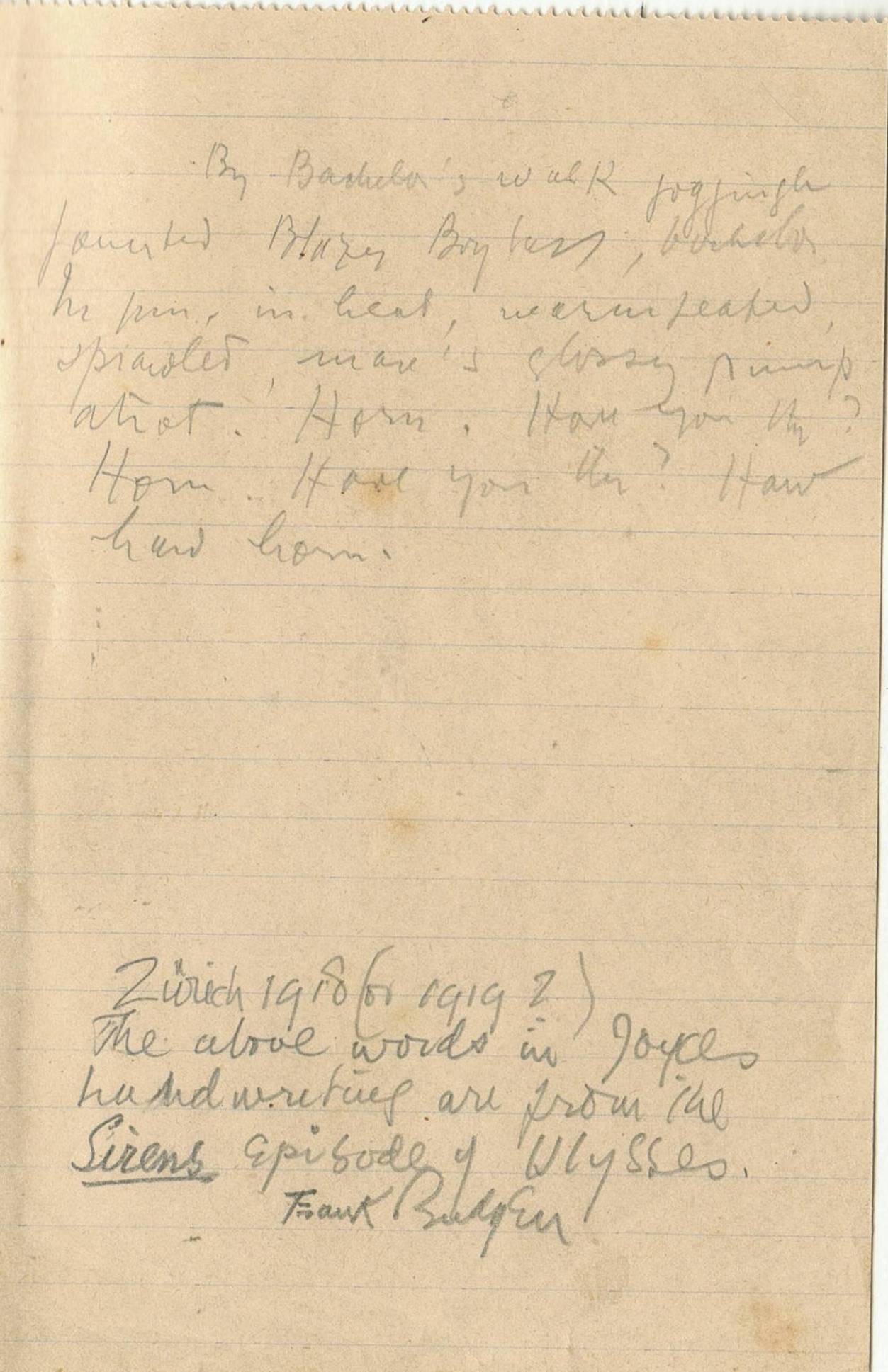
Image courtesy Glenn Horowitz Bookseller, Inc.; document now part of a private Joyce collection in New York.

There’s so much to celebrate today, February 2, the birthday of James Joyce. On January 1 of this year the published works of Joyce came into the public domain. What does this mean? It means that scholars no longer need to go to his grandson Stephen Joyce, bowl in hand, begging for a ladle full of text. It means that I can translate for you the above illegible bit of manuscript from Ulysses in Joyce’s hand:
By Bachelor’s walk jogjingle
jaunted Blazes Boylan, bachelor.
In sun, in heat, warmseated,
sprawled, mare’s glossy rump
atrot. Horn, Have you the ?
Horn. Have you the ? Haw
haw horn.
Clearer? Good.
Even better, it also means that I can quote you the slightly different published version of this passage:
By Bachelor’s walk jogjaunty jingled Blazes Boylan, bachelor, in sun, in heat, mare’s glossy rump atrot with a flick of whip, on bounding tyres: sprawled, warmseated, Boylan impatience, ardentbold. Horn. Have you the ? Horn. Have you the ? Haw haw horn.
You see the improvement? Excellent.
Full piece at Paris Review Daily

Cairo’s book fair is back


By JOSEPH MAYTON / THE MEDIA LINE02/01/2012 The Jerusalem Post

Writers and readers alike reflect on revolution in Egypt's first major international cultural event since Mubarak's overthrow.

Bookstore
CAIRO - One-year ago Egypt was embroiled in massive street protests. A Day of Rage occurred as the country rose up after decades of dictatorship to force out its aging dictator, who had promised years earlier to “remain in office until death.” Like much else in the country back then, the Cairo International Book Fair fell victim to the chaos.
Protests and strikes are still the norm in Egypt, where many fear the interim government of generals ruling Egypt threaten the revolution. But something else has returned from last year: the Cairo book fair is back. Some 745 publishers from 29 countries (17 of them Arab) are taking part in the fair, which runs until February 7.

And revolution is in the air. Besides the usual cultural activities, a section this year is dedicated to the testimonies of the revolutionaries. Tunisia, the birthplace of the Arab Spring, is the guest of honor, with a group of the country’s intellectuals and artists attending in order to share their experience with revolution.
Amnesty International, the London-based human rights movement, is displaying its literature at this year’s fair, a first ever for the organization, which has had a testy relationship with Egypt’s interim military government.
Full story at The Jerusalem Post

Publishing’s Ecosystem on the Brink: The Backstory


Authors Guild - Posted

Subtlety is out. Bloomberg Businessweek’s January 25th cover shows a book engulfed in flames. The book’s title? “Amazon Wants to Burn the Book Business.” A towering pile of books dominates the front page of Sunday’s NYT Business Section. The pile starts well below the fold (print edition), breaks through the section header at the top of the page, and leans precariously. Books are starting to tumble off. “The Bookstore’s Last Stand,” reads the headline.
These stories capture pretty well the state of book publishing: this appears to be no ordinary, cyclical crisis that future authors and publishers will shrug off. To understand how the book industry got into this predicament, however, a broader perspective may be needed. The cover story of February’s Harper’s Magazine provides that, discussing a fundamental shift in the federal approach to antitrust law that’s affected bookselling and countless other industries. It’s a story that hasn’t previously been told in a major periodical, to our knowledge.
We’ll get to that in a moment. First, let’s set the stage with the other two stories.
Burning Down the Houses
Brad Stone’s Businessweek story discusses Amazon’s campaign to prevent other booksellers from securing a foothold in the booming e-book market and the company’s furious reaction to Random House’s decision last March to adopt agency pricing for e-books, just as five of the other “Big Six” trade publishers had the previous year. (Before agency pricing, Amazon could sell e-books from Big Six publishers at deep discounts, taking losses at a rate that Barnes & Noble could never afford to match. See How Apple Saved Barnes & Noble, Probably for more.)


Full piece at The Authors Guild

Poland’s 1996 Nobel winning poet Wislawa Szymborska has died at 88


By Associated Press (Czarek Sokolowski) , Published: February 2 - Washington Post


WARSAW, Poland — Poland’s 1996 Nobel Prize-winning poet Wislawa Szymborska, whose simple words and playful verse plucked threads of irony and empathy out of life, has died. She was 88.
Szymborska, a heavy smoker, died in her sleep of lung cancer Wednesday evening at her home in the southern city of Krakow, her personal secretary Michal Rusinek said.


She died surrounded by relatives and friends, said Katarzyna Kolenda-Zaleska, a journalist and a friend of the poet.
The Nobel award committee’s citation called her the “Mozart of poetry,” a woman who mixed the elegance of language with “the fury of Beethoven” and tackled serious subjects with humor. While she was arguably the most popular poet in Poland, most of the world had not heard of the shy, soft-spoken Szymborska before she won the Nobel prize.
She has been called both deeply political and playful, a poet who used humor in unforeseen ways. Her verse, seemingly simple, was subtle, deep and often hauntingly beautiful. She used simple objects and detailed observation to reflect on larger truths, often using everyday images — an onion, a cat wandering in an empty apartment, an old fan in a museum — to reflect on grand topics such as love, death and passing time.
Foreign Minister Radek Sikorski said on Twitter that her death was an “irreparable loss to Poland’s culture.”
Last year, President Bronislaw Komorowski honored Szymborska with Poland’s highest distinction, The Order of the White Eagle, in recognition of her contribution to her country’s culture.
In reaction to her death, Komorowski wrote that “for decades she infused Poles with optimism and with trust in the power of beauty and the might of the word.”
Szymborska was our “guardian spirit,” Komorowski wrote. “In her poems we could find brilliant advice which made the world easier to understand.”
Rusinek said on TVN24 that as long as her condition allowed, Szymborska was working on new poems, but she had not had time to arrange them in order for a new book, which she had intended. The book will be published this year, he said.
The Nobel Prize brought a “revolution” into the life of the modest poet and she had to struggle to protect her privacy, Rusinek said, but the prize also was a “great joy, a great honor which brought new friendships and changes for the better.”
Despite six decades of writing, Szymborska had less than 400 poems published.
Asked why, she once said: “There is a trash bin in my room. A poem written in the evening is read again in the morning. It does not always survive.”
Culture Minister Bogdan Zdrojewski said in a statement that Szymborska was candid, authentic and hostile to any form of celebrity.
“She had understanding for others, she understood the weaknesses of others and had huge tolerance for them,” the statement said. “On the other hand, she expected to have a modest place for herself.”
Szymborska was born in the village of Bnin, now part of Kornik, near Poznan in western Poland on July 2, 1923. Eight years later she moved with her parents to Krakow, and developed deep ties to the medieval city, with its rich artistic and intellectual milieu. She lived there until her death.

Bernard Schlink Sues The Weinstein Co. Over Movie Profits

Book2BookWednesday 01 Feb 2012


Bernard Schlink (left), who authored the novel that formed the basis of the acclaimed drama The Reader, has sued distributor The Weinstein Co claiming he has been cheated out of millions in profits from the Oscar-winning film.

deadline.com

hollywoodreporter.com

Guardian

International print sales retreat—but US e-books 'slowing'

Print sales are in retreat in almost all markets across the world tracked by Nielsen BookScan, with the drop in fiction sales particularly pronounced in markets, such as the UK and US, where e-book sales are growing quickly.
But in the US publishers are facing a potential double blow, with anecdotal evidence suggesting that the growth in e-book sales has also slowed over the past few months, as e-reader adoption has dragged and resistance to e-reading has grown. Publishers were also warned to beware of Amazon's growth.
The global sales figures were given out by president of Nielsen Book Jonathan Nowell at the Italian e-book event IfBookThen this morning (2nd February). Nowell highlighted sales declines in markets such as US, UK and Spain, with Italy the one exception where fiction sales were still growing.
He said the decline in sales in the US had doubled over two years, with fiction showing the clearest decline, down 7.2% in 2010 and in 2011 down 18%. In the UK the print decline accelerated in 2011, while in the first four weeks of 2012 print sales have dropped 12%, with fiction sales down almost 26%. But not all of the drop was attributed to e-book conversion, with Irish print sales also down, despite there being no significant impact from e-books.
Digital consultant and head of The Idea Logical Company Mike Shatzkin said e-book sales had doubled or more for four straight years, from 2007 to 2010, but recently there was evidence that the growth was slowing down, with Shatzkin pointing to research that suggested the resistance to e-readers in some people's minds was growing. He added that the initial growth was fuelled by heavy readers who moved across to e-reading first, with more reluctant adopters slower to change and likely to read less.

Read full piece at The Bookseller


Barcelona’s Blackie Books: Pretty Books for the Apocalypse


Publishing Perspectives
Named after a beloved but deceased pet, Barcelona's Blackie Books is a surprisingly successful independent publisher of cult fiction, poetry, and illustration.
Read story here.


DISCUSSION:
What is the Future of the Slush Pile?
Will authors have the patience to wait for an agent or publisher to discover them? Or will they seek the immediate gratification of self-publishing?

Thursday, February 02, 2012

Writers & Readers Tickets on sale tomorrow


Following the launch of the full Writers and Readers programme last week, 9am tomorrow marks the next significant milestone for fans of the written word as tickets for all Writers and Readers Week events go on sale to the general public. On from 9-14 March, Writers and Readers Week consists of over 40 events and features some of the world's finest writers and thinkers. View the full programme on the Festival website now and get ready to book your spot at a fascinating session.

Paris vs. New York: Which Is Better?

Huffington Post: 02/ 1/2012 

Vahram Muratyan's new book, "Paris Versus New York" [Penguin, US$20.00] illustrates the idiosyncrasies that make each city unique.
So whether you're reading in a cafe or coffeehouse, a park or a garden, check out these comparisons and vote on which city YOU think is the best! 

TO KILL A SNOW DRAGONFLY

This handsome hard-cover novel by the multi-talented and 2011 New Zealander of the Year nominee, Dr.Sharad Paul was mentioned on the Kim Hill's Saturday radio show last week.

Here is the inside cover blurb:
Even as the snow falls existentially, the portends aren't good for Lobsang's family: A mole has appeared
on his little sister Bhunchung's left cheek, foretelling that her husband will die an untimely death. Can the
mole be removed? After all, Grandfather is a tantric lama with magical powers.
As Bhunchung and Lobsang worry about the distant future, their village in Tibet is swept up in the Chinese
Revolution, with Mao's troops overrunning it and enforcing hard labour. Will they manage to escape from Tibet? And just where has Grandfather disappeared after the Chinese arrived?
Seen though the eyes of Lobsang, To Kill a Snow Dragonfly is an evocative journey through revolutions and disruptions, desires and memories, friendships and exile, as the narrative moves from a tranquil Tibetan village to a boarding school in south India and eventually to Bombay.

Copies can be obtained from the author's bookstore, Baci Lounge at 167/169 Broadway Newmarket, Auckland 1023 - (09) 529 4360 - bacilounge.com

Sharad Paul's debut novel COOL CUT was published in 2007.

John Dybvig writes............

This is my latest project....my book is now available to be downloaded on Apple itunes in the States....you can also listen to it with me reading it....


Dec 14, 2011 ... Get a free sample or buy The Two Of Me by John Dybvig on the iTunes Store. 
You can read this book with iBooks on your iPhone, iPad, or iPod ...


DIGITAL CAMERAS THE EASY WAY

I stumbled on to this pocket-size reference book last week. It costs a mere $15 and explains in simple terms (has to be simple for me when it comes to cameras) all the essentials you need to know to understand your manual, learn to use your digital camera and to improve your photos and images you send to friends and family.
I'm not at all surprised to learn that boutique Dunedin-based publisher Lifelogs has sold over 10,000 copies.
It is simple, sensible and most helpful.


Author - Brian Miller
Publisher - Lifelogs Ltd.
P.O.Box 39,
Dunedin 9054.
mail@lifelogs.co.nz
www.lifelogs.co.nz