
By
offering writers ready-made art as inspiration, Storybird has attracted 2
million users and is turning traditional children's and YA publishing
workflow on its head.
Read more » |
|
|
Discussion:
|
|
|
In
what's become a trend, Korean publishers are opening popular bookstore cafes.
Should more Western publishers follow suit or is bookselling no longer part
of their DNA?
Read more » |
|
|
More News from Publishing
Perspectives:
|
|
|
Brazil's
is demanding that every school in the country house a library by 2020. To
meet that goal, 128,020 libraries will have to be built, or 39 per day.
Read more » |
Photographer
Paul Nathan's two new books document two of New York's visually fascinating,
yet opposing, subcultures: high-fashion dogs and tattooed Brooklynites.
Read more » |
|
From the Archives:
|
|
|
After
20 years’ experience in German publishing, Beate Kuckertz has turned to a new
challenge: starting a digital-first publisher in the print-focused German
market.
Read more » | |
Saturday, February 02, 2013
Publishing Perspectives


10 New Must-Reads for February

By on Flavorwire -
Ladies and gentlemen, it’s getting cold out there. February is our traditional hibernation time, so as far as we’re concerned, for the next month we’ll be eschewing nightlife and staying inside with various hot beverages and various room-temperature books. This month, we’re looking forward to blistering essays, masterful short stories, incredible debut novels, and a posthumous book from Maurice Sendak. Sounds good right? But as we all know, February’s a short month, so you’d better get cracking. Let us know what you’re most excited to read over the next few weeks in the comments. … Read More
Worlds Collide in New Rick Riordan Short Story
By Shannon Maughan |
 What if Percy Jackson and Carter Kane – the stars of Rick Riordan’s bestselling mythology-inspired series—Percy Jackson and the Olympians, The Heroes of Olympus, and The Kane Chronicles – met each other? That’s a question young readers often pose to the author, and a question that Riordan has now answered in a new short story called “The Son of Sobek.” The never-before-published story will appear as a bonus in the paperback edition of The Kane Chronicles, Book Three: The Serpent’s Shadow (Disney-Hyperion), which is due out May 7, 2013. (Click here to read an excerpt from the story.)

Jan 31, 2013 - PW
What if Percy Jackson and Carter Kane – the stars of Rick Riordan’s bestselling mythology-inspired series—Percy Jackson and the Olympians, The Heroes of Olympus, and The Kane Chronicles – met each other? That’s a question young readers often pose to the author, and a question that Riordan has now answered in a new short story called “The Son of Sobek.” The never-before-published story will appear as a bonus in the paperback edition of The Kane Chronicles, Book Three: The Serpent’s Shadow (Disney-Hyperion), which is due out May 7, 2013. (Click here to read an excerpt from the story.)
“It’s actually something the fans had been asking me for,” says Riordan. “At least once a day I’ll get an email or a letter asking ‘Are you ever going to combine the series?’ ” So he decided to give it a try. “There are a lot of gods and a lot of characters in my books,” he says. In choosing the new work’s protagonists, “I picked two that I know very well,” he explains. “Percy and Carter are my touchstones. They represent very different sides of me. Carter is thoughtful and cautious and Percy is impetuous and sarcastic. I started to experiment with how it would be to put them together and have them join forces against a common foe.”
Photo: Mike Frost
Rick Riordan.
Riordan says he’s pleased with how the experiment turned out, and hopes his legion of devoted readers enjoys reading it. “I imagine they’ll want more and start asking ‘Where’s the rest? It’s only a short story?’ ” But Riordan has not yet decided on whether Carter and Percy will appear together in other projects. “It’s possible,” he says. “I’d love to play around with that idea, and I always like to leave some room to create other adventures for my characters. My problem is never ideas. I’ve got more than I’ll ever have time to write. It’s all about how many I can get to, and which ones readers want to see the most.”
With a broad cast of players featured in his multiple series, how does an author keep track? “I have to be careful,” Riordan says. “My readers are very detail-oriented, and if I make a mistake they’ll call me on it.” But one guiding force is the original inspiration for the books. “I stick closely to the structure of the myths,” he explains. “I may have some fun with the mythology by changing the environment to modern-day, but the structure of the myths, the monsters, the relationships of the gods – none of that is made up.” It’s a strategy that has given him confidence over the years. “I get letters from college kids who have read Percy Jackson when they were younger who tell me, ‘I just passed my Classics exam.’ The books are accurate enough that they can serve as a gateway to Homer and Virgil.”
Full story at PW
Warsaw Ghetto: The story of its secret archive

27 January
2013 -

Throughout the bitter days of the
Warsaw Ghetto, a clandestine group of researchers compiled a vast archive
detailing every aspect of life in this prison city built and then obliterated by
the Nazis. Led by a historian, Emanuel Ringelblum, the group then buried the
archive for for future generations.
On the hot night of 3 August 1942, 19-year-old David Graber signed his name
on a piece of paper and put it inside a metal box at 68 Nowolipki Street, in the
heart of the Warsaw Ghetto. "I would love to see the moment in which the great treasure will be dug up and scream the truth at the world," he wrote. "May the treasure fall into good hands, may it last into better times, may it alarm and alert the world to what happened… in the 20th Century… May history be our witness."
David knew that he might have only hours, or minutes. German soldiers had arrived in the next street. Two weeks before, they had begun to drive the half-million Jewish men, women and children living in the ghetto into trains taking them to the new death camp at Treblinka.
On 2 August, 6,276 people had been taken. On 3 August, another 6,458 were seized.
With David was another teenager, Nahum Grzywacz, and a
teacher, Israel Lichtensztajn. The three were part of a colossal, secret attempt
to record every detail of ghetto life in an archive - David's "great treasure".
The codename for this project was Oyneg Shabbes (Joy of the Sabbath).
The Oyneg Shabbes collaborators had amassed tens of thousands of documents by
August 1942. Some were written, in the form of diaries, essays and commissioned
surveys, poetry and precise reportage in Yiddish, Polish and other European
languages.Others were gathered. Hundreds of paintings, sketches, maps, tram tickets, recipes and even photographs secretly developed in the ghetto were carefully wrapped in paper and stored.
Unearthed from the archive
 Food coupons and an official ration card - rations
were limited to 189 calories a day, and a quarter of the ghetto population
starved to death
 Sweet wrappers such as this were collected by the
Oyges Shabbes group - a ghetto workshop made caramels and artificial honey from
saccharine
 'Portrait of a Girl with a Ball', one of 300
watercolours by Gele Sekstajn who died in 1943 - "I think I am the last
surviving Jewish painter," she wrote
 'Song of the Rebbe of Radzyn', a poem by Yitzhok
Katzenelson, exploring responses to death - the poet also ran an underground
children's school
 Concert poster - many musicans were imprisoned in the
ghetto, and a symphony orchestra, choirs and chamber groups often
performed
The researchers filled 10 of the metal boxes, bound them
with cord and hid them inside the brick foundations of 68 Nowolipki, an old
school building.
"I only wish to be remembered," reads Lichtenstzajn's last note on behalf of
himself and his wife, a well-known artist. "I wish my wife to be remembered,
Gele Seksztajn. I wish my little daughter to be remembered. Margalit is 20
months old today."The man behind the Oyneg Shabbes was a historian and social activist, Emanuel Ringelblum.
Read the full article
IBPA Launches Benjamin Franklin Digital Awards
 The Independent Book Publishers Association is launching the Benjamin Franklin Digital Awards, which will honor achievement in electronic book publishing by individuals and organizations of all sizes, including publishers, developers, designers, manufacturers, institutions and technology leaders. Entries will be judged in four categories: e-books, enhanced e-books, books as apps and new technologies.
The BFDA will serve as a companion to IBPA's Benjamin Franklin Awards for print. For both award programs, every entrant receives feedback from the judges regarding product improvement.
Unlike most awards, the BFDA is a rolling awards program--submissions will be accepted year round.
IBPA presents gold and silver award of excellence honorees with promotional opportunities that include announcements on IBPA's website and all social media outlets, in the monthly magazine, the Independent, to industry publications and more. Honorees will also be featured at an event at IBPA's annual Publishing University, to be held April 26-27 in Chicago.
Friday, February 01, 2013
Arts on Sunday 3 February 2013 - Radio New Zealand National
12:43 Christchurch-based photographer and music teacher
David Sutton David Sutton talks about taking his precious 100 year old camera
to Antarctica. The results of his trip will feature in the celebration of
Scott's departure for the South Pole 100 years ago this month.
12:48 Performance artist Dr Mark Harvey
Dr Mark Harvey is heading to the 55th Biennale in Venice
later this year where he's been invited to perform in the first Maldives pavilion
at the arts extravaganza. Mark's a senior lecturer in Dance at the University
of Auckland and explains how he came to be invited by the Maldives.
1:10 At the Movies
Once again Dan Slevin takes centre-screen this week while
Simon Morris enjoys the golden summer, Dan looks at new releases including
Silver Linings Playbook and The Impossible.
1:25 Actress Antonia Prebble
Antonia was just 12 when she started her professional
acting career in 1997. She managed both study and filming while still at school
and has been in demand on stage and screen ever since. Best-known for her
portrayal of Loretta West in the long running TV series Outrageous Fortune,
she's now back in a very different role in a murder-mystery-comedy called The
Blue Rose.
1:35 Amanimal - choreographer Malia Johnston
Lateral-thinking artists like choreographer Malia Johnston and theatre director
Emma Willis are at the forefront of dismantling the old 'dyed in the wool'
definitions of dance and drama. They're about to stage their third collaborative
work, Amanimal, and Malia joins Lynn to talk about that show and how she fits
everything into an incredibly busy schedule.
1:45 Auckland arts advocates the Creative Coalition Good
arts policy should come out of accurate information and strong data. Who better
to provide that than the sector itself? Auckland arts advocates the Creative
Coalition have mapped what they call the creative ecology of our biggest city
so as to inform central and local government's arts and culture planning. Elise
Sterback led the project and tells Justin Gregory just what a "creative
ecology" is.
2:05 The Laugh Track
Radio New Zealand newsreader and comedy collector, Nicola
Wright.
2:26 Actor, TV Presenter and writer Robert Llewellyn He's
the fastidious mechanoid Kryten to his fans, but there's much more to him than
a chisled rubber face with a predilection for housework. Robert Llewellyn
coming to New Zealand for a Red Dwarf Convention in Auckland.
2:36 The music of the Cook Islands
Amelia Nurse discovers that Cook Islands music is alive
and well in New Zealand. Fairoa Aporo offers "The beginners guide
to..." and plays some tunes on his eight stringed ukulele.
2:55 The New Zealand Guitar Quartet
We bring together three members of the New Zealand Guitar
Quartet, which is among the homegrown acts performing at the Nelson Chamber
Music Festival, to talk about chemistry, repertoire and why sometimes one
guitar just isn't enough.
3:05 The Drama Hour - Live the Day by Terry Swanson This
Monday is Nelson Anniversary Day so today in the Drama Hour we bring you a
piece about the Nelson region, past and present, as seen through the eyes of
two students who are making a radio documentary about the issues that affect
the Nelson area, namely tourism and development and foreign ownership of land,
the foreshore and sea bed debate, and so on. It includes actual interviews with
residents of Nelson.
To see images and find out more visit our web page: http://www.radionz.co.nz/national/programmes/artsonsunday/
Sir Paul Holmes R.I.P.
Sir Paul was a very good friend to Jack Reacher, Harry Hole
and I’m sure many other crime fiction heroes. Paul has done some outstanding
author interviews over the years on both his top-rating TV and radio shows for
which I’m sure the authors and book publicists are grateful. I know Lee Child,
for one, was always so impressed with Paul’s energy, enthusiasm, quick wit and
fondness for our beloved Reacher.
Jennifer Balle
Random House NZ
2013 Science Book Prize
The organisers advise that the
2013 Science Book Prize is also accepting e-book entries –
This is an amendment to the original entry details.
“E-books will be accepted provided they are widely available
to the bookselling trade and the New Zealand public. Any e-books submitted
should be available from two or more of the leading online retailers if
they are not nationally for sale in print.”
Wellington Media Collective Book Launch
CLOSING EVENT FOR THIS EXHIBITION:
Saturday 9
February, 4 pm
Victoria University Press, Wellington Media Collective, and the Adam Art Gallery warmly invite you to the launch the book We Will Work With You: Wellington Media Collective 1978-1998, at the closing of the exhibition.
This event is presented in conjunction
with the Adam Art Gallery’s current exhibitions, We Will Work With You! Wellington Media Collective 1978-1998 / Martha Rosler, The Bowery
in Two Inadequate Descriptive Systems / The Consumers of the Future,
a commissioned project by White Fungus, on view until Sunday 10 February.
|


Marketing Manager - 12 Months Maternity Leave Contract
Random House New Zealand, part of the Random House Group, has a proud and successful record publishing a wide range of authors from New Zealand and around the world. We are currently seeking a Marketing Manager for a 12 month maternity leave contract, starting early/mid April 2013. The successful candidate will report into the Random House Australia and New Zealand Marketing and Publicity Director and manage a supportive, enthusiastic team of three.
Responsibilities include:
- Managing promotional activity including advertising, Roadshows, conferences, point-of-sale, and competitions
- Managing external relationships with key stakeholders including actively creating, pitching and driving promotional opportunities with booksellers using co-op funds, and seeking and executing opportunities with promotional partners
- Managing budgets and ensuring own and team deadlines are met
- Managing people including the team's work flow and conversations with internal stakeholders
The successful applicant will:
- Be positive, energetic and solution-focused, with great communication skills
- Have experience in or knowledge of the New Zealand publishing or bookselling industries
- Be a talented and organised project manager
- Be able to legally work and drive in New Zealand
Interested applicants are invited to forward their resume to jobs@randomhouse.com.au by Friday 15 February 2013. Please mark your applications to the attention of the Marketing Manager.
Only short listed candidates will be contacted.
Random House New Zealand is an Equal Opportunity Employer.
Human Resources Department
Random House ANZ
North Sydney NSW 2060
Australia
Email: Please click the 'Apply Now' button below.
Saturday Morning with Kim Hill: 2 February 2013 on Radio New Zealand National

8:15 Tim Berners-Lee: the internet
8:35 Richard Adams; Washington DC
9:05 Jocelyn Bell Burnell: star dust
9:45 John Pratt: contrasts in punishment
10:05 Playing Favourites with Steve McKinlay
11:05 Ingrid Horrocks: Mary Wollstonecraft
11:45 Children's Books with Kate De Goldi
Producer: Mark Cubey
Wellington engineer: Carol Jones
Photo of Kim Hill (right) by David White.
8:15 Tim Berners-Lee
Sir Tim Berners-Lee invented the World Wide Web in 1989.
He is a Professor at the Massachusetts Institute of Technology and the
University of Southampton, director of the World Wide Web Consortium, and
founder of the World Wide Web Foundation. He has promoted open government data
globally and is a member of the UK's Transparency Board. Sir Tim visited
Wellington as a guest of InternetNZ to deliver a public lecture exploring the
benefits of an open Internet.
8:35 Richard Adams
New Zealand journalist Richard Adams blogs on US politics
and culture from the Guardian's Washington DC bureau.
9:05 Jocelyn Bell Burnell
British astrophysicist Dame Jocelyn Bell Burnell
discovered pulsars. She visited Auckland to present a public lecture, We Are
All Made of Star Dust, at AUT University and talk at the New Zealand and the
Beginnings of Radio Astronomy conference which commemorated two major radio
astronomy observations that were made in 1948 at Piha and Leigh. While in
Auckland she visited AUT's radio telescope near Walkworth.
9:45 John Pratt
John Pratt is a professor at Victoria University's
Institute of Criminology. He was Royal Society of New Zealand James Cook
Research Fellow July 2009 to June 2012 and he was also a Fellow at the Straus
Institute for Advanced Studies of Law and Justice, New York University 2010-11.
For the last six years, the last three of them with Anna Eriksson, he has been
working on his recently published book, Contrasts in Punishment: An Explanation
of Anglophone Excess and Nordic Exceptionalism (Routledge, ISBN:
9780415524735).
10:05 Playing Favourites with Steve McKinlay
Steve
McKinlay is a Senior Lecturer in Computing as well as his school's Research
Coordinator at Wellington Institute of Technology. He holds a degree in
Information Technology from Griffith University, Australia, and after working in
database and software development for several years he studied Philosophy at
Victoria University, Wellington, finishing with a Masters degree in 2004. He is
a few weeks away from completing a PhD in Philosophy of Information with
Charles Sturt University, Australia, and currently holds a position on the
executive board of the International Association of Computing and Philosophy.
11:05 Ingrid Horrocks
Dr Ingrid Horrocks is a poet, travel writer, and Senior
Lecturer in English at Massey University, Wellington. Her new book is an
edition of an early work of travel writing, Letters Written During a Short
Residence in Sweden, Norway and Denmark (Broadview Press ISBN:
978-1-55111-808-6), by 18th century feminist Mary Wollstonecraft.
11:45 Children's Books with Kate De Goldi
New Zealand
writer Kate De Goldi is the author of a number of books, including the
multi-award winning novel, The 10pm Question and last year's The ACB of Honora
Lee. She will discuss four books:
 Sammy and the Great Skyscraper Sandwich by Lorraine
Francis and Pieter Gaudesaboos (Book Island, ISBN: 978-0-9876696-0-5); Bernie
Loves Flora by Annemie Berebrouckx (Book Island, ISBN: 978-0-9876696-1-2); The
Selfish Giant by Oscar Wilde, illustrated by Ritva Voutila (Allen & Unwin,
ISBN: 978-1-74237-650-9); and The Little Mermaid by Hans Christian Andersen,
pictures by Lisbeth Zwerger, translated by Anthea Bell (Michael Neugebauer
Publishing, ISBN: 978-988-19152-3-8).
***********
On Saturday 2 February 2013 during Great Encounters
between 6:06pm and 7:00pm on Radio New Zealand National, you can hear a repeat
broadcast of Kim Hill’s interview from 26 January with Joe Cross on juice
fasting.
Preview: 9 February
Next week, Kim Hill’s guests will include Roald Hoffman,
Cissy Houston and Victor Rodger.

Blog statistics past 7 days
 Visitors to the blog have come from these places:
42% - New Zealand
22% - USA
9% - UK
4% - Australia
3% - Canada
2% each - France, Germany, India
1% each - Korea, Italy, Netherlands, Spain & Brazil
9% - 47 other countries
Salman Rushdie abandons visit to Indian city amid protests
Salman Rushdie has called off his trip to the eastern Indian city of Kolkata to promote the film based on his best selling novel, "Midnight's Children", following protests by Muslim groups.

Salman Rushdie promoting
'Midnight's Children' in New Delhi last week Photo:
EPA
Several hundred Muslim demonstrators shouting anti-Rushdie slogans
congregated at the airport in Kolkata (formerly Calcutta) on Wednesday ahead of
the controversial British author's planned arrival, triggering security fears
and forcing him to summarily terminate his visit.
Rushdie, whose novel "The Satanic Verses" is considered blasphemous by some
Muslims and over which the Iranian clergy placed a bounty on his head in 1989,
also stayed away from India's biggest literature festival in Jaipur last year
following threats to his life.
"We will not allow him here. He is hated by all Muslims in the world. I thank
the state government for listening to us (and canceling his visit)" Idris Ali,
chief of the fringe All India Minority Forum said from outside the city airport.
The decision to call off the trip was Rushdie's "personal call", Arun Nair,
of PVR Cinema Group that is promoting and distributing "Midnight's Children"
said.
Will Self: the joy of armchair anthropology

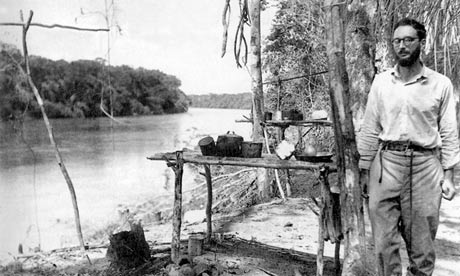
The French anthropologist Claude
Levi-Strauss in Amazonia in the 1930s. Photograph: Apic/Getty
In Barry
Lopez's haunting, poetic book about the hyperborean realms, Arctic Dreams,
there's a magnificent story about an Inuit family who are washed out to the seas
on a calved iceberg. Nothing is heard of them for about 30 years, until one day
they rejoin the rest of their tribal group. The reason for their prolonged
absence is this: it has taken them this long, on the deserted island where they
fetched up, to hunt the seals, narwhals, whales and assorted other fauna,
required to provide the skins, the baleen stretchers, the bone needles and the
sinewy thread with which to construct a seagoing boat – as soon as it was done
they headed home.
There's something about this tale that represents, for me, the quintessence
of what I imagine to be the relationship between traditional hunter-gatherer
peoples and their world. The Inuit family are simultaneously at the mercy of
their environment, and its masters; their capacity to instinctively utilise
every available resource is seamlessly united with high levels of forward
planning, so that in a situation that would cost anyone not so attuned their
lives, they instead go – literally as well as metaphorically – with the
flow.
I probably reread Lopez's
book about every couple of years. Arctic Dreams is a more or less
perfect example of a tendency in my reading towards what can only be described
as "comfort savagery". Lying abed, in the heart of a great, pulsing,
auto-cannibalising conurbation, the supply chain of which girdles the earth like
the monstrous tail of some effluent-belching comet, I find descriptions of how I
myself might have lived before the great grainy surplus of the agricultural
revolution curiously heartening. After all, what does any kind of reading
provide for us if not the opportunity to exercise imaginative sympathy? Others
may prefer to will themselves into James Bond's dinner jacket and Aston Martin
DB4, but I'd rather slip into a !Kung hunter's penis
sheath and heft his hunting spear.
Full article
Orion snaps up two from Fanny Blake

31.01.13 | Charlotte Williams - The Bookseller
Orion Fiction editorial director Kate Mills bought UK and Commonwealth rights from Clare Alexander at Aitken Alexander Associates for two novels, for a five-figure sum.Orion will publish the first novel in the deal, The Secrets Women Keep, on 4th July as a £12.99 trade paperback and e-book.
Mills said: "I'm delighted that Fanny has joined the Orion list, bringing her warmth, wit and wonderful storytelling ability. The Secrets Women Keep is a bittersweet story about a newly-widowed woman coming to terms with a secret in her husband's past. It shows that women continue to have passionate, fulfilling lives beyond children and grandchildren. It's delightful."
Blake was previously published by HarperCollins
RELATED STORIES
- PPC unveils 2012 awards shortlistsThe Publisher's Publici...
- Willoughby sisters kids' series to OrionOrion Children's Books ...
- Chatto buys third Lawson novelChatto & Windus has acq...
- VMC acquires Mary Renault backlistVirago Modern Classics has ...
- Sphere buys Cox's 'moggy adventures'Sphere has acquired a new b...
Chatto buys third Lawson novel

31.01.13 | Charlotte Williams - The Bookseller
Chatto & Windus has acquired Road Ends, the third novel by Mary Lawson, author of Crow Lake.Publishing director Clara Farmer and senior editor Poppy Hampson at Chatto, Susan Kamil at The Dial Press, Random House in the US, and Louise Dennys and Marion Garner at Knopf Canada acquired English language rights in the novel from Felicity Rubinstein at Lutyens & Rubinstein.
Road Ends is described as "the story of the Cartwright family, living in the beautiful wilderness of Northern Ontario, in the fictional small town of Struan in the 1960s, and their eldest daughter Meg, who realises one day that life is passing her by, and books a one-way ticket to London".
Lawson's debut Crow Lake sold in 26 territories, and her second, The Other Side of the Bridge, was longlisted for the Man Booker Prize in 2006.
Knopf Canada will publish in autumn 2013, with Chatto & Windus and The Dial Press to publish in spring 2014.
OTHER STORIES
- PPC unveils 2012 awards shortlistsThe Publisher's Publici...
- Willoughby sisters kids' series to OrionOrion Children's Books ...
- VMC acquires Mary Renault backlistVirago Modern Classics has ...
- Orion snaps up two from Fanny BlakeOrion has acquired two nove...
- Sphere buys Cox's 'moggy adventures'Sphere has acquired a new b...
Winnie The Pooh - AA Milne's Winnie The Pooh characters in quotes

“I am a Bear of Very Little Brain, and long words bother me.”
Winnie The Pooh
Picture: Film Stills
Post These Letters, Jeeves. Thanks, Old Bean.
‘P. G. Wodehouse: A Life in Letters’
By DWIGHT GARNER
Published: January 30, 2013 - The New York Times
Writing to his agent in 1935, the comic novelist P. G. Wodehouse (1881-1975) proposed an essay about literary criticism that he planned to call “Back to Whiskers.” This piece is still worth rooting around to find.

P. G. Wodehouse, in 1969. - Don Hogan Charles/The New York Times
P. G. WODEHOUSE - A Life in Letters
Edited by Sophie Ratcliffe
Illustrated. 602 pages. W. W. Norton & Company. $35.

Sophie Ratcliffe - David Fisher
His argument, Wodehouse declared, was that “the soppiness and overenthusiasm of modern literary criticism is due to the fact that critics are now clean shaven instead of wearing full-size whiskers.” He pined for the “brave old days when authors and critics used to come to blows.” Bring back, he cried, “the old foliage and acid reviews.”
Wodehouse was among the best-paid and best-loved writers in the world during the 1930s, a British institution, and he could afford to have a sense of humor about critics. He had found that “jolly old Fame” suited him.
His deliriously funny novels about the foppish and “mentally negligible” aristocrat Bertie Wooster, the imperturbable valet Jeeves and an enormous Berkshire pig named the Empress of Blandings, among other characters, were best sellers. He’d written Broadway musicals with Jerome Kern. He was fresh from Hollywood, where he’d composed screenplays and palled around with Mary Pickford and Edward G. Robinson. Oxford University had awarded him an honorary doctorate.
But things turned for Wodehouse during World War II. Imprisoned by the German Army, he recorded a series of radio broadcasts, intended to be funny and inspiring to those back home, that backfired badly. That his voice was on Nazi radio outraged his countrymen. He later admitted his “ghastly blunder,” but it took many years for people to forgive him.
Nearly as bad for Wodehouse, the world had changed. In his excellent biography “Wodehouse: A Life” (2004) Robert McCrum noted: “As George Orwell pointed out, Wodehouse became associated in the public mind with the wealthy, idle, aristocratic nincompoops he often wrote about, and made an ideal whipping boy for the left.”
'Buying Local. It's Personal For Me'
from Shelf Awareness
"Buying local is not a political notion to me, it is very personal, very important. Buying local affects and changes my life in so many different ways. I love buying things from people who know me. A kind of friendship develops, a mutual relationship that is important. It is foolish to sell junk at high prices to people who will be back in a couple of days, people you know. It is easy to do that online, customer and seller will never meet. "It is so important to me to walk into Battenkill Books and know Connie and Kate and Marilyn and Colleen. This morning, Connie alerted me to the fact that Dancing Dogs had sold out, was out of stock. I was able to alert my publisher. I don't think Amazon would really care....
"But the tragedy of technology is that for every thing it brings, it takes something away. Post offices are closing, mega-chains have pressured community hardware stores, bookstores are fighting for their niche in the world. I'm shopping local. I don't want to live a life of loneliness and disconnection even if it might be cheaper. Price is important, but it is not the only thing that is important."
--Author Jon Katz in a Bedlamfarm.com post headlined "Buying Local. It's Personal for Me"
Hilary Mantel Defiant In Win
 Michael Birt for Newsweek
Hilary Mantel has become the first author to win the Man Booker Prize and the Costa Book Award in the same year. There had been pleas for her to forego the prize in favor of lesser-known authors, as her novel Bring Up the Bodies had already had huge recognition.
But Mantel was defiant as she picked up the award. "I'm not going to apologize," she said. "Thank you to the judges for not letting anyone else tell them how to do to their jobs. I was writing for many years and either I was not among the prizes or I was a perpetual runner-up. Things have changed in a big way. I feel my luck has changed but it's not true. What's changed is what I'm working on."
"We couldn't allow the number of times she had been lauded to affect our decision," said Jenni Murray, the chair of the judges. "She simply stood head and shoulders—more than head and shoulders—above the rest; she stood on stilts."
Why Publishing of the Future Is "Networked Publishing"

Publishing
of the future demands collaborating across the process chain, in order to
successfully place the right product forms in the right markets.
|
|
|
Discussion:
|
|
|
Hillary
Mantel wins another book prize — the Costa this time — raising the question:
should book prize juries spread the love a little more?
Read more » |
|
|
More News from Publishing
Perspectives:
|
|
|
Stephen
Colbert and George Saunders traded entertaining and insightful commentary
about the nature of the short story, which Saunders described as more urgent
than the novel.
Read more » |
Pushkin
Press is launching a children’s imprint, Pushkin Children's Books, for
publishing works that have had success overseas but have not found a
publisher in the UK.
Read more » |
|
From the Archives:
|
|
|
Renée
Register, co-author of The Metadata Handbook, shares a checklist of tips,
ideas and to-dos that publishers can use to plan effective metadata
strategies.
Read more » |
|
Subscribe to:
Posts (Atom)