Tuesday, July 02, 2013

HarperVoyager signs debut trilogy after fighting off five other publishers in a hotly contested auction.


01.07.13 | Joshua Farrington - The Bookseller

HarperVoyager has signed a deal for a debut trilogy, after fighting off five other publishers in a hotly contested auction.

Emma Coode, deputy publishing director at HarperVoyager, signed UK and Commonwealth rights to Francesca Haig's trilogy for a "significant" six-figure sum, in a deal with Juliet Mushens at The Agency Group.
Film rights have also been signed, with DreamWorks securing them in a pre-emptive deal through Rich Green at Resolution on behalf of Mushens at The Agency Group.

The first book in the trilogy, The Fire Sermon, was selected by Mushens from the slush pile. It has also sold in Turkey, and is currently in auction in Spain.
The Fire Sermon is set in a world without technology, 400 years in the future after a nuclear apocalypse. All humans now have a twin, with one, the Alpha, being physically perfect, and the other, the Omega, having a mutation. A state of division exists between the two, with rebellious Omegas forced to live on blighted land, but although they live apart, when one dies, the other dies too. The book follows Cass, an Omega with an invisible defect, the ability to see the future, and sees what happens when her power is discovered and her twin Zach casts her out.

Coode said: "I was completely  hooked by the concept and her narrative skill was evident from the first few pages. The Fire Sermon is a wonderful adventure layered with high drama and provocative world building, with a strong, appealing heroine at its heart."

Haig is a senior lecturer at the University of Chester, where she is programme leader in creative writing.
Voyager plans to publish the book in hardback in spring 2015.

July short story competition launches


The monthly Global Short Story Competition for July has opened with the total prize money in the competition’s history rapidly approaching £10,000.
Writers from 50 countries have entered the competition since it was launched five and half years ago and it still runs every month with a £100 first prize and a £25 prize for highly commended writers.

The competition, which has had winners, commended and shortlisted stories from all over the world, is judged by Fiona Cooper, an author based in North-East England, where the competition’s organisers, Inscribe Media Limited, are based. Inscribe took over responsibility for the competition in February.

John Dean, competition administrator since its creation and a director of the company, said: “The idea has always been to encourage new writing and we have certainly done that. We’ve seen some terrific, original writing submitted down the years.“

The competition can be entered at www.inscribemedia.co.uk Details of the company’s ebooks can be found on the same site.


* Inscribe Media are also running a free six-word competition with a deadline of July 18. More at http://www.facebook.com/pages/Inscribemedia/183385438479538

9 Things You Can Learn From 'Hamlet'


The main reason why Hamlet is Shakespeare's most enduring play is that it requires the most endurance. 

Contrary to centuries of Shakespeare scholarship on Hamlet's quintessential modernity, this requirement is first and foremost factual: Hamlet is the Shakespeare character with the most lines in a single play and Hamlet is Shakespeare's longest play, clocking in at over 4 hours onstage. Hamlet in its entirety might be thought of as Hamlet in its eternity. Hamlet is a king of infinite space.
 Continue reading...

Stephen King’s TV Adaptations, Ranked From Worst to Best


Stephen King's TV Adaptations, Ranked From Worst to Best

By Tyler Coates on


Stephen King’s catalog has seen numerous big-screen adaptations, some successful (The Shining, Carrie, The Shawshank Redemption) and some not-so-much (Children of the Corn 666: Isaac’s Return immediately comes to mind, doesn’t it?). 
Considering his tendency for thousand-page novels, it’s no surprise that the breadth of his books have also received the small-screen treatment. With CBS’s 13-part adaptation of Under the Dome currently underway (much to fans’ dismay, despite King’s endorsement of the series), here’s a ranking of Stephen King novels that have played out on our television sets
… Read More

5 Literary Hoaxes: Lies Are Stranger Than Fiction

 07/01/2013 HuffPost Books - Thomas Heise


From Dionysius the Renegade to Jeremy "Terminator" LeRoy, the successful hoaxer must concoct the right combination of elements to make the work believable.
When it comes to a false attribution, mastering another's style is essential. But instead of stealing someone else's letters and peddling them as their own, hoaxers hawk their own words as another's or, in a modern variant, fabricate a past for themselves--and the more outlandish, the better.

Whatever the motive--fame, money, envy, or malice--the act is at heart a desire to recreate the world. For the literary prankster, this world and this life are never enough. While preying upon human gullibility, s/he also caters to our need to have faith in a world different from the one we know. The hoaxer liberates us a little and permits us to imagine that with the right story we too might be someone else entirely.

Here are five famous literary hoaxes.

Penguin and Random House Merge

Unfortunately, it won’t be called Random Penguin. 

The publishing companies Random House and Penguin have completed their merger, becoming the largest book publisher in the world. The new company, called Penguin Random House, will control more than 25 percent of the trade book market in the U.S., giving it a stronger position in negotiating with Amazon. 

The company says there are no immediate layoffs planned, though it also says it will try to reduce redundancies in printing, distribution, and storage.

Best Selling Murder Mystery Author of Dead Man's Time Peter James To Appear at ThrillerFest VIII, July 10-13 in New York City


Peter James, best selling author of the murder mystery crime novels featuring Detective Superintendent Roy Grace, will make a rare and highly anticipated American appearance at ThrillerFest VIII, the major international conference for suspense and thriller writers and readers.  As part of the ThrillerFest conference, Peter James will also be participating in CraftFest, which is designed to hone the techniques of writers in the genre.  ThrillerFest and CraftFest take place in New York City July 10-13, 2013.  The author will present and host a number of special programs, including a CraftFest workshop on how to keep a reader turning the page and a ThrillerFest panel discussion on the pros and cons of writing with a partner.

Peter James (www.PeterJames.com) is one of the world's best selling crime and thriller novelists. His Roy Grace detective novels have sold over 13 million copies worldwide, and are now translated into 36 languages.  His latest Roy Grace novel, Dead Man's Time, recently debuted in UK hardcover to rave reviews and is currently in the number 2 spot, on the UK Sunday Times best seller list, just behind Dan Brown's latest novel. Dead Man's Time finds Roy Grace racing against the clock, following a murderous trail that leads him from the shady stolen antiques world of Brighton, across Europe and all the way back to the legendary New York City waterfront gang struggles in 1922.

The mystery writer has developed a close working relationship with the Sussex, UK police over many years, spending an average of one day a week with them.  His writing reveals a unique insight into the reality of modern day police work and forensic science.  He has also carried out extensive research with police in Moscow, Munich, Paris, Melbourne, Sweden, New York and Romania, and regularly attends international police conferences to ensure he is at the cutting edge of investigative police work.

Aspiring authors and devoted Peter James fans will have the chance to meet the author at numerous presentations and special programs taking place during Thrillerfest VIII.  First, at CraftFest, the author will present a revelatory workshop, "How to Keep the Reader Turning the Page," where he will share the secrets of creating gripping plotlines and enigmatic characters.  A book signing will follow the program, where participants will have the chance to meet Peter one-on-one.

At the ThrillerFest conference on Friday, July 12 he will also participate in a panel discussion that answers the question "What is the Elixir that Keeps Your Series Character Fresh," with panel master Neil Nyran, publisher and editor-in-chief at G.P. Putnam's Sons.  The following day, on July 13, he will lead a panel discussion on the pros and cons of co-writing titled "Are Two Scribes Better Than One?" featuring popular authors Catherine Coulter, Douglas Preston and others.  Notably, he will also be in attendance for the launch of FanFest, a special, invite-only event on July 12 designed to introduce a few lucky fans to some of their favorite authors.  For details on the conference, visit http://www.ThrillerFest.com.

Peter James is also an established film producer and screenwriter, having produced numerous films, including The Merchant Of Venice, starring Al Pacino, Jeremy Irons and Joseph Fiennes.  A film adaptation of Dead Simple, the first novel in the Roy Grace series is currently in development, with Peter overseeing all aspects, including the screenplay.

Mystery fans seeking up-to-the-minute news about James' public appearances and book signings can find him on Facebook at www.facebook.com/peterjames.roygrace.

Editor's Note: 
* Interviews with Peter James encouraged.
* Personal interviews in New York City July 10-13 can be arranged.
* Additional background and digital color images on request.


Zadie Smith library event in London

Award-winning novelist Zadie Smith will make a rare public appearance in London on 18 July, to read from and discuss her much-acclaimed new book NW.

In a special evening event brokered by national charity The Reading Agency, the London Borough of Camden and Penguin Books, Zadie Smith will be in conversation with Richard Godwin of the Evening Standard at Swiss Cottage Library in north west London. She will then take questions from the audience, followed by a book signing. 

NW follows four Londoners – Leah, Natalie, Felix and Nathan – after they've left their childhood council estate, grown up and moved on to different lives. From private houses to public parks, at work and at play, their city is brutal, beautiful and complicated. Yet after a chance encounter they each find that the choices they've made, the people they once were and are now, can suddenly, rapidly unravel. A portrait of modern urban life, NW is funny, sad and urgent - as brimming with vitality as the city itself.

Councillor Tulip Siddiq, Camden’s cabinet member for culture, will introduce this special event which is part of a London-wide reading group conversation about NW this summer. In a Reading Agency brokered campaign, all London library authorities have been sent Penguin promotional materials for the novel, including free copies, an audio extract and reading guide, posters and reader review postcards. 

The aim is to encourage the capital’s biggest ever reading group engagement with a novel via The Reading Agency's Reading Groups For Everyone website (readinggroups.org), which has a special web page where NW readers can interact and post reviews: readinggroups.org/join-in-the-big-nw-reading-group-conversation.html On 1 July – as part of a week of competitions celebrating National Reading Groups Day – The Reading Agency also launched a competition in which reading groups are offered the chance to win ten tickets to the Swiss Cottage Library event – details are on readinggroups.org/news/national-reading-group-day.

Our work with writers and publishers aims to bring readers in every kind of community amazing experiences. It doesn’t get much better than meeting Zadie Smith,” says Miranda McKearney, director of The Reading Agency.

Zadie Smith was born in north-west London in 1975. She is the author of the novels White Teeth, The Autograph Man and On Beauty, and of a collection of essays, Changing My Mind. She is also the editor of The Book of Other People. She won the Orange Prize for Fiction in 2006, and White Teeth was included in Time magazine's TIME 100 Best English-language Novels from 1923 to 2005 list. She is also a passionate advocate for the importance of public libraries in local communities.

Why the rise of the unstoppable Amazon juggernaut is worrying its rivals

By  - The Telegraph - June 28th, 2013

( Photo: NTI Media Ltd/Rex Features)

Amazon is offering to transform every CD purchase customers have made with them into a new digital, downloadable file of the same album. Buy a CD, get an MP3 for free. With the launch of its new "AutoRip" service in the UK, Amazon shows why millions of shoppers love them and why its rivals are furious with them.

Amazon's new service is a direct attempt to lure business away from Apple's iTunes. Anyone ordering a CD can now have the digital file sent straight to a cloud player while they wait for the postman.
While the power struggle with Apple is fascinating, the side effects on UK high street stores could be brutal. And it will pose yet more questions about what policymakers can do to help.

Ever since John Lewis, the self-styled doyen of fair play, complained about Amazon's tax "dodging" last autumn, the web giant has been in the eye of a storm.
The complaint Amazon's high street rivals have is that AutoRip is yet another example of why Amazon's low tax bill is a problem.
With the margins in electrical retailing wafer thin, saving on tax gives Amazon precious wriggle room and a huge competitive advantage.

The US giant already escapes the onerous business rate levy hitting high street stores.
The problem for the critics is that Britain's youth place Amazon above almost every brand in the country. "Generation Y", attached at all times to their smartphones and tablets, adore Amazon.

There is bound to be catch with AutoRip, be it fees for using Cloud Player in the future, or higher prices for physical CDs. Amazon's pledge that it simply wants to help customers is, simply, unbelievable.
Yet the web giant's service will no doubt be successful, meaning it's taken another huge step in a ruthless expansion drive that's sending shudders through Britain's best known stores.
Just watch for the sparks to fly when Amazon eventually decides to move into food.

Ray Richards Funeral arrangements

Ray's funeral will be held in Auckland on Friday afternoon, 5 July. It will probably be held in Devenport but I will post full details as soon as they are known.

Newstalk ZB acknowledge death of Ray Richards


Literary agent Ray Richards has died

By: Lesley Deverall, | New Zealand News | Monday July 1 2013 


Tributes are flowing for literary agent Ray Richards after his death today at the age of 92.
Mr Richards started his career with AH Reed in 1946 after serving as a World War II pilot.
He established his own agency in 1976 and was agent to a large sable of children's a young adult writers, including Joy Cowley and Tessa Duder.

Storylines Children's Literature Trust chairwoman Dr Libby Limbrick says the rise of New Zealand children's publishing in the last three decades is due in large part to his support and quiet guidance.

And the New Zealand Society of Authors describes him as an iconic figure whose contribution to New Zealand publishing is unprecedented.

Monday, July 01, 2013

Weldon to lead Penguin Random House UK


Penguin UK chief executive Tom Weldon has been appointed chief executive of Penguin Random House UK following the finalisation of the merger between the two publishing groups. Gail Rebuck, chair and chief executive of Random House UK, is to be chair of the new business. Ian Hudson is to be deputy chief executive, reprising the role he has at Random House UK.

Rebuck said Weldon and Hudson would "forge a new team and a great publishing house fit to flourish in the 21st century". Hudson will also oversee Penguin Random House’s operations in Australia, New Zealand, India, South Africa, and Asia in his capacity as chief executive officer, Penguin Random House International.
In his letter to Penguin Random House staff in the UK, India, Australia and New Zealand, global chief executive Markus Dohle praised Rebuck's "stewardship" and track record of delivering profitable growth and creative excellence at Random House". Weldon, he said, had "guided Penguin to its most succesful three years in its financial history, combining a host of bestsellers with an innovative development of the Penguin brand and a very successful broadening of its Intellectual Property strategy, particularly in the children's area". Weldon will report direct to Dohle. Hudson will report to Weldon in terms of his UK role, and direct to Dohle in terms of his international role. Rebuck's role as chair of the UK board is non-executive.
The announcements were made to the City this morning, and follow weeks of speculation with many in the trade expecting Weldon's appointment.

A statement from Dohle about the merger indicated that there would be a "gradual and careful integration process". He added: “Today, Penguin and Random House officially unite to create the first truly global trade book publishing company. As separate companies, we have long performed outstandingly by every benchmark; as colleagues, we will share and apply our passion for publishing the best books with our enormous experience, creativity, and entrepreneurial drive. Together, we will give our authors unprecedented resources to help them reach global audiences—and we will provide readers with unparalleled diversity and choice for future reading. Connecting authors and readers is, and will be, at the heart of all we strive to accomplish together.”

In the letter to staff, Rebuck added: "To see Penguin and Random House come together into this new company is an amazing day.  For  several  years I have been advocating a strategic merger and to see these two companies both at the top of their game join together is truly an historic moment and I am honoured to be their first UK Chair. It is terrific that I can now admire Tom as a colleague rather than a competitor. He has that rare combination in publishing of editorial talent and business acumen with strong marketing and innovation skills."

Coram Williams, previously chief financial officer for the Penguin Group, will serve in a dual capacity as chief financial officer for Penguin Random House, in the US and worldwide. Williams will also oversee the self-publishing business Author Solutions. David Shanks has stepped down as chief executive of the Penguin Group (USA). He will serve as senior executive advisor to Dohle and the US executive team.  Madeline McIntosh, formerly chief operating officer, Random House US, becomes president and chief operating officer of Penguin Random House in the US. Brad Martin, formerly President and chief executive of Random House of Canada, is appointed chief executive of Penguin Random House in Canada.
A temporary logo only has been unveiled for Penguin Random House (pictured below), with new permanent corporate branding to be revealed at a later date.
The merger was first announced in October last year, with Random House chief executive Markus Dohle becoming chief executive of the new group, with Penguin global chief executive John Makinson taking up the post of chairman. In 2012, Penguin Random House had pro forma revenues of £2.6bn (€3.2bn) and operating profit of £346m (€427m). The new company employs more than 10,000 people and publishes more than 15,000 new titles every year across 250 imprints.

John Fallon, chief Executive of Pearson, said: "This combination creates a clear world leader with a strong platform for continued creative and commercial success in a rapidly-changing consumer publishing industry. This will be an excellent business and we will be active long-term partners in it." Makinson said: "Penguin Random House starts life today as a freshly minted company, but also as a creative enterprise that will draw on the greatest legacies in the history of book publishing. That heritage will help to frame the culture and personality of Penguin Random House as we place our extraordinary shared resources at the service of our authors, our customers, our readers, and our colleagues. It is an exciting day for all of us."

The Penguin Random House board will comprise:
John Makinson - chairman, Penguin Random House
Markus Dohle - chief executive officer, Penguin Random House
Coram Williams - chief financial officer, Penguin Random House
John Fallon - chief executive, Pearson

Philip Hoffman  EVP corporate finance & strategy, Pearson
Dr. Thomas Rabe - chairman and chief executive officer, Bertelsmann
Dr. Judith Hartmann - chief financial officer, Bertelsmann
Dr. Thomas Hesse - president corporate development and new business, Bertelsmann
Gail Rebuck - member of the Bertelsmann Group Management Committee

Pearson and Bertelsmann announce the completion of the merger of Penguin and Random House

July 01, 2013 Press Release

Pearson and Bertelsmann today announce the completion of the joint venture between Penguin and Random House to create Penguin Random House, the world's leading consumer publishing company.

Penguin Random House will be the first truly global publishing company with operations in the US, Canada, UK, India, South Africa, Australia, New Zealand, Spain, Mexico, Argentina, Uruguay, Colombia and Chile. The new company employs more than 10,000 people and publishes more than 15,000 new titles every year across 250 imprints. It publishes many of the world’s bestselling authors, including more than 70 Nobel Prize laureates.

Pearson and Bertelsmann believe that the combined organisation will have a stronger platform and greater resources to invest in rich content, new digital publishing models and high-growth emerging markets. The organisation will generate synergies from shared resources such as warehousing, distribution, printing and central functions. Pearson and Bertelsmann intend that the combined organisation’s level of organic investment in authors and new product models will exceed the total investment of Penguin and Random House as independent publishing houses.

The Penguin Random House board will comprise:
  • John Makinson - Chairman, Penguin Random House
  • Markus Dohle - Chief Executive Officer, Penguin Random House
  • Coram Williams - Chief Financial Officer, Penguin Random House
  • John Fallon - Chief Executive Officer, Pearson
  • Philip Hoffman - EVP Corporate Finance & Strategy, Pearson
  • Dr. Thomas Rabe - Chairman and Chief Executive Officer, Bertelsmann
  • Dr. Judith Hartmann - Chief Financial Officer, Bertelsmann
  • Dr. Thomas Hesse - President Corporate Development and New Business, Bertelsmann
  • Gail Rebuck - Member of the Bertelsmann Group Management Committee
Two independent directors will be appointed in due course.
Bertelsmann owns 53% of the joint venture and Pearson owns 47%. The joint venture excludes Bertelsmann’s trade publishing business in Germany and Pearson retains certain exclusive rights to use the Penguin brand in education markets worldwide. In 2012, Penguin Random House had pro forma revenues of £2.6bn (€3.2bn) and operating profit of £346m (€427m). Penguin reported revenues of £1.1bn and operating profit of £98m with total assets of £1.2bn. After completion, Pearson will report its 47% share of profit after tax from the joint venture as an associate in its consolidated income statement from 1 July 2013. Pearson will report interim results on 26 July 2013 and will provide more financial information on the transaction.

As previously indicated, John Makinson is today stepping down from the Pearson board to assume his full-time responsibilities as Chairman of Penguin Random House.
John Fallon, Chief Executive of Pearson, said: “Penguin has been at the heart of Pearson for more than four decades and is deeply intertwined with our culture and operations. This combination creates a clear world leader with a strong platform for continued creative and commercial success in a rapidly-changing consumer publishing industry. This will be an excellent business and we will be active long-term partners in it.”
Thomas Rabe, Chairman and CEO of Bertelsmann, said: “With today’s launch of Penguin Random House, Bertelsmann and Pearson have set a great course for the future of the book, and book publishing – and new growth for Bertelsmann. Together, we can and will invest on a much larger scale than separately in diverse content, author development and support, the publishing talent, the entire spectrum of physical and digital book acquisitions, production, marketing, and distribution, and also in fast-growing markets of the future.”

Hank the Wrestling Shark music video makes a splash in kid’s competition


Award-winning songwriter Gerry Paul is delighted that his Hank the Wrestling Shark video, formerly a children’s picture book, has made it through to the finals of the ‘What Now Best Children's Music Video Competition 2013’.

Paul’s hilarious and entertaining Hank the Wrestling Shark music video was selected from a huge pool of New Zealanders, with just three making the list of finalists. Paul’s video will be aired on TV2’s What Now programme in New Zealand over three consecutive Sunday mornings, commencing 30 June 2013. 

The 4:12 minute video of Hank the Wrestling Shark was directed by Wellington director Ryan Fielding, and supports the song that won the Grand Prize in the international John Lennon Songwriting Contest in 2010. Hank the Wrestling Shark can be viewed via the following link: https://www.youtube.com/watch?v=XTW3ksf_jhw.

The song was recorded in Dublin where Paul called on the talents of fellow friends and well known musicians Trevor Hutchinson (‘The Waterboys’), Dave Hingerty (‘The Frames’), Jessica and Emily Staveley-Taylor (‘The Staves’/Tom Jones) and Christof.

Paul and his specially made ‘Hank the Shark’ costume will be traveling to the award ceremony in Christchurch on July 27. There, Paul will be performing at TV2’s KidsFest from July 18-22, alongside children's entertainers Craig Smith of ‘Wonky Donkey’ fame and ‘Levity Beet’. 


Gerry Paul is a Wellington-based musician and author who has played in 40 countries with his band GrÃ¥da, and Irish accordion maestro Sharon Shannon. Most recently, Paul was in Nashville where he was recording on a new solo album by Grammy Award Winning Bluegrass musician Tim O'Brien. He is about to head back to Europe in August for three months to tour Ireland, the UK and Germany.

Hippocrates in Venice: workshop on poetry and medicine

Hippocrates in Venice

Weekend of Saturday 21st – Sunday 22nd September 


Venue: 15th Century Palazzo Ca' Pesaro Papafava

For more information: email the organizers

An invitation from the Ministry of Culture & Heritage - David Young, author of Coast, on Writing fiction as a non-fiction writer.

Please join us at lunch time on Wednesday this week to hear David Young, author of Coast, on Writing fiction as a non-fiction writer. 


Coast is a novel from David after some decades as a writer of non-fiction, particularly in the field of history and environment.  Exploring the effects of two world wars on three generations of men from the same family, Coast is also a meditation on the power of landscape. The east coast of Kincardineshire, Scotland and the North Island’s Rangitikei coastline where a Scots community endures even today, anchor this story in psychological, as well as physical, reality. Told from the standpoints of the three related key characters, the narrative unfolds a male social history spanning much of the twentieth century. It embraces issues of identity, belonging and connection to place. Kin and romantic love, matters of class, the Depression, active service abroad – first on the Western Front, then through the air war in the Pacific – and of family life, reach out beyond Pakeha concerns to the circularity of history and the tangata whenua. 

The question of how much the writer brings to his fiction from his previous historical endeavours and from his own life will be explored in this talk. The author’s history of conservation in New Zealand, Our Islands Our Selves, his Whanganui River book, Woven by Water, and even his first book, Faces of the River, played a part in the genesis of this work. So too did oral and documentary historical research.
Time and date:  12.15pm, Wednesday 3 July

Venue:  L4, ASB House, 101 The Terrace, Wellington.

The Elusive Language of Ducks - review by Nicky Pellegrino

How you feel about NZ author Judith White’s latest novel The Elusive Language Of Ducks (Random House) will depend very much on your feelings towards animals. Anyone who doesn’t care much for them is likely to dismiss the story’s main character, Hannah, as losing the plot, fairly early in the piece. Those who love them, however, will have more sympathy and tolerance.

Childless Hannah is grieving for her dead mother. She is withdrawn and depressed so her husband brings home an orphaned duckling for her to rear. It is a thoughtful act he will come to regret. For although at first Hannah is reluctant to take on this helpless ball of fluff very quickly it fills a gap in her life, satisfying a need to nurture. She tends it carefully; hand feeding squashed snails and bits of dandelion leaf. She carries it round the house, lets it sleep snuffled in the crook of her arm. Soon the duck and Hannah bond, leaving her husband of many years, Simon, resentful and displaced.

Increasingly obsessed, Hannah holds long conversations with “Ducko”. She worries if she has to leave him alone, talks and dreams about him, observes closely as his yellow fluff turns to down and he grows into an adolescent.
By now the non-lovers of animals will be impatient with Hannah, just as her husband is. But it is easy enough to see why she prefers her feathered friend to most of the humans in her life. Sulky, pedantic husband Simon, selfish sister Maggie and her drug addict husband Toby, Eric the taciturn neighbour; her connection with the duck seems more satisfactory than her relationship with any of them, and certainly less complicated.
The smallness of Hannah’s day-to-day life contrasts with the world beyond her front gate. The Christchurch earthquake strikes and aftershocks continue, meanwhile she arms herself with a garden rake because the duck is all grown up and prone to episodes of amorous violence.

Still The Elusive Language of Ducks is less whimsical than it sounds. It is a novel about human relationships, about the elusive language of people in fact, more than anything. It is about how easily we misunderstand each other, and how disastrously that can shake up our lives.
Apparently White was inspired by her own reluctant duck adoption. She kept a journal on its development which explains the level of detail about the progress from fluff-ball to handsome Muscovy.
Her prose is quite the best thing about this book, poetic and reflective, wry and playful at times, compassionate and observant.

White has published sparingly over the course of her career – this is only her second novel plus there has been a volume of short stories. While this seems a pity I suspect her work benefits from this long, slow cooking. Ideas are mulled over and lived through, words polished, characters coaxed into life, flavours gradually deepen. The result is writing to savour – even for those who only like duck served barbecued in pancakes.


About the reviewer.

 Nicky Pellegrino, an Auckland-based author of popular fiction, is also the Books Editor of the Herald on Sunday where the above review was first published on Sunday 30 June 2013.

Her latest novel When In Rome is set in 1950's Italy and was published in September 2012. 
Her next novel, The Food Of Love Cooking School, will be published in September this year

Footnote:
Judy White, author of 'The Elusive Language of Ducks', will be at the Going West Festival in september in  conversation with Xanthe White.


HarperCollins New Zealand announce the appointment of Finlay Macdonald


HarperCollins New Zealand has engaged journalist and editor, Finlay Macdonald to steer its local publishing program, led by ANZ Publishing Director Shona Martyn.

Finlay Macdonald has worked as a journalist, editor, publisher and broadcaster in New Zealand since 1986. He was editor of the New Zealand Listener magazine from 1998 to 2003, and deputy editor before that. He worked as commissioning editor at Penguin New Zealand from 2003 to 2005, during which time he published the late David Lange’s best-selling memoir My Life. He was an award-winning columnist for the Sunday Star-Times from 2003 to 2011, and continues to write for various publications. He is also a regular commentator on radio.

‘I’m delighted to be working with HarperCollins and to be re-entering the world of book publishing. I’m especially looking forward to working with existing and new authors to make the best books, and the right books, for New Zealand readers,’ says Macdonald. ‘Yes, there are definitely challenges ahead, but there are also great opportunities to bring energy and a commitment to quality to the local publishing scene.’

Shona Martyn says: ‘It will be exciting to work with Finlay who has a commitment to quality publishing, stellar contacts and an instinctive sense of the type of books that New Zealanders want to read.’


Finlay starts his work with HarperCollins on Thursday 18 July.

Ray Richards’ lifelong love affair


From the time he started as an office boy in 1936, Ray Richards was at the heart of New Zealand literature as a publisher and later a literary agent.

By Joy Stephens   

Ray Richards with wife Barbara
At 91, Ray Richards, pictured with wife Barbara, still works with a few major clients, photo David White.

To mark the death overnight of much-loved veteran New Zealand literary agent Ray Richards, here is another opportunity to read our January profile of him.

Show Ray Richards a newly published book and his focus is immediate and intense. “Here is a jacket that is a joy to look at, which tells you that the book has been loved. The interior design is first class.” After examining the cover further: “I can see a full point there, which I think is arguable.”

Editor, publisher and vice-chairman at AH and AW Reed through its golden years, and a literary agent for another 36 years, Richards has had a lifelong love affair with books. In 1936, aged 15, he began working as a callow office boy in the new Wellington offices of Reed. “I was as green as grass; nobody could have known less about the world than I did.”
Richards’s father, a dedicated Methodist minister, was emotionally reserved. When Richards was 11, he and his younger brother were taken to hospital to see their mother, who, unbeknown to them, was dying of pernicious anaemia. Likewise, when Richards senior remarried, the brothers weren’t told until just before the wedding.

The family did not experience hardship during the Depression years, but transfers to new churches and towns took their toll on the parson’s son. By the time he arrived at Wellington College, Richards was unsettled and insecure and thought he would fail the crucial matriculation exams. He didn’t, but a job offer from AH Reed, a Dunedin church friend of his father, provided an escape from school uncertainty and employment at a time when jobs were scarce.

“Ray was born to be a publisher,” says Barbara, his wife of 63 years. Charming and warm, she is the emotional backbone of Richards’s life. Mrs Richards regards her husband’s single-mindedness with a mixture of pride and exasperation. Over the years, she has cooked hundreds of dinners for authors and the literati, and hard-up writers have slept on the sofa.

“Making books became the first priority in my life. I was obsessed by it and it was unfair to my wife and children,” Richards admits. After four years at war, where he flew a Corsair for the Fleet Air Arm in World War II missions in the Far East, earning a Distinguished Service Cross and a captain’s commendation, Richards worked as a journalist in London for a short time, before returning to Reed in 1946. “They were making a mark in the publishing world, but looking back, some of those 1930s books were terrible, ugly things which had no right to be printed, let alone published.

“AW Reed wanted to write and virtually gave me my head as production manager, editor and publisher. I commissioned many authors, including two crucial acquisitions – artist Peter McIntyre and the remarkable and exasperating Barry Crump.”
Full article on The Listener website

Ray Richards, R.I.P.

Following my post yesterday afternoon it is now with enormous regret that I advise that Ray Richards died overnight.
I will advise the funeral arrangements once known.

Photo below - Ray in uniform during WW2.

Row erupts over prize-winning YA title in NZ Post Children's Book Awards

There are stories in the  Herald on Sunday yesterday and New Zealand Herald today plus editorial in New Zealand Herald on Ted Dawes' controversial self-published title, Into The River. 


The Herald coverage follows.

I bought the book after it won the top prize at the NZ Post Children's Book Awards ceremony at the Booksellers Conference in Christchurch last week and must say I was impressed with the author's characterisation skills but suggested to a friend after I had read the book, and before the controversy broke out, that I thought it was really an adult novel featuring children as the main characters.

Judge defends winning kids' book - sex, drugs, foul language and all

By Nicholas Jones, New Zealand Herald -  Monday July 1, 2013

Ted Dawe, author of the controversial Into the River.
Detailed descriptions of sex acts, coarse language and scenes of drug-taking are at the heart of why a novel was voted the best children's book of the year, the award's head judge says.
Ted Dawe's Into the River won the top honour at the annual New Zealand Post Children's Book Awards.
However, its racy content has led one bookstore to refuse to stock it, and award organisers are sending "explicit content" stickers to all booksellers to warn potential buyers.
The book uses expletives including the c-word and depicts drug use and sex scenes, including one where a baby mimics the sounds of intercourse.
The chief judge of the awards, author Bernard Beckett, said Into the River was in the young adult category, for ages 14 to 18, and was aimed at those aged 15 and older.
The content that had offended some needed to be taken in context, he said.
"There's a massive difference between, 'Hey, look at this exciting world of sex and drugs and rock and roll', and 'Look at the damage being done to this young man because our society can't find a place for him to stand'. And within that context, hard-hitting material is crucial; it is what makes the book authentic, real and important."

Award-winning kids' book drops c-bomb

Herald on Sunday - By Lynley Bilby

Sunday June 30, 2013


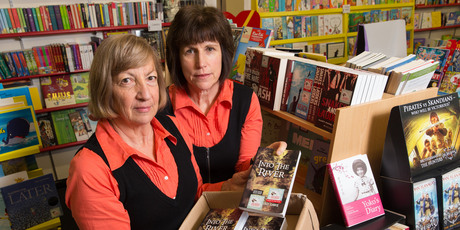
Helen Le Heron (left) and Anne Cooper in their Hamilton bookstore. Photo / Stephen Barker

A novel voted this week as the best children's book of the year is laced with detailed descriptions of sex acts, the coarsest language and scenes of drug-taking.
Ted Dawe's Into the River has polarised the literary community after claiming top prize in the annual New Zealand Post Children's Book Awards. At least one well-regarded book store is refusing to stock it.
The author makes no apology for the racy content, saying the story needs to be told, even if it risks upsetting parents and booksellers.
In a rare move, award organisers last week sent "explicit content" stickers to all booksellers to warn potential buyers.
The 2013 Kiwi Kids' Good Book Guide lists the book's target age as 13 years and over. But one nationwide book chain has advised store managers the book is suitable only for children over 15 years.
The book uses expletives including the c-word, depicts drug use and sex scenes, including one where a baby mimics sounds of intercourse. The Herald on Sunday has decided not to print extracts as they would offend some readers.
Full article  (including book excerpt)


Book prize lets down the young - Editorial in Herald on Sunday

Into the River took the top prize in the New Zealand Post Children's Book Awards.
Children are exposed to a great deal of explicit sexual material these days. As they come through puberty and beyond, they are liable to come across so much of it on the internet that those who would like to bring a better influence to bear might despair.
They should not give up. There are more weapons in the fight than heavy-handed bans and censorship that never worked, even before pornography was as pervasive as it is now. The best weapon is a book.
Good, well-written stories that go to the heart of a reader and touch the truth of any human experience, including sex, can help a young mind rise above smut. That is why it is a worry when a national award for children's books is given to a novel that needs to carry a warning.
Some booksellers, we report today, are refusing to display Into the River by Ted Dawe, which took top prize in the recent New Zealand Post Children's Book Awards. One explained that it was "unnecessarily graphic" and contained themes the bookseller considered inappropriate for young teenagers.
It contains obscenities and shock references that worthwhile literature does not need. We can only wonder what the judges were thinking, or how much worse the other entries could have been.
Nobody has to wonder at the embarrassment of the award organisers. Last week they sent out parental warning stickers to shops stocking the book, advising them to put it on its covers. The 2013 Kiwi Kids Good Book Guide lists it for children aged 13 and over but one national booksellers' chain has told all its managers to mark it for over-15s.
Schools, though, seem to think it fine. The School Library Association welcomes the book as a reflection of our society, evidently because its central character is a young male Maori. "There is so little out there with this type of protagonist," says the president, Fiona Mackie. "When you as library staff see that sort of book, you grab it."
It is often remarked that New Zealand fiction written for film and television is oddly and uncharacteristically dark. There is not much that is bright, stylish or subtle in its treatment of most subjects, especially sex.
That is probably a reflection of the immaturity and limitations of screen writers in a small nation's talent pool, but our literature has been better than that. And our writing for children has been exceptionally good. Novelists should not let the crude depictions of New Zealand on air wash back into its literature, particularly when writing for the young.
Teachers and school librarians do teenagers a disservice when they point them towards books that need to shock to capture their interest. Teenagers are not shocked by the subject matter, of course. They can see worse without going to much trouble.
What might shock them is that teachers and librarians have put this stuff in front of them. Teenagers would never say so, but they do not want this sort of fare from their school any more than they would want it from their parents.
It is not prudish or patronising to maintain a certain standard, it is re-assuring them that quality exists and people they respect can recognise it. For many, their early teenage years might be the last in their lives when they read literature worthy of the name.
Reading it might not be easy but it can reward the effort with pleasure far exceeding anything that needs an age warning. The only warning that Dawe's material really needs is that reading it almost certainly will be a waste of time.
- Herald on Sunday