Thursday, January 31, 2013

Author reveals crime writing "secrets"


30.01.13 | Katie Allen - The Bookseller

The Chosen Dead author and "Kavanagh QC" scriptwriter M R Hall has launched a free online crime-writing course, with a competition for crime-writers.

Seven Secrets of Successful Crime Writing comprises a series of weekly videos, each covering a different aspect of crime writing including such "secrets" as: "However big the story, it must take place within a confined world" and "The central character must have a moral centre, but also be conflicted on many levels". Each week there will also be a detailed worksheet, with podcasts also available.
At the end of the course, there will be a competition for the budding crime-writers, with prizes including an intensive two-day writing course at Goldsboro Books in central London, hosted by Hall and author William Ryan.
Writers will be able to upload the first chapter of their crime novel to the Facebook page http://apps.facebook.com/sevensecrets-crime/ from the opening date of 11th March. Hall will judge entries, alongside Mantle publisher Maria Rejt and editor Sophie Orme. More details will be announced when the competition opens.
The course can be found at www.facebook.com/MRHallAuthor.


New children's festival from Chorleywood


30.01.13 | Benedicte Page - The Bookseller

Chorleywood Bookshop in Hertfordshire, which already runs the Chorleywood Literary Festival, is to hold a book festival for children.
Carol Ann Duffy, Rachel Bright, Simon Mayo, Laura Dockrill [pictured] and Jez Alborough are among poets and authors holding events at The Great Little Litfest, which will run from 9th to 15th March and cater for children from primary school age to A Level.

The festival will include a schools programme, a weekend of public events, book groups for children to shadow the Blue Peter Book Awards and children's writing competitions.

Morag Watkins of Chorleywood Bookshop said: "Great Little Litfest is a natural extension of the Chorleywood LitFest and allows us to concentrate on the needs of younger readers, to build a love of reading that will stand them in good stead for all their lives."


200 Years of Pride and Prejudice - Celebrating the book's best covers.


By |Posted Tuesday, Jan. 29, 2013

p&p_launcher

It’s a truth universally acknowledged that sometimes it’s OK to judge a book by its cover. This week marks the 200th anniversary of the publication of one of Jane Austen’s most beloved novels, Pride and Prejudice. The bicentennial is being celebrated with marathon readings and themed balls, and in the years since its publication, the book has inspired countless Hollywood movies and some bizarre reimaginings. But the numerous editions of the original text have also seen a wealth of interpretive covers: from the annotated to the peacock-inspired. Here’s to 200 more years.

German row over whitewashing the n-word from children's books


Father delighted that racist words will be removed from bedtime storybook but decision generates hate mail from opponents

The Little Witch
Detail from the cover of Thienemann's new edition of The Little Witch. Photograph: Thienemann

A German man whose letter to a publishing house prompted it to expunge the racist sentiment from a classic children's book has spoken of his relief that about the decision, despite the angry backlash and hate mail it has generated.
Mekonnen Mesghena wrote to one of Germany's oldest children's publishers urging it to revise the text of Die Kleine Hexe (The Little Witch) after stumbling across a passage in which two children dress up as "neger", which can be translated from German as both "nigger" and "negro". "I am hugely relieved to have been told that all the words to do with the skin colour will be abolished," he said.

Mesghena wrote to Thienemann Verlag after realising that he could not continue reading the book to his seven-year-old daughter, Timnit, one bedtime. "Suddenly it was full of racist language referring to little niggers and gypsies and basically a lot of labelling of people. I was not prepared. Normally if you come across a problematic word you can change it, but this was a whole chapter so I simply had to stop reading, much to the disappointment of my daughter," he said.
But the decision has caused an outcry amongst many of the country's intellectuals, who have accused Thienemann of censorship and of unnecessarily meddling with a beloved classic. Both Thienemann and Mesghena have been inundated with angry correspondence, even hate mail.

Amazon reports record sales of $21bn


Amazon's popularity with shoppers in Britain surged over the Christmas period, underlining the growing threat the online retailer poses to the UK high street.

Amazon packaging
Amazon was expected by analysts to report global sales of $22.2bn (£14bn) in the last three months of last year Photo: Alamy
The world’s largest online retailer on Tuesday night reported record sales in the final quarter of 2012, as more consumers did their shopping on the internet.
International sales, which includes the UK, jumped 20pc to a record $9.09bn (£5.8bn). That helped drive Amazon's total sales in the quarter to $21.3bn, up 23pc from 2011.
"The market is underestimating the long-term international sales opportunity," said Scott Devitt, an analyst at Morgan Stanley. January has already proved to be one of the most brutal months on record for British retailers, with HMV, DVD rental chain Blockbuster and camera group Jessops all collapsing into administration.
All three traditional brick and mortar retailers could not cope with competition from Amazon, and analysts say their failure will only feed the US company’s growth in Britain.
“The failure of high street players will just drive more people to Amazon,” said Neil Saunders at retail analysis firm Conlumino. “Now that Jessops has gone, if you want a camera, you’re more likely to go to Amazon.”
Amazon, which was founded by Jeff Bezos in 1994 as a bookseller, said that sales of electronic books surged 70pc, while sales of physical books saw their weakest growth in the company's history. "We're now seeing the transistion we've been expecting," Mr Bezos said of the shift in book sales. Morgan Stanley estimates that by 2016 Amazon will have almost a quarter of an global online shopping market that will be worth $1 trillion.
While popular with shoppers, Amazon’s muscle in Britain is controversial due to the relatively small amount of UK corporation tax it pays. The company has paid just £2.3m in corporation tax over the past three years despite making £7.1bn in sales. David Cameron said last week that the public had had enough of companies that sell in the UK but use “ complex tax arrangements abroad to squeeze their tax bill”.

Amazon's Slim Profit Gets Smaller Still; Bezos Confirms eBooks A "Multi-Billion Dollar Category"


Amazon reported fourth quarter sales after the close of the market on Tuesday, coming in at the low end of their own sales projections. That means that sales of $21.27 billion, up 22 percent, also fell $1 billion short of analysts' expectations. The company did show some net income--but it was a slim $97 million or 21 cents per share, again short of investors' expectations. (Net income is also much lower than the same quarter a year ago, when they earned $177 million.) But operating income rose--at $405 million, 55 percent better than a year ago, and better than the forecast that scared investors three months.

So in a market where Amazon has been trading at all-time highs and investors want to believe, shares rose more than 6 percent in early trading Wednesday, more than gaining back what they had lost the day before. For those who don't want to believe, Amazon's total sales for the quarter were about the same as Apple's gross margin for the same period, $21.06 billion (which yielded operating income of $17.62 billion). In   a similar vein, analyst Benedict Evans noted in a tweet that excluding charges, since its birth Amazon has had cumulative sales of $245.5 billion, yielding net income of $1.9 billion (or less than eight-tenths of one percent).

In Amazon's release, ceo Jeff Bezos spoke directly to their book business: "After 5 years, ebooks is a multi-billion dollar category for us and growing fast – up approximately 70 percent last year. In contrast, our physical book sales experienced the lowest December growth rate in our 17 years as a bookseller, up just 5 percent." The latter statistic has already been misconstrued in some places--their print book sales continue to grow, and have grown continuously since the company was founded. Which means, effectively, they continue to take print book market share from other sellers of books. Their competitors, and the trade, would be celebrating if other major vendors announced that print book sales were up 5 percent in the biggest quarter of the year. (Separately, the company reports that 23 KDP authors each sold over 250,000 copies of their books in 2012.)

Speed Dating for Book Lovers


from Shelf Awareness

For the second year in a row, the Strand Book Store in New York City will help single book lovers find the perfect date for Valentine's Day. On February 6, the Strand will host Queer Ladies Speed Dating, followed a day later by Valentine's Day Speed Dating.
Both events will be held in the rare books room and feature colorful MCs, raffles with prizes donated by local businesses and catering provided by local bakeries, along with copious amounts of champagne. Prohibition Bakery, "New York City's original alcoholic cupcake company," will provide food for Queer Ladies Speed Dating, while Billy's Bakery of Chelsea will cater the February 7 event.

Participants pay $25, receive an ID number and raffle tickets, along with a booklet containing question prompts and score sheets. At the end of the night, the Strand staff will collect the score sheets and match up the participants, and shortly thereafter let people know their matches.

"Given the location, there will be a lot of talk about literature," said Lizzy Selzer, head of events and marketing at the Strand, "and people are encouraged to bring their favorite books."

The Strand held its first speed dating event for Valentine's Day last year, and did the first Queer Ladies Speed Dating during Pride week last June. Both events went extremely well, Selzer said, and, assuming an equally strong reaction to these two upcoming events, the Strand plans to hold at least two more during the year. "One will probably be around Pride, and then either later in the summer or in the fall," she said. "The choice for that one is between tourists and college students." --Alex Mutter

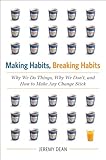
Making Habits, Breaking Habits


delanceyplace header

In today's selection -- how long does it take to form a new habit? You will often hear that it takes 21 days, but the real answer is quite different than that:

"How long does it take to form a new habit? ... I looked for an answer the same way most people do nowadays. I asked Google. This search suggested the answer was clear-cut. Most top results made reference to a magic figure of 21 days. These websites maintained that 'research' (and the scare-quotes are fully justified) had found that if you repeated a behavior every day for 21 days, then you would have established a brand-new habit. There wasn't much discussion of what type of behavior it was or the cir­cumstances you had to repeat it in, just this figure of 21 days. Exercise, smoking, writing a diary, or turning cartwheels; you name it, 21 days is the answer. In addition, many authors recommend that it's crucial to maintain a chain of 21 days without breaking it. But where does this number come from? Since I'm a psychologist with research training, I'm used to seeing references that would sup­port a bold statement like this. There were none. ...   

"Thanks to recent research, though, we now have some idea of how long common habits really take to form. In a study carried out at University College London, 96 participants were asked to choose an everyday behavior that they wanted to turn into a habit. They all chose something they didn't already do that could be repeated every day; many were health-related: people chose things like 'eating a piece of fruit with lunch' and 'running for 15 minutes after dinner.' Each of the 84 days of the study, they logged into a website and reported whether or not they'd carried out the behavior, as well as how automatic the behavior had felt. As we'll soon see, acting without thinking, or 'automaticity,' is a central component of a habit.

"So, here's the big question: How long did it take to form a habit? The simple answer is that, on average, across the participants who provided enough data, it took 66 days until a habit was formed.  As you might imagine, there was considerable variation in how long habits took to form depending on what people tried to do. People who resolved to drink a glass of water after breakfast were up to maximum automaticity after about 20 days, while those trying to eat a piece of fruit with lunch took at least twice as long to turn it into a habit. The exercise habit proved most tricky with '50 sit-ups after morning coffee,' still not a habit after 84 days for one par­ticipant. 'Walking for 10 minutes after breakfast,' though, was turned into a habit after 50 days for another participant. ...
"Indeed, overall, the researchers were sur­prised by how slowly habits seemed to form. Although the study only covered 84 days, by extrapolating the curves, it turned out that some of the habits could have taken around 254 days to form-the better part of a year! What this research suggests is that 21 days to form a habit is probably right, as long as all you want to do is drink a glass of water after breakfast. Anything harder is likely to take longer to become a really strong habit, and, in the case of some activities, much longer."

 
Author: Jeremy Dean
Title: Making Habits, Breaking Habits 
Publisher: Da Capo Press
 Date: Copyright 2013 by Jeremy Dean
 Pages: 3-7
Making Habits, Breaking Habits: Why We Do Things, Why We Don't, and How to Make Any Change Stick
by Jeremy Dean by Da Capo Lifelong Books
Hardcover


About Us

Delanceyplace is a brief daily email with an excerpt or quote we view as interesting or noteworthy, offered with commentary to provide context.  There is no theme, except that most excerpts will come from a non-fiction work, mainly works of history, are occasionally controversial, and we hope will have a more universal relevance than simply the subject of the book from which they came. 

10 of the Most Twisted Short Stories About Love


It’s almost Valentine’s Day, which has us thinking about affairs of the heart — but not in the Hallmark card way, of course. Yesterday saw the release of Ludmilla Petrushevskaya’s There Once Lived a Girl Who Seduced Her Sister’s Husband, and He Hanged Himself: Love Stories (an even better title than her last translated collection, There Once Lived a Woman Who Tried to Kill Her Neighbor’s Baby: Scary Fairy Tales), and needless to say, the book is full of off-kilter, lurid, even violent attempts at connection.

To celebrate the book’s release (and stock you up on reading in advance of Valentine’s Day), we’ve put together a list of ten of our favorite thoroughly messed up short stories about love. But of course, the literary world abounds with these, so read through and add your own twisted favorites in the comments. … Read More

Jerry Jenkins Launches Self-Publishing Company


By Andy Butcher |Jan 30 - PW

In an about-face, bestselling Christian author Jerry Jenkins, a long-time critic of do-it-yourself books, will help authors publish their works through his new Christian Writers Guild Publishing.
Co-author with Tim LaHaye of the blockbuster Left Behind series, and someone with more than 150 other books to his name, Jenkins said the new venture was the result of an "epiphany." Despite the best efforts of his guild's training, he said, not enough new authors have been able to land deals with traditional publishers, in part because houses continue to insist that authors have a significant "platform." As a result, "good, passionate authors are ignored because they're unknown," Jenkins told PW. 
Though having long discouraged new writers from self-publishing because "for too many years so [many self-published works were] awful—poor writing, little editing, sloppy proofing, bad covers"―Jenkins said he realized his school could help. The goal is to help authors "produce books that donn’t look self-published, and at the very least could compete in the marketplace without their having to apologize for them."

Jenkins described the CWG initiative as “[coming] alongside” writers rather than self-publishing, with integral educational and mentoring components. Those applying to the guild's “Published” program must submit part of their manuscript for evaluation. If accepted, they follow a six-month course—costing just under $10,000—that includes mentoring by a published author. Copy-editing, typesetting, proofreading, custom cover design, marketing advice, printing, digital formatting, and e-book file creation in all formats are included in the package. There will be a surcharge for manuscripts over 75,000 words.
“I’m sympathetic to traditional publishers—I used to be one [as v-p of publishing at then-Moody Press]—and understand why they’ve had to become so much more exclusive in their choices,” Jenkins said. “To deserving writers who have suffered from such belt-tightening, our aim is to offer anything but a last resort but rather to help them prove their worthiness in the market.”

Jenkins' “forward-thinking” move was welcomed by Steve Laube, a leading agent who formerly ran ACW Press, one of the first self-publishing services in the Christian market. “It is a natural conclusion to what the guild can offer their constituents,” Laube said, distinguished from other packages because it includes the course work “to bring a level of craft to the process.”
Jenkins acquired the Christian Writers Guild, founded in the 1960s as a correspondence course, in 2001. There are currently some 700 members; more than 200 will attend the group's annual Writing for the Soul conference in Colorado Springs, Colo., Feb. 14-17.

Wednesday, January 30, 2013

Making Waves and Money With Poetry


Poetry may be a hard sell in the mass market, but direct sales and subscriptions help Seattle poetry publisher Wave Books survive the stormy economy.
Discussion:
Michael Moorcock, grand master of the fantasy genre, has fallen in and out of favor and print. Publisher Victor Gollancz is banking on a digital revival.
Read more »
More News from Publishing Perspectives:
You may think of Excel as a spreadsheet tool, but it is one of the best all-purpose data visualization tools and especially useful for publishers.
Read more »
This year's coveted American children's book awards go to The One and Only Ivan (Harper), This is Not My Hat (Candlewick), and In Darkness (Bloomsbury).
Read more »
From the Archives:
A new online magazine enlists top writers to covers stories of underrepresented world conflicts, underlining the personal, the intimate and the introspective.
Read more »

The death of the book is e-fiction


Business Spectator -  - 30 Jan 2013

One thing the digital revolution has not done is kill off the book. In fact, I think we can conclude now that, if anything, it is leading to the book’s rebirth.
E-reader and tablet sales are booming, with another big Christmas for them just past, and it looks like e-books now take about 10 per cent of total book sales, rising fast.
I used to think that digital publishing would at least end up redefining what a book is, since the number of words was determined by the optimal size of the printed object, both for pricing and for the shelf, but that’s not happening either – yet.
Well actually, sales of short novels and summaries at a price point around $3 each are doing well and there was a lot of talk at the Digital Book World conference earlier this month about the need to slice books up into smaller parcels for better indexing by Google.
But on the whole a book is still a book, and it looks like the decline in reading has been halted and turned around by the advent of digital publishing. It’s just that more and more are being read on small screens – tablets and e-readers rather than paper.
It’s not good news in the long-term for bookshops, of course, but sales of printed books are still doing okay, and the best bookshops are surviving doing other things. 
Amazon released the first Kindle e-reader in November 2007, just as the global stock market peaked and the credit crisis began. Five years on, from ad hoc discussions with those in the industry, we can start to form some conclusions about what’s happening.
Fiction is moving to e-book more quickly than non-fiction, especially romance and crime; in fact sales of romance novels have dramatically increased. The biggest market for e-books is women over 45 and whereas the split between female and male print book consumers is 60-40, in digital form it’s 70-30.
This stands to reason by the way: I tend to buy crime fiction on my tablet and serious non-fiction in print, although that may change in future.

Full article 

Hillary Clinton Confirms New Memoir


Huff Post Books 
Taking part in a global town hall, she announced her plans in response to a question about her future plans.
“I don’t know what I will say in it yet,” she said. She said that first she has to catch up on "about 20 years worth of sleep deprivation."

On CNN last Sunday, presidential historian Douglas Brinkley said she would likely write such a book, when talking about what Clinton would do after leaving office as Secretary of State. "She needs to work on a memoir, she'll probably give speeches. At that point, in about 18 months or two years, [the Clintons] have a big decision to make," he said.
Clinton has already written a bestselling memoir, Living History, published in 2003, about her suburban middle-class upbringing and her time as First Lady in the White House. She also wrote It Takes A Village, a book about child development, published in 1996.
Of course, though Clinton continues to refuse to be drawn on the question, publishing a book can sometimes be a sign of intent to stand as a presidential candidate. As The New York Times wrote in 2007,
For candidates, writing a book is a way to make money, build gravitas and grab media attention. (They can also use a memoir as a dumping ground for past unpleasantries, paving the way for the campaign-trail line “I addressed that in my book.”)
Last year, Monica Lewinsky made headlines when it was reported that she was writing a memoir, but thus far, no further news about that particular book has emerged.

Events that changed the course of New Zealand history


TURNING POINTS


By Paul Moon
Publication date: February 2013
New Holland Publishers -  Price: $39.99


What constitutes a turning point? In his new book, leading historian Paul Moon has chosen 20 pivotal events, (half in the 20th century and half before), that have shaped the course of New Zealand history over the years. Each event is described as a discrete story and illustrated with photographs drawn from the archives, and the author outlining how New Zealand history has changed as a result.

Written for the interested layperson, the episodes run from first discovery of the land of the long white cloud to the emergence of a new electoral system with MMP. Arranged in chronological fashion, other events in the book include Hongi Hika’s visit to England, the impact of the New Zealand Company settlements, when women get the vote, the First World War, Maori migration to the cities, Britain joining the EEC, the Springbok Tour, the Homosexual Law Reform Act and the politics of Rogernomics. All of these turning points reveal the huge diversity of ideas, beliefs, and courses of action that go to make up the history of this nation.
A fascinating and highly accessible illustrated account of New Zealand history

About the author:
Dr Paul Moon is Professor of History at the Faculty of Maori Development at AUT University. He has written extensively on nineteenth-century New Zealand history and Maori history and is also a frequent media commentator and, in the past few years, has appeared on TVNZ’s Frontier of Dreams, Prime TV’s New Zealand's Top 100 History Makers, TVNZ’s Close-Up, Marae, Te Karere, and Waka Huia, TV3 News, and Māori Television as an election night analyst. He has also appeared regularly on Radio New Zealand’s Morning Report and Checkpoint, on NewsTalk ZB, Radio Pacific, and Radio Live.


Who was that woman anyway?: Snapshots of a Lesbian Life


by Aorewa McLeod
Victoria University Press -  $35.00


Emerging brittle and cynical from a wildly dysfunctional family, Ngaio careers from ice cream factory to children's home to Oxford to rehab. Along the way, she discovers herself and her sexuality -- at raucous parties with trainee nurses, in feminist encounter groups and Wiccan covens, in university classrooms and legendary sapphic hotspots. 
This novel delivers vivid and hilarious snapshots of late 20th Century lesbian life: witty, tender, frank.

Aorewa McLeod taught in the University of Auckland English Department for 37 years until her retirement. She undertook the MA in creative writing at Victoria University of Wellington in 2011. She has published as a critic and edited anthologies. This is her first book.

Taipei, translation rights and THAT proposed merger !


From the latest PANZ Newsletter

Smooth setup for Taipei stand


One day out and judging by the photo, there was even time for conversation during the PANZ stand setup at the Taipei International Book Exhibition (TIBE), which opens today. Clearly no carpet dramas here...

From left: Kathleen Ferrier (Lanky Hippo Publishing), David Ling (Duck Creek Press/David Ling Publishing), Julia Marshall (Gecko Press) and PANZ President Kevin Chapman (Hachette NZ).
 
  
Translation rights to NZ titles vigorously pursued


The impetus to continue international rights sales of New Zealand published titles following the Frankfurt Book Fair in 2012 continues under the PANZ umbrella. Sarah Ropata is currently putting together the 2013 New Zealand Rights Catalogue which will promote 30 new Kiwi titles available for translation into international languages.

The catalogue will be launched at the European spring rights markets at the Leipzig Book Fair, 14–17 March. It will seek to build on the sales momentum gained at Frankfurt.

The production and distribution of the catalogue is supported by investment from Creative New Zealand and will feature a strong selection of New Zealand literary titles. In addition a mix of trade publishing including commercial publications will be presented in order to profile a balanced range of New Zealand books.

Titles have been selected for their high-quality writing and their international sales potential by a panel with experience in international rights sales, market trends and in-depth knowledge of NZ writing.


Penguin, Random House merger: submission to Commerce Commission available online


“The market is not concentrated and is characterised by a large number of international and local competitors,” according to the Bertelsmann and Pearson submission filed with the Commerce Commission.

Read it here: www.comcom.govt.nz/assets/Uploads/1481305Bertelsmann-and-Pearson-clerance-application-public-20-December-2012.pdf

Submissions to the Commerce Commission re the merger close on 1 February. The Commission hopes to release its decision on 15 February.

Text Prize for Young Adult and Children's Writing


It is just one month until Text Publishing begins the search for the 2013 winner of the Text Prize for Young Adult and Children's Writing?

The Text Prize is an annual search for the best unpublished manuscript written by an Australian or New Zealander for young adults or children. Past winners include Richard Newsome for The Billionaire's Curse, Jane Higgins for The Bridge, Leanne Hall for This is Shyness, Myke Bartlett for Fire in the Sea and A.J. Betts for Zac & Mia.

The Text Prize for Young Adult and Children's Writing is now in its sixth year and the  2013 winner will receive a publishing contract with Text Publishing worth $10,000.

One key thing to note is that our entry dates have moved forward this year.  
Entries for this year's prize open on Monday 4 March and close on Wednesday 3 April.

For more details and to download a submission form visit http://textpublishing.com.au/about-text/the-text-prize

BRING UP THE BODIES BY HILARY MANTEL NAMED 2012 COSTA BOOK OF THE YEAR


Bring Up the Bodies by novelist Hilary Mantel has won the title of 2012 Costa Book of the Year.  The sequel to Mantel's award-winning novel Wolf Hall and the second book of a trilogy, Bring Up the Bodies continues the life of Thomas Cromwell and explores one of the most mystifying and frightening episodes in English history, the destruction of Anne Boleyn.

The announcement was made this evening (Tuesday 29th January) at an awards ceremony held at Quaglino’s in central London.

Mantel’s win secures her a unique place in literary history: Bring Up the Bodies is the first book to have been both named as Costa Book of the Year and won the Man Booker Prize in the same year. 

The inaugural Costa Short Story Award, judged separately from the main prize, was won by Avril Joy.

Mantel, the bookmakers’ odds-on favourite,  beat debut writer Francesca Segal, for The Innocents, graphic memoirists Mary and Bryan Talbot for Dotter of Her Father’s Eyes, Scottish poet Kathleen Jamie for The Overhaul and children’s author Sally Gardner for Maggot Moon, to win the overall prize and a cheque for £30,000 at the awards ceremony.

Following the judging, Dame Jenni Murray, chair of the final judges, said: “Despite a lengthy discussion, there was no doubt which book stood head and shoulders above the rest and there was absolute unanimity about our decision.  Every hand went up for Bring Up the Bodies.”

She continued, “Hilary Mantel writes beautiful, poetic prose, set in its time but also incredibly modern.  It’s a book I’ll go back to again and again.”

Murray chaired a final judging panel that included actress Jenny Agutter, broadcaster Katie Derham, actress and writer Sophie Ward, author and comedian Mark Watson, poet Daljit Nagra and authors Wendy Holden, DJ Taylor and Marcus Sedgwick.

The Costa Book Awards recognise the most enjoyable books of the last year by writers based in the UK and Ireland.  Originally established by Whitbread PLC in 1971, Costa announced its takeover of the sponsorship of the UK’s prestigious and popular book prize in 2006.  2012 marks the 41st year of the Book Awards.

Bring Up the Bodies, published by Fourth Estate, is the eleventh novel to take the overall prize. Pure by novelist Andrew Miller was named Costa Book of the Year in 2011.

Since the introduction of the Book of the Year award in 1985, it has been won eleven times by a novel, four times by a first novel, five times by a biography, five times by a collection of poetry and once by a children’s book.

Avril Joy wins Inaugural Costa Short Story Award
The Costa Book Awards ceremony also saw the announcement of the first-ever winner of the Costa Short Story Award. Former prison manager and now full-time writer, Avril Joy, won the public vote to win £3,500 for her story, Millie and Bird.  Two runners-up, writer Chioma Okereke and creative writing student Guy Le Jeune, each received £750.

Established this year, the new Award - run in association with the Costa Book Awards but judged independently of the main five-category system – is unique in that it was judged anonymously (ie without the name of the author being known throughout the process).  It is for a single, previously unpublished short story of up to 4,000 words by an author aged 18 years or over and written in English, and is open to both published and unpublished writers.

A shortlist of six stories was selected by a panel of judges - Richard Beard, Fanny Blake, Victoria Hislop, Gary Kemp and Simon Trewin - and then made available on the Costa Book Awards website for the public to download and vote for their favourite.  Costa Managing Director, Christopher Rogers, announced the winner and runners-up and presented them with their cheques.

For more information please visit www.costabookawards.com.


Who will win the 2012 Costa book of the year award?


The winner of the 2012 Costa book of the year award will be announced this evening. Who do you think should triumph?

A cup of Costa cappuccino
Forget the coffee, who should win Costa Book of the year? Photograph: Phil Noble/Reuters
Tonight the Costa book of the year will be announced. It's a slightly complicated prize that starts with a longlist split into categories, and ends with five books from different genres fighting it out for the glory (and increased sales) of being named book of the year. At about 8pm GMT, we'll find out if Hilary Mantel has done the triple by winning the Man Booker prize, the Costa novel prize and the overall Costa prize, all in the same year.

Here's a reminder of the five titles on the shortlist, made up of the winners of the five sections:

Before this shortlist was announced a couple of weeks ago, we asked you who you thought should win in the category sections. A few of you were clear which tiles you were rooting for, but as that stage in the prize was announced on the 2 January, it's fair to say that a far greater number of you were still in holiday mood and miles away from a computer. We're hoping that now we're into the swing of 2013, we're up for a discussion. So, who do you think will win the 2012 Costa book award? Who do you think should win? Place your bets

Why books need literary prizes


The Costa and Booker prizes may be a literary lottery but awards have more influence now than reviews

Tuesday 29 January 2013 
Trophies
Trophy club ... awards pack more punch than reviews when it comes to a book's fortune. Photograph: Image Source/Alamy

Tomorrow sees the annual Costa book award: a notoriously hard competition to get a handle on, not least because, now the individual categories (fiction, poetry, biography etc) have been adjudicated, the celebrity jury has the unenviable task of comparing Hilary Mantel's Man Booker-winning novel Bring Up the Bodies with a graphic biography, Dotter of Her Father's Eyes, and three other category winners, including Sally Gardner's Maggot Moon, a book for children. It's a bad case of apples and oranges, and the outcome rarely satisfies. Still, whatever its deficiencies, I agree with those who say that, in general, these trophies are A Good Thing. Yes, it's a lottery, but it's a lottery that attracts the reading public to new books, and sometimes promotes unknowns. What's not to like?

Far more than book reviews, it's literary prizes that shape the afterlives of new titles. Even in the recession-hit UK, these prizes show no sign of losing popular appeal. Far from it. As well as Costa, the Booker will soon be facing competition from the avowedly highbrow Literature prize, set up in protest at the perceived dumbing-down of the Booker. Elsewhere there are South Asian, Russian and African prizes. A hundred years ago, there were virtually no prizes, but there's no question that the phenomenon is here to stay, reflecting (I think) the important role of the marketplace in the contemporary book world. We are all Thatcherites now.

In other parts of the literary landscape, however, it's a case of plus ca change, plus c'est la même chose. On a whim, I've been re-reading Somerset Maugham's acerbic little novel of literary life, Cakes and Ale. Just like George Gissing's New Grub Street, much of it could have been written yesterday. Maugham's satire on Edward Driffield, a famous and greatly revered writer bearing a more-than-passing resemblance to Thomas Hardy, and his portrait of Alroy Kear, a similarly biting evisceration of popular 30s bestseller Hugh Walpole, reveals a young novelist taking well-timed shots at his seniors. That's a story as old as the hills, and eventually Maugham himself would fall from favour, too (although unlike Walpole, whom I dare say nobody reads any more, the author of The Razor's Edge and Of Human Bondage continues to sell and sell).

An introductory note to the paperback edition of Cakes and Ale contains Maugham's whiskery complaints against the perils and burdens of professional authorship. In particular, he deplores the publicity circuit in language that certainly dates him. If there is "one form of advertisement" that he loathes, it is, he says, "the cocktail party that is given to launch a book. This ignoble practice is not rendered less objectionable when it is presumed to be given at the expense of the publisher …"
Actually, these days, the recession has dramatically cut publishers' launch parties, dinners etc. Prizes such as Costa and Booker, on the other hand, are floated on a sea of sponsored alcohol. God knows what Maugham would say about that.

How we made the children's favourite Angelina Ballerina


The creators of the tutu-wearing white mouse explain how real-life dancing tantrums inspired some of their heroine's best adventures

Angelina Ballerina View larger picture
'I used memories of the thatched cottage where I grew up' ... Angelina Ballerina. Click to enlarge

Katharine Holabird, writer

In the early 1980s, my five-year-old daughter was obsessed with ballet. Her heart's desire was a pink tutu, so when my husband's publishing house, Aurum Press, wanted to commission a children's picture book, I sat at the kitchen table and wrote a story straight off about a would-be ballerina. Originally my heroine was based on my two daughters, and I called her Primrose, but as soon as I showed the story to Helen Craig, the illustrator I'd worked with on the Little Mouse counting and alphabet books, she drew the dancer as a white mouse. I immediately felt that Helen had captured the epitome of the character: any child from any culture can identify with a cute little mouse. Then we sat down with the publishers to find a suitable name. We started with the letter A, and when an editor called Angela came into the room, Angelina Ballerina was born.
I wrote the first book as a one-off in 1983. About six months later we got a call asking for another. It was easy to oblige because my daughters were by then going to ballet classes and I would eavesdrop on all the jealousies, upsets and dramas that erupted constantly in the class and elaborate on them. Once, when my daughter was ill in bed and threw a tantrum about missing a show, I gave in and let her perform. It was a disaster, of course, but I used the experience in Angelina and the Princess, when Angelina tiptoes off to some auditions from her sickbed and fails to win the lead role because she is unwell.

Many of the characters were based on real-life friends and family: Alice was the mouse version of a very loyal friend of my daughter's, and Henry was my son, who followed his two sisters everywhere. If you live with children, there are outbursts and meltdowns every day, and I wanted to write about real situations so readers knew Angelina had ups and downs just like them. Children understand Angelina because she makes a lot of mistakes – but she always picks herself up and dances on again.

Helen and I always talk about the book together before we start. She has a complete vision of Mouseland in her head, all based on her country childhood during the war, and this makes us an interesting combination, as I grew up in Chicago.
When the Angelina books were turned into a television series, I read every script beforehand, but it can be a wrench to have your character and stories handed over to a team of scriptwriters who have ideas of their own, however good – and few children's authors have the draconian power over brand development that JK Rowling does.

This year is Angelina's 30th anniversary, but for me, she will never grow old. As a character she's so full of life that I feel I can create any situation and just sit back and watch what she does next. As a writer, I can't ask for more.

And from illustrator Helen Craig