Monday, July 04, 2011

Harry Potter author J K Rowling dumps the man who conjured up her millions

J K Rowling, the author of the Harry Potter books, has 'terminated her association' with Christopher Little, who has been her literary agent for 16 years. 


Exile, Literature and the High Price of Freedom

Publishers Perspective

Authors exiled from Iran, Cuba, Afghanistan, Egypt, Algeria and the Congo discuss oppression, inspiration, and freedom
Last week, to mark the 60th anniversary of the 1951 Refugee Convention, the United Nations High Commissioner for Refugees (UNHCR) and the City of Paris organized a seminar on the theme of “Exile and Literature.”
The first event addressed the writer’s relationship to language and offered a variety of views from across the Francophone world. Congolese novelist Alain Mabanckou and Palestinian poet and writer Elias Sanbar (who grew up in Lebanon) pointed out that they both French as children — Mabanckou at home in a former French colony and Sanbar as a child in a in a French “protectorate.” Egyptian-born author Paula Jacques noted that she was educated in French, as were the Egyptian elite and bourgeois classes at the time.


READ MORE >>

THAT BOOK - Bromhead cartoon

Love this cartoon that appeared in yesterday's Herald on Sunday.
Cartoonist Peter Bromhead kindly gave me permission to use it.

THAT BOOK - 'World's worst mother' is entitled to have her say

By Tapu Misa,New Zealand Herald,, Monday Jul 4, 2011

Macsyna King. Photo / Dean Purcell

It's disconcerting when you find yourself in the corner with people you've seldom (Ian Wishart), if ever (Christine Rankin), agreed with. Especially when there's an angry and unforgiving 48,000-strong Facebook community (I hesitate to use the incendiary "mob", however apt) on the other side.

But, at the risk of becoming the second most hated woman in the country, I will say that when Breaking Silence: The Kahui Case is published next month, I intend to buy it and read it. I, for one, want to hear what the Kahui twins' mother Macsyna King has to say.
Why would I not?
Because Macsyna shouldn't be allowed to profit from her babies' death? She won't. Apart from three slices of pizza, says the book's author and publisher Ian Wishart, she's getting nothing.
Because nobody should profit? Wishart is a former award-winning journalist, who now edits the conspiracy-loving Investigate magazine. I'm not a fan of the magazine or the books he's written, but to suggest, as some in the media have, that Wishart should have turned his back on the chance to gain some insight into a case that, five years down the track, continues to generate such strong public interest and emotion, is frankly hypocritical.


Human frailty and tragedy are our stock in trade in the news media. Telling stories in the hope of illuminating an issue is what we do. I would have done the same thing in his place.
Because there's nothing more to be learned? Mike Hosking might confidently assert, as he did on Close Up last week, that "I don't need to read the book - because I know what happened, and what happened is, they're a bunch of dysfunctional losers and their kids died".
But I'm inclined to the old-fashioned view that you need to read a book before you can decide if it's rubbish. There's a chance we might actually learn something, which I would have thought would be a good thing given our horrifying child abuse statistics.But I'm inclined to the old-fashioned view that you need to read a book before you can decide if it's rubbish. There's a chance we might actually learn something, which I would have thought would be a good thing given our horrifying child abuse statistics.

Read Tapu Misa's full column at the New Zealand Herald.

Social Media Marketing course for book marketers

Martin Taylor advises:

We'll be running a workshop in Auckland next month on how to use social media, especially Facebook, to market books and ebooks.
Love it or hate it, social media - with Facebook and Twitter to the fore - are taking over more and more of the discussion around books. Books are a traditional word-of-mouth sale so understanding and being part of that online conversation is essential.

I've developed this book marketing training course with social media and internet marketing expert Michael Carney. Michael is well-known in marketing and media circles in New Zealand. He is an author as well as all-round marketing and tech guy and his online social media courses have been taken by hundreds of marketers in the past few months.

The course will be useful for publishers, booksellers, authors and librarians, many of whom are using or planning to use social media. It doesn't assume prior knowledge and we're confident that you'll find plenty of good tips, whether you're just starting out or you are an old hand.

This one day course explains the social concepts and techniques you'll need to understand and master. It gives you a practical toolkit of techniques you can use that are vital for success with social media marketing.
You'll learn:
  • Why Social Media has reached the tipping point in New Zealand
  • The Five Unique Attractions of Social Media for Publishers, Authors and Booksellers
  • 12 Keys to Effective Promotion on Social Networks
  • Targeting: Who are your customers?
  • Collective vs Niche: How should you promote your list?
  • How to set yourself up on Facebook
  • How to add content to your pages
  • Sneaky ways to add your first followers
  • You talkin’ to me? How to listen and engage
And, of course, much more.
Here's the link to the full course description and registration details for Social Media Marketing for Books and Ebooks which will be held in Auckland on 31 August 2011. We look forward to seeing you there.

BY ANY MEANS - Ben Sanders


21-year-old bestselling novelist Ben Sander’s new book By Any Means is releasing next month (August) and Ben’s character Sean Devereaux now has his own Facebook page where you can win copies of The Fallen if you can indentify photos of crime scenes taken around Auckland.

Below is the link to his Sean’s Facebook page


THE TROUT DIARIES

From a renowned photographer, writer and adventurer comes an engaging and truly handsome new book that is set to open the world of fly-fishing to a wider audience, with its elegant prose and passionate descriptions of our beautiful country.
With honesty and freshness, Derek Grzelewski has written a highly readable account of his year dedicated to fly-fishing in New Zealand, relating the highs and lows, and the intricacies and finesse, of pursuing trout in the wild places and pristine waters he loves so much.
The thrill of close encounters with this elusive quarry is mirrored by the pleasure he takes in the companionship of his dogs, his friends and the many others he happens across in, often secret, fly-fishing locations around the country.
Each month, illustrated with fly sketches by passionate fellow angler Johnny Groome, (above Woolly Bugger-August), covers aspects of fly-fishing relevant to that time of year. Along the way we meet many of the author’s friends and clients, including top professional guides and a couple of trout scientists, and share his insights into the art of fly-fishing. He also considers innovative techniques and equipment, the pros and cons of catch-and-release, and ponders on our relationship with the natural world and environmental factors affecting our waterways.

The Trout Diaries contains a wealth of captivating and often amusing anecdotes as well as useful technical information making it a true angler’s companion, both literary and practical. It is also an extremely attractive book to hold; an outstanding job has been done on the design and I offer my congratulations to those involved. The beautiful colour photographs, hand drawn maps and trout flies are another most appealing aspect of the book.
About the author:
Derek Grzelewski was born in Poland in 1964 and grew up behind the Iron Curtain. At 22, he escaped the communist regime by climbing over the mountains into Slovakia, making his way through Western Europe and on to New Zealand. With a successful career as a photographer, writer and adventurer under his belt, he is also a regular contributor to high-end magazines such as New Zealand Geographic, Australian Geographic, Smithsonian, GEO and Flylife. He is a former professional fly fishing guide and the founder of Wanaka Flyfishing Academy. He lives in Wanaka, on the bank of the Clutha River.
www.derekgrzelewski.com  -  (well worth a visit by the way)

Comment from Kennedy Warne from the back cover:
‘In The Trout Diaries the author has his eye on larger, more elusive quarry than just fish. These pages are a salute to the joy of wild encounters and a call to protect the rivers and the trout that make our country unique. Here is a tasty catch that will satisfy angler, adventurer and philosopher alike.’ (Kennedy Warne, founding editor of New Zealand Geographic, author of Roads Less Travelled and Let Them Eat Shrimp)


2011 Philippa Pearce Memorial Lecture

The 2011 lecture will be given by Philip Pullman (left).
Entitled Both Perhaps Present, it will be held at 5.00pm on Thursday 8th September 2011, at Homerton College, Cambridge.

 Tickets to the lecture are free, but must be booked at the lecture website: www.pearcelecture.com 

Booking will open on Monday 4th July. If you visit the site on the 4th and find that the booking form is not yet active, please be patient as it may not go live until later in the day. 

THAT BOOK - EDITORIAL IN HERALD ON SUNDAY

Beware censors and hucksters

 July 3, 2011

We don't burn books in this country. Too many of our sons and fathers died fighting repressive regimes for us to yield to such impulses.
But the mob mentality on display since it emerged that Macsyna King, mother of the Kahui twins Chris and Cru, will tell her story in a book, differs only in degree, not quality, from the Nazi excesses.
Facebook pages and the talkback radio lines have been humming with indignation about the book, Breaking Silence, and threats to boycott booksellers who stock it.

Those who ooze righteousness in the matter have the luxury of doing so for free, of course; booksellers, operating in a precarious market, will forgo big income if they yield to the baying of the mob.
But booksellers are not responsible for the content of books. They select what books to stock on the basis of their commercial prospects - they are booksellers, after all - and they should exercise with great care their entitlement to decline to carry certain titles because of their personal distaste for their content. Bookbuyers should be able to access Adolf Hitler's spittle-flecked Mein Kampf and the novels of Jeffrey Archer with equal ease, despite their objectionable content.


In any case, outrage is premature.
To condemn someone for what we imagine they will say - indeed to seek to stop them saying it - is to take public discourse to a new low. Macsyna King has not, let it be remembered, been charged with a crime.
Those who sneer at the idea that she is still tarred by association with the twins' sickening deaths might care to ask themselves what degree of separation from a crime they would seek before allowing someone's gag to be removed. At this stage, and still unread, King's story is not, of itself, offensive. In a civilised country, public odium is not sufficient reason to deprive someone of human rights, including freedom of speech.

In the case of the book's author, Ian Wishart, the matter is more problematic. A journalist and publisher whose imprint is named, apparently without irony, Howling at the Moon Books, he is a fundamentalist Christian who believes in the literal truth of the biblical narrative. He is also a denier of human-induced climate change which he calls a con designed to raise funds for climate-change scientists (who presumably are in competition with the fundamentalists for the right to warn that the end of the world is nigh).
Wishart says that King approached him, not vice versa, and that she will not profit from the book. If this is so, it certainly bespeaks a sincerity on King's part that was not on show during the police investigation. But people have changes of heart.
The reason that Wishart decided to record King's candour in print for sale can only be guessed at, though profit is a logical conclusion. The man writes for a living, after all. He is also, it must be said, one of the country's great conspiracy theorists, and over time that combination has, presumably, led to a comfortable lifestyle.
On the King book, he promises "answers". It remains to be seen whether he will supply any - but based on his previous works, that might be the best reason to boycott the opportunity to find out.

New Zealand Film - An illustrated history


Our love affair with movies film by film, page by page

Aotearoa New Zealand has always had a soft spot for the silver screen. 
Moving pictures were first screened here in 1896 to a curious and captivated audience and we’ve loved watching them, and making them, ever since.
Now for the first time the full story of this country’s history with film is recorded in a book that all Kiwi movie buffs will want to get their hands on. And what a gorgeous big handsome book it is too.

New Zealand Film: An Illustrated History, edited by Diane Pivac, Frank Stark and Lawrence McDonald and published by Te Papa Press, went on sale July 1 and can be found in all good bookstores.
It is published in association  with the New Zealand Film Archive Ngā Kaitiaki O Ngā Taonga Whitiāhua which marks its 30th anniversary this year.

It sets a course through New Zealand’s history in film, starting when Professors Hausmann and Gow introduced “Edison's latest marvel, the Kinematograph” as part of a vaudeville programme of short films; through the hokey-pokey era of gritty kiwiana classics like Goodbye Pork Pie and Smash Palace; and into the flash modern era when Wellington has become synonymous with cutting edge digital cinema technology.

Featuring many previously unseen images and unheard anecdotes, the book chronicles the journey through 11 chapters, featuring 25 essays penned by some of our most respected writers, film makers, industry insiders and fans - including a foreword by one of the biggest fans of New Zealand cinema, Sir Ian McKellen.

It is a comprehensive celebration of more than a century’s worth of local film ranging from the first cinema screenings and magic lantern shows of the 19th century through the determined development of an industry infrastructure and the establishment of the Film Societies and Film Festivals in the mid-20th century, to the many ingenious technical innovations and the post-Jackson Effect professionalism of the present day.

New Zealand Film: An Illustrated History comes with a DVD of some of the most noteworthy films in our history. It is being launched at events in Auckland and Wellington in early July and  is available from bookstores nationwide.

New Zealand Film: An Illustrated History edited by Diane Pivac, with Frank Stark and Lawrence McDonald, Te Papa Press, July 2011 
RRP NZ$85.00
ISBN: 978-1-877385-66-7
Contributors to the book include: Bruce Babington, Virginia Callanan, Bruce Connew, Sarah Davy, Kathy Dudding, Sir David Gascoigne, Matthew Grainger, Ann Hardy, Roger Horrocks, Geoff Lealand, Aaron Lister, Lawrence McDonald, Jane Paul, Geraldene Peters, Diane Pivac, Christopher Pugsley, Dame Anne Salmond, Lindsay Shelton, Waihoroi Shortland, Monty Soutar, Clive Sowry, Frank Stark, Tainui Stephens, Lawrence Wharerau. 

Chapter headings:
1. The Magic Of Moving Pictures: Film Making 1895–1918
2. The Rise Of Fiction: Between The Wars
3. Non-Fiction Films: Between The Wars
4. Political And Alternative Film Making: From The Second World War To 1950
5. From Holland To Holyoake: Film In The 1950s And 1960s
6. Waking From A Fretful Sleep: Film In The 1970s
7. Boom Times: The Early 1980s
8. After The Boom: The Second Half Of The 1980s
9. New Currents In The Mainstream: The 1990s
10. The ‘Jackson Effect’: The Late 1990s To 2005
11. Into The Blue: Film Making In The Early Twenty-First Century



THE BUTTERFLY CABINET - reviewed by Nicky Pellegrino

There was a point in Frank McCourt’s bestselling Angela’s Ashes when I had to put the book down because I couldn’t have borne it if one more baby had died. I felt similarly about this novel as the sadnesses were mounting up but what kept me hooked into The Butterfly Cabinet by Bernie McGill (Headline, $36.95) was the easy, fluid writing, the vibrant voices of the two main characters and the secrets that are slowly revealed about them.

Set in Ireland in 1892 and 1968, this is a story about how we are rarely what we seem to be. Maddie McGlade is living in a rest home that was once the grand country house where as a young girl she worked as a servant. The mistress, she tells us, was a hard woman and fond of meting out cruel punishments to both her staff and her large brood of children. Now the possessor of her old butterfly cabinet, Maddie has discovered hidden in it the diary her mistress Harriet Ormond kept while incarcerated in prison for the manslaughter of her only daughter Charlotte. It is this journal that forms the second strand of the story.

To begin with it all seems utterly black and white; Harriet the child-killer is cruelty personified and Maddie the beloved one. But first impressions are misleading and in fact there are endless shades of grey. Maddie has a story to tell before she dies and secrets to unburden, Harriet’s journal reveals the truth is far more complex than it first appears.

I think McGill’s real triumph with this novel is how successfully she manipulates the way we feel about her two main characters. As we come to know Harriet we cannot help but find sympathy for her – unfavoured as a child, happiest galloping down the beach on her horse, overwhelmed by nine children and her role as a homemaker, misunderstood by society in general, crippled by her position and her pride; it is no surprise that tragedy finds her.  And as we come to know of Maddie’s duplicity and her own role in the little girl’s death, our opinion shifts again.

Although the characters themselves are fictional, the story is loosely based on real events that took place in McGill’s hometown of Portstewart, Ireland in the late 1800s when a little girl called Mary Helen Montagu was found asphyxiated at her family home Cromore House and her mother, accused of cruelty to children by her servants, was found guilty of manslaughter and jailed for 12 months. What McGill has done is used a novelist’s license to fill in the gaps and try to explain why such a thing might have come about.

McGill (right) is a playwright and it’s difficult to believe this is her debut as a novelist because the prose is so elegant and assured. Take this passage with Harriet telling of her passion for her husband Edward and where inevitably it leads: “How can I describe the way I am with him when we are alone together? It has something to do with touch, and something to do with ache, and something to do with living, and something to do with freedom, and something to do with loss, and something to do with a return to oneself…and with colour, startling colour and with harmony, and with rhythm and with abandon. A thrumming of parts, a butterflying, a dancing. And at the end of it, often, there is a child. It is a price to pay.”

Footnote:

Nicky Pellegrino is a succcesful Auckland-based author of popular fiction, The Italian Wedding was published in May 2009, Recipe for Lifewas published in April, 2010, while her latestThe Villa Girls, was published in April this year.

She is also the Books Editor of the Herald on Sunday where the above review was first published on 3 July, 2011 as was the Booklover column below:

Booklover
Owen Marshall is one of New Zealand’s leading fiction writers whose latest novel is The Larnachs (Vintage, $39.99).

The book I love most is….............Pride And Prejudice by Jane Austen. Some of us who have always admired Austen's work, struggle to suppress pique at the mass of come lately and casual fans gathered by film and television at considerable remove from the books.  But I must put up my hand with all the others.  What epigrammatic wit and exact turn of phrase, what wry and penetrating insight into human nature, what a detailed and compelling vision of a way of living long gone.  How well her work has stood the test of time, while many of the famous Victorian writers who followed her are now almost unreadable.

The book I'm reading right now is…............Storyteller: The Life of Roald Dahl by Donald Sturrock.  A substantial 655 page account of the hugely successful, but flawed, children's writer. As Dahl rewrote and retold his rich personal history with imaginative gusto, biographers have a difficult task separating fact from fiction, but it makes for interesting reading.

The book I'd like to read next is…............. Vincent O'Sullivan's new book of poetry, and any new fiction by William Trevor, Alice Munro, or Annie Proulx.

My favourite bookshop is…........ Unity Books in Wellington.  It has a rich selection, an explicable layout, a welcoming literary milieu and, best of all, a staff who cherish the product and are knowledgeable concerning it.  I like also that poetry is abundant and prominently displayed close to the entrance, not hidden in the lowest rack at the back of the shop.

The book that changed me…I can think of no book that was life changing, but I do recall real pleasure and admiration when, as a university student, I came across the work of the English writer H.E. Bates.  He had an infectious love of landscape and provincial life, and a compassionate but clear eyed  understanding of the complexity of human motives and character. The contemporary novel that most impresses me is Ian McEwan's Enduring Love.

The book I wish I'd never read is….......  Literary merit is notoriously subjective, and every book is someone's baby, however sickly.  I don't wish to publicly record those I have flung against the wall.

'Publishing for Authors - Industry Experts Share their Insights'


The New Zealand Society of Authors, in association with the Ashton Wylie Charitable Trust, are pleased to offer a day of publishing workshops. This one day workshop promises to deliver insightful information from experts in the print, digital, sales and marketing sectors.

Learn more about the latest industry developments used for:
- Publishing and distribution to cater for a global market
- E-publishing and E-books
- Book and author promotion
- Writing or children

Guest Speakers include:
- Steve Messenger, CEO Astra Print
- Paula Browning, CEO Copyright Licensing Ltd
- Sarah Gumbley, Publicist
- Maria Gill, Children’s author

Workshops held on Saturday, 20 August 2011 at the Hopetoun Alpha, Auckland. Morning and afternoon teas are provided. For bookings please contact office@nzauthors.org.nz or phone 09 379 4801.

The Best of Brit Lit

From Yeats to Occupied Paris to a state of England novel, the editor of the TLS, Peter Stothard, picks his favorite reads from the week.

Yeats’s Magic
yeats a vision
Reading W. B. Yeats’ cosmological work A Vision is “famously impossible”, writes Clair Wills in the TLS, although the letters between Yeats and his wife, George, do now shed a little light on this book, which was written by the couple in mutual cooperation through “automatic writing” and “sleep dictation” over 15 years. The effect of this correspondence is to “humanize the visionary,” and make it all seem “nicely ordinary.” "The endless drafts of A Vision were the means by which Yeats could continue to work on his theory of the imagination, an enabling marriage of the everyday and the mystical as important as the enabling presence of George to send a clean pair of pants.”

Click here to find out more!
Graham Swift’s Piece of England
wish you were here
Clare Morgan also finds echoes of Yeats in Graham Swift's new novel, which "portrays the struggle of the dispossessed individual with all the complex and overwhelming force of what, in Yeats’ words, 'is past, or passing, or to come.'"
Wish You Were Here is concerned with everyday tragedies in England: "Madness, in one form or another, is pervasive. Mad cow disease, the madness of the invasion of Iraq, and the madness of greed and avarice which results from the unbridled expression of a late capitalist banking system—all these lie at the heart of a narrative whose central subject is grief and loss."

Dancing Under the Nazis
and the show went on
From the glum days of England to the "dark years" of Occupied Paris, once the capital of artistic and intellectual freedom; what happened when this free-spirited community was run by the Nazis? "The question of how its artists and writers behaved after the German army rolled into the city in June 1940" is the subject of And The Show Went On. "Although some . . . are revealed as fervent collaborators and others as committed résistants, things were not always as clear-cut as they appeared," notes David Drake; divided loyalties, patriotism and the shadow of the Dreyfus Affair all muddied the waters. The book's author, Alan Riding, "neither falls into moral relativism nor indulges in accusatory finger-pointing, but instead allows his subjects’ words and deeds to speak for themselves."

Sunday, July 03, 2011

The Harry Potter Fans Own the Magic

Center, Jaap Buitendijk/Warner Brothers Pictures; Other film stills from Warner Brothers. Clockwise from top left, Tim Boyle/Bloomberg News; Hiroko Masuike for The NYT; Kevin Kolczynsk/Reuters; Keith Bedford for The NYT; Getty Images; Chip Litherland for The New York Times.
Like the books the Harry Potter movies have grown progressively darker and more complex, as the initially stark moral universe of good and evil became increasingly shaded by prickly, often confusing questions of sex and death (including the death in 2002 of Richard Harris, the first Dumbledore, who was replaced by Michael Gambon). The books and movies have fed the imaginations of fans with a richly conceptualized, densely populated world of plucky school kids, giants, dragons, trolls and adult wizards, benign and malevolent, played by the cream of British acting. Meanwhile Harry, Hermione and Ron, as incarnated by Daniel Radcliffe, Emma Watson and Rupert Grint, have grown up before our eyes.
“I was on the train when I suddenly had this basic idea of a boy who didn’t know who he was,” Ms. Rowling once said, explaining the genesis of her creation as lightning hit her and then Harry. In the years since, the books and movies along with all the toys, games and even a Harry Potter theme park have helped show us that in today’s multiple-platform media landscape, a movie is no longer necessarily an evening’s entertainment but, in the case of those who came of age with Harry, that of a lifetime.  

Read the full piece at New York Times.     

The 10 best literary picnics

James Joyce by Gordon Bowker – review

Gordon Bowker has missed the chance to say anything new and interesting about the great write

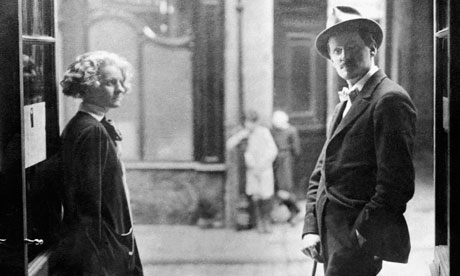
James Joyce with Sylvia Beach outside her book shop in Paris, 1920.
James Joyce with Sylvia Beach outside her book shop in Paris, 1920. Photograph: AFP/Getty Images

This would be a good time for a strong new biography of James Joyce, 70 years after his death and almost 30 since the revised version of Richard Ellmann's classic contribution to the form. In the last few decades, Joyce seems to have lost a little ground to Proust. People like to read about the rich – perhaps it's as simple as that, and Joyce committed a number of crimes, over the years, against formal dress. No one in his books is worth more than a thousand pounds all told, as he pointed out after being denounced for lack of political engagement, along with Kafka as well as Proust (and Lawrence, Eliot, Yeats), at a 1937 Writers' Congress in Madrid

Even Gabriel Josipovici, a stubbornly brilliant critic, seemed to short-change Joyce in his recent polemic What Ever Happened to Modernism? He was more attracted to writers with a high rating of aesthetic anguish, to Kafka's writhings and incompletions, to Beckett's long campaign against his own charm and eloquence, which is a rather romantic way of responding to an anti-romantic movement. In his books, Joyce shed the 19th-century cleanly and decisively, and had a great gift for generating rich new material from arbitrary scraps of patterning. The interval between his realising that a certain way of writing the world was bankrupt and finding a new one seems to have been enviably short, however long it took him to get the words exactly as he wanted them.

The life was a different matter, displaying not so much the celebrated trinity of tactics asserted by his creation Stephen Dedalus (silence, exile, cunning) as unpredictable volubility, reluctant nomadism and the frantic exploitation of benefactors.

A literary biographer needs to be a bit of a historian, a bit of a critic and a bit of stylist. It's hard to say in which department Gordon Bowker falls shortest. Take this historical sketch of Joyce's birth year: "For the British Empire, as 1882 dawned, it was business as usual. Queen Victoria …had ruled her domain for 45 years, and would reign for a further 19." Perhaps there was some sort of floral clock arrangement in public parks, displaying a countdown, so as to keep citizens properly informed of their future.
The great temptation of literary biography is the obsessive coupling of the life and the work, as if a writer's surroundings entered the books directly, and the exact process by which they did so (when they did) was relatively unimportant. Bowker's biography is full of things "inserting themselves" or "finding their way" into Joyce's fiction, as if he wasn't in charge of the process.

Read the full review.

What’s Scrabble When You Can Play Novelist?

Dave Sanders for The New York Times
Published: July 1, 2011- By , New York Times. 


The best after-dinner games need no special equipment to play: no dice, cards, tiles or machines that bleat at wrong answers. Classics like charades and the dictionary game — sometimes called Fictionary, and tweaked for the unimaginative under the brand name Balderdash — call at most for paper and pencils. They’re D.I.Y. and lo-fi.

The paperback game — a variant on poetry and quotation games, involving 4 to 10 players — requires used books often sold for no more than 50 cents apiece.
As Christopher Hitchens reminded us in his memoir “Hitch-22,” even paper and pencil are sometimes superfluous. He described a game, played with Salman Rushdie and other friends, that involved replacing the word “love” in famous book titles with the phrase “hysterical sex.” (They played dirtier versions of this game too.) Thus you’d get titles like “Hysterical Sex in the Time of Cholera.”

In my extended family, over the past decade, we’ve looked forward to playing something we call the book game, which I am going to retitle, for the purposes of this article, the paperback game. Introduced to us by friends, it’s been kicking around forever, handed along by word of mouth. (A narrow version of it was packaged in 1991 under the brand name Ex Libris.) Some of you may have played the paperback game; I’m guessing many of you haven’t. It’s time to plug this small but vital gap in your education.

I think of the paperback game as a summertime entertainment, best played in beach and lake houses and old inns, all of which tend to collect visitors’ random and abandoned books. So the weekend of the Fourth of July seems like a good time to share, review and/or clarify the rules. From here you can bend them to your will and make the game your own.  
Full piece New York Times.     

THAT BOOK - PAUL LITTLE ON THE SUBJECT - HERALD ON SUNDAY

By Paul Little
5 Sunday Jul 3, 2011
The publicity around Ian Wishart's book on Macsyna King has been a publisher's dream. Photo / NZ Herald

The publicity around Ian Wishart's book on Macsyna King has been a publisher's dream. Photo / NZ Herald

The Facebook page urging a boycott of Breaking Silence, the story of Macsyna King, written by Ian Wishart, has been a stunning victory for unthinking hysteria.
Those opposed to the book would have done more damage to its fortunes by saying nothing and not drawing attention to it. As it is, they have made Ian Wishart the beneficiary of the sort of publicity most small publishers can only dream of.
Wishart is a professional controversialist and fundamentalist Christian whose beliefs prey on our worst instincts. Big brother is watching us. Helen Clark had a secret agenda. The justice system favours criminals. Name a right-wing piece of lunacy and he is likely to be for it. Fortunately, we live in a society where he has every right to express his opinions, no matter how crazy.
Publishing is not a democracy. We don't get to vote on which books are printed. From Mein Kampf to the Bible we allow books to be published and sold that propagate ideas many of us find offensive.
But it is one of the fundamentals of our society that everyone is entitled to express their opinion, no matter how extreme.
Read Paul Little's full column at Herald on Sunday.

11th international festival of literature berlin - 7 to 17 September 2011 - NZ author on programme

The Asia Pacific region will be in the Focus of ilb 2011. The cultural wealth of the countries in the region, and the diversity of their histories and geographies are being reflected in their literatures. Twenty magnificent voices in the Focus this year include Ha Jin (winner of the National Book Awards in the year 2000 and two-time winner of the PEN/Faulkner Awards), Tom Keneally, the author of the novel “Schindler’s Arc”, Mao biographer Jung Chang from China, and the Indian novelist and essayist Pankaj Mishra
We are pleased to also announce the participation of C.K. Stead from New Zealand, the winner of the Man Asian Literary Prize 2008 Miguel Syjuco and the Korean national poet Kim Chi-Ha


C.K.Stead will have one session as a poet, one as a fiction writer (reading from and talking about My Name was Judas), and one in which he will read a Katherine Mansfield story (‘The Doll’s House’) and talk about her work.


Photo - Sydney Morning Herald.

AN ILLUSTRATED HISTORY OF CHRISTCHURCH'S THE PRESS

Congratulations to The Press on achieving 150 years of supplying news to the people of Canterbury.

In this entertaining, highly illustrated look back over those years Mike Crean and his picture research assistant, Jude Twenion, have done The Press proud. All Cantabrians, past and present, should get hold of a copy.
The following picture of Allen Curnow appears in the chapter on notable writers who have written for The Press. The caption reads - The Press published Allen Curnow's weekly verse under the pseudonym Whim Wham, who soon became New Zealand's favourite and best-read poet.
The caption on the following photo reads:
Mr.A.E.Humm on Septemer 6, 1950. Humm, a newspaper delivery runner in the publishing department of The Press, is standing beside the car in which he had travelled 345,000 miles since 1939. Humm delivered The Press in the Lincoln district for more than 30 years.
Both photos from The Press archives.
Stories featured the book include the Parker Hume case, , the Christchurch Commonwealth Games in 1974, international cartoonist David Low, Britain at War, first train to Lyttelton in 1867, the building of Christchurch Cathedral, the death of Queen Victoria, the loss of the Titanic, Kingsford Smith's flight from Australia to New Zealand,  the Coronation, Everest conquered and much more.

The Press - First With The News - an illustrated history - Mike Crean - Random House - $34.99

Poetry Reading - an invitation

Marsden Books invites you to a reading of new poetry by Vincent O’Sullivan from his new book ‘The movie may be slightly different’, introduced by Harry Ricketts

Wednesday July 13th, 6pm at Marsden Books – 159 Karori Rd, Karori, Wellington, NZ

The 30 Harshest Author-on-Author Insults In History

27. Harold Bloom on J.K. Rowling (2000)


“How to read ‘Harry Potter and the Sorcerer’s Stone’? Why, very quickly, to begin with, and perhaps also to make an end. Why read it? Presumably, if you cannot be persuaded to read anything better, Rowling will have to do.”


Read, and enjoy, the full list here.

Saturday, July 02, 2011

Tomorrow - Sunday 3 July - Readers Writers & Rogues at the Piha Surf Club

Piha to Host Writer's And Reader's Season
Some big names in the literary world will be making appearances on the wild west coast this winter - as part of the inagaural Writer's and Reader's Festival, hosted by the Piha Library Trust.
Over a glass or two of wine - Ian Mune, Emily Perkins and Hamish Keith aided by the ebullient presence of John Yelash and Peter Williams Q.C. reading poetry, with music by local musicians, Helen Duder and friends. The monthly Sunday showcase is likely to draw a full house.
The library organisers hope to make it an annual event, if it goes well this year, nest year will be even bigger - with a three month season.

On July 3rd, Hamish Keith and Bill Ralston will talk about writing, art, editing and grumpiness.
Emily Perkins will read from her work and talk of getting it down on paper. She is one of the judges of this year's N.Z. Book Awards.
The west coast poet - Sam Sampson will support the afternoon with readings from his books and unpublished poems.
August 7th will see Ian Mune, a finalist in this year;s Book Awards, reading from his book "Mune" and talking of his life as an actor and writer, as well as his new film, a documentary on Billy T. James.
John Yelash will support Ian with his personal recollections of James K. Baxter and read some of Baxter's poetry. Yelash will also read with his mate Peter Williams Q.C. a selection of poems and stories of protests and prison life.

The line up is known as Writers, Readers and Rogues. The organisers will look to local thespians to join in with guest slots welcome.
The season will be held at the Piha Surf Club, the library being too small, for what is anticipated to be a sellout. The afternoon commences at 2.pm.
Tickets are $20.00 at the door