Thursday, July 28, 2011

Judges announced for BBC National Short Story Award 2011

Three of the UK’s leading authors have joined Chair Sue MacGregor and BBC Radio’s Di Speirs to judge the 2011 BBC National Short Story Award this autumn. The Award, which is now in its sixth year, celebrates the best in contemporary short story writing and is one of the most important for a single short story. The author of the winning story will be awarded £15,000, with the runner up receiving £3,000 and a further three authors receiving £500 each. 
This year’s panel consists of:

  • BBC Radio 4 broadcaster Sue MacGregor (Chair)
  • Joe Dunthorne, poet and author of Submarine
  • Author and journalist Geoff Dyer
  • Tessa Hadley, whose most recent novel is The London Train
  • Di Speirs, Editor Readings, BBC Radio,
Sue MacGregor, BBC Radio 4 broadcaster and Chair of the 2011 judging panel comments:
‘We've had an impressive number of short stories to keep us busy reading these last few weeks. My fellow judges – three distinguished writers and a BBC editor of vast experience – will join me over breakfast one morning this month and pick our shortlist of the best of them, fortified by several gallons of strong coffee, some lively argument, and the knowledge that the genre is in terrifically good health. It won't be easy but we'll have a fine time.’

The Award has moved forward by two months in 2011 from November to September to coincide with Books on the BBC 2011 – a major season of programmes focusing on literature. The shortlist will be announced on Friday 9 September with each of the five stories broadcast on Radio 4 the following week. The winner will be announced on Monday 26 September. The five stories will also be published in a special anthology and be available for free audio download for a limited time.

Lighting the literary fire: Remembering Michael King - Rachael King and Lloyd Jones in conversation

The Press Christchurch Writers Festival just keeps on keeping on. Two festivals couldn’t proceed due to earthquakes, their Kidsfest events had to be cancelled on Tuesday due to snow, but the first of the literary events they are determined to bring to Christchurch went ahead successfully last night.

Lloyd Jones and Rachael King were in conversation about The Silence Beyond: Selected Writings of Michael King, the collection Rachael has assembled of her father’s essays, talks and eulogies.
It’s always good to get the chance to hear writers talk about their own work, but the novelty of listening to two wonderful writers talk about someone else made for a fantastic evening. It’s a shame there weren’t more people there to enjoy it.
The man who emerged from their reminiscences and from the the excerpts they read from The Silence Beyond was not at all how I imagined him. Surely “one of New Zealand’s greatest modern thinkers” would be super serious, even a bit dour.

Read the full account at Christchurch City Libraries Blog.

Authors Workshops in Auckland

                                                  
The New Zealand Society of Authors (PEN NZ Inc.)
in association with the
Ashton Wylie Charitable Trust

Are delighted to present a day of workshops

Publishing for Authors
Saturday, 20th August 2011

to run in conjunction with the
Ashton Wylie Book and Unpublished Manuscript Awards
for the mind, body, spirit or 'new age' genre. 

The workshop will follow
The Ashton Wylie Charitable Trust Book Awards Ceremony
On
Friday, 19th August 2011

Both to be held at
Hopetoun Alpha, 19 Beresford Square, Auckland

The New Zealand Society of Authors (PEN NZ Inc.), PO Box 7701, Wellesley Street, Auckland 1141

Ph (09) 379 4801 director@nzauthors.org.nz

WRITERS ON MONDAYS AT TE PAPA - A REMINDER

From the country of the novel
 Charlotte Randall lives in Christchurch. She was Writer in Residence at Victoria University in 2000. Her 6th novel,  Hokitika Town,  was published this year by the Penguin Group NZ.  Set in the gold rush of 1865, it’s the story of a coin boy, Halfie, told in his own unique take on the English language. Three of her earlier novels were runners-up for the Montana New Zealand Book Awards.
Laurence Fearnley lives in Dunedin. She has written 8 novels,  two of which have been runners-up in the Montana New Zealand Book Awards. Her latest, The Hut Builder (Penguin 2010), is part of the PhD in Creative Writing she is working on at Victoria University and last night it won the Fiction Award in the New Zealand Post Book Awards.  Mt Cook, Sir Edmund Hillary and Charles Brasch enter this very southern story set in 1950’s New Zealand.
Tim Wilson is well known as a TVNZ US correspondent and as a print journalist. He is based in New York. Over the years he has had much short fiction published. His first novel, ‘Their Faces Were Shining’, came out from VUP in 2010 and was a finalist in the New Zealand Post Book Awards. Exploring the notion of The Rapture, as the author says ‘it describes relearning love in late middle age while the world ends’.  

Fergus Barrowman will chair this session.

Date:         Monday 1 August
Time:         12.15-1.15pm
Venue:       Te Papa Marae, 4th floor, Te Papa (please note that no food may be taken into Te Papa Marae).

Writers on Mondays is presented with the Museum of New Zealand Te Papa Tongarewa, and additional support from Circa Theatre and City Gallery Wellington. These sessions are open to the public and free of charge.

Jo Nesbo on Norway's lost innocence

The attacks in Oslo and Utøya have changed Norway for ever and it will never again be the innocent, trusting place it once was, says novelist Jo Nesbø. 
The Bookman warmly recommends reading this piece which appears in The Guardian today. What a thrill to be able to buy The Guardian on the day of publication at 7.30am in Paris while out on our morning walk.
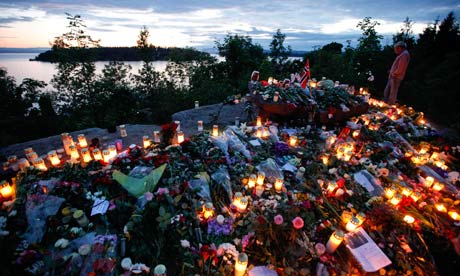
A temporary memorial on Utøya island, Norway, scene of the 22 July shootings.
A temporary memorial on Utøya island, Norway, scene of the 22 July shootings. Photograph: FABRIZIO BENSCH/REUTERS

A few days ago, before Utøya and the government building, a friend and I were talking about how two things always go hand in hand: the joy of being alive and the sorrow that things change. That even the brightest future can never entirely make up for the fact that no roads lead back to what went before. To the innocence of childhood. To the first time you fell in love. To the scents of July, the blades of grass tickling your sweaty back as you leap from a boulder and in the next second are enveloped by the ice-cold meltwater of a Norwegian fjord, with your nose and throat filled with the taste of salt and glaciers.
No road back to when you were 17 and, with 10 francs in your pocket, stood by the harbour in Cannes and watched two grown men wearing idiotic white uniforms row a woman ashore from a yacht with her poodle and credit cards, and you realised that the egalitarian society you came from was the exception and not the rule. Or you stood, wide-eyed, in front of another country's national assembly, which was surrounded by guards carrying automatic weapons – a sight that made you shake your head with a mixture of resignation and self-satisfaction, thinking: "We don't need that sort of thing where I come from."
Because I came from a country where fear of others had not found a foothold. A country you could leave for three months, travelling through two coups d'état, a catastrophic famine, a school massacre, two assassinations, a tsunami, and come home to read the newspapers and discover that the only thing new was the crossword puzzle. A country where everyone's material needs were provided for when oil was discovered in the 70s, and where the political path was established right after the second world war.
The consensus was overwhelming, the debates focused primarily on the best means for achieving the goals that had been agreed upon by everyone from the rightwing to the left. It was a country that thought it was best served by keeping to itself and chose to remain outside the EU, which most small countries would give their right arm to be admitted to. Ideological debates arose only when the reality of the rest of the world began to encroach, when a nation, which up until the 70s had consisted largely of people of the same ethnic and cultural background, had to decide whether their new citizens should be allowed to wear the hijab and build mosques, and when Norwegian soldiers were sent to Afghanistan and Libya. But the Norwegian self-image before 22 July 2011 was that of a virgin – nature untouched by human hands, a nation unsullied by the ills of society.
An exaggeration, of course. A glance at police records is all it takes. And yet. In June I was cycling with the Norwegian prime minister, Jens Stoltenberg, and a mutual friend through the streets of Oslo, setting out for a hike on a forested mountain slope within the city limits of this big yet little city. Two bodyguards followed a few metres behind us, also on bicycles. As we stopped at an intersection for a red light, a car drove up beside the prime minister with the window rolled down. The driver called out his name. "Jens!" The fact that the Norwegian people usually speak of the nation's top leader and even address him directly by his first name is in the tradition of the egalitarian spirit, and it has long since ceased to surprise me.
"There's a little boy here who thinks it would be cool to say hello to you," said the man.
Stoltenberg smiled and shook hands with the little boy sitting in the passenger seat. "Hi, I'm Jens."
The prime minister wearing his bike helmet. The boy wearing his seatbelt. Both of them stopped for a red light. The bodyguards waited a discreet distance behind us. Smiling. It's an image of safety and mutual trust. Of the ordinary, idyllic Norwegian society that we all took for granted. Of what we considered normal. How could anything go wrong? We had bike helmets and seatbelts, and we were obeying the traffic rules.
Of course something could go wrong. Something can always go wrong.
Read the rest of Jo Nesbo's thoughtful essay at The Guardian.

Kiwi Music History Takes Top Literary Prize


Blue Smoke by Chris Bourke wins 2011 New Zealand Post Book of the Year

Christopher Finlayson, Minister of Arts, Culture and Heritage, tonight awarded music historian Chris Bourke the New Zealand Post Book of the Year, for his work Blue Smoke: The Lost Dawn of New Zealand Popular Music 1918-1964.

New Zealand Post Book Awards convenor of judges, Paul Diamond, described the winning work as a magnificent book that achieves what it sets out to do, and reveals a hidden social history.  'Blue Smoke tells us about ourselves, our music, and the way we take things from overseas and make them our own.'
Bourke, who lives in Wellington, describes Blue Smoke as “a music history before it is a social or cultural history”.   ‘It is a book about music and musicians, many of whom Bourke has interviewed himself, drawing out anecdotes that enrich our understanding of our nation’s cultural development’, says judge Charmaine Pountney. Bourke (pic right) scored a unique hat trick by also winning the New Zealand Post General Non-fiction Award and the coveted People’s Choice Award.

Laurence Fearnley (Dunedin) wins the 2011 New Zealand Post Book Award for Fiction for her seventh novel, The Hut Builder.

Emily Perkins, who joined Charmaine Pountney, Bob Harvey, Michael Harlow and convenor of judges, Paul Diamond on the Awards judging panel, said this is elating, transformative prose.’
‘In this novel Laurence Fearnley continues her committed exploration of Southern lives, and in doing so creates something new  –  a 21st century approach to a sort of 20th century Pakeha origin story. Through the character of
Boden Black, butcher, poet, and sometime mountaineer, she gives voice to the taciturn archetype of the Great Southern man, and reaches into awkward corners of the psyche with tenderness and empathy’, says Perkins.
  
Wellington-based poet Kate Camp was presented with the 2011 New Zealand Post Book Award for Poetry for her collection, The Mırror Of Simple Annihilated Souls, described by judge Michael Harlow as a truly thoughtful and engaging book of poems.

Harlow says, ‘In ‘The Mırror Of Simple Annihilated Souls, Kate Camp has rather courageously accepted the challenge to make words sing to that universal and always fascinating experience: what is it that love desires the self to do, and be — in the service of what we can recognise as ‘soul-making. Camp demonstrates a poetic brilliance of her own by making ‘original translations’ of her own in a contemporary idiom that deals with the spiritual dimension of life-lived-in-the world’.

Freelance art historian and curator from Gisborne, Damian Skinner took out the Illustrated Non-Fiction award for his book The Passing World, The Passage of Life: John Hovell and the Art of Kowhaiwhai.

Awards’ judge Bob Harvey described Skinners’s work as a beautiful book that showcases Hovell’s astonishing design and creativity for marae projects on the East coast, urban Auckland and in the Coromandel.

‘Maori whare whakairo – the decorated meeting houses were often hidden away from the Pakeha world.  Many have been lost and the ones that remain are fragile.  These elaborately painted and beautifully designed  
buildings, have given inspiration to John Hovell's life.  From the mid 1960's Hovell has been at the very heart of the contemporary Maori art movement,’ says Harvey.

The full list of 2011 New Zealand Post Book Awards winners are as follows:
New Zealand Post Book of the Year and General Non-fiction Award winner:
Blue Smoke: The Lost Dawn of New Zealand Popular Music 1918-1964 by Chris Bourke (Auckland University Press)

Fiction Award winner: The Hut Builder by Laurence Fearnley (Penguin Group (NZ))

Poetry Award winner:  The Mirror of Simple Annihilated Souls by Kate Camp (Victoria University Press)

Illustrated Non-fiction Award winner:  The Passing World: The Passage of Life: John Hovell and the Art of Kowhaiwhai by Damian Skinner (Rim Books).

Bourke also took out the popular vote by winning the People’s Choice Award, as voted for by thousands of New Zealanders nationwide.

The generous prize-pool for the New Zealand Post Book Awards reflects the high calibre of writing being recognised. The winner of the New Zealand Post Book of the Year Award receives $15,000, the winners of the four Category Awards each receive $10,000 and the People’s Choice Award winner receives $5,000.

This year’s New Zealand Post Book Awards winners will appear at a free event:
On Thursday 28 July from 12.15 to 1.45pm at Te Papa Marae, hosted by Kim Hill.

The winners of the 2011 New Zealand Society of Authors (NZSA) Best First Book Awards – announced earlier this year –  were also honoured tonight. They are:

NZSA Hubert Church Best First Book Award for Fiction:  Pip Adam with her short story collection, Everything We Hoped for (Victoria University Press)

NZSA Jessie Mackay Best First Book Award for Poetry: Lynn Jenner for her collection, Dear Sweet Harry (Auckland University Press)

NZSA E.H. McCormick Best First Book Award for Non-Fiction:  Dr. Poia Rewi for Whaikōrero: The World of Māori Oratory (Auckland University Press).

Each NZSA Best First Book Awards category winner received $2,500.

New Zealand Post Group’s sponsorship of the country’s national book awards is symbolic of their strong and active support of the country’s literature. As sponsor of the New Zealand Post Children’s Book Awards for 15 years, this new sponsorship highlights the company’s commitment to making literature accessible and promoting literary excellence. 
www.nzpostbookawards.co.nz

Photos below - Chris Bourke and Kate Camp accepting their awards - Photos Mark Tantrum


Hollinghurst favourite to win Man Booker

26.07.11 | Graeme Neill - The Bookseller

William Hill has installed former Man Booker winner Alan Hollinghurst as the 5/1 favourite to clinch the prize for the second time for his novel The Stranger's Child (Picador).

The longlist was announced this afternoon and the bookmaker has moved quickly to lay out its odds. Julian Barnes is 6/1 second favourite for The Sense of an Ending (Jonathan Cape).
Three Canadians are on the longlist—Alison Pick, Patrick deWitt and Esi Edugyan—and William Hill is offering odds of 4/1 that one of them walks away with the £50,000 prize when it is revealed on 18th October.
Wiliam Hill spokesman Graham Sharpe said: "The Man Booker is easily the most popular literary award with punters and all indications suggest that a significant six-figure sum will be riding on the outcome.
“Alan Hollinghurst has had rave reviews for his latest book which is a worthy favourite in what, nonetheless, looks an open year. For the first time a book with a horse racing theme is in the running and we would be delighted to see the book upset the favourite—D J Taylor has already outdone racing’s bestselling Dick Francis by making it to the Man Booker shortlist.”

The odds in full are:
5/1 Alan Hollinghurst - The Stranger’s Child (Picador - Pan Macmillan)
6/1 Julian Barnes - The Sense of an Ending (Jonathan Cape - Random House)
8/1 Carol Birch - Jamrach’s Menagerie (Canongate Books)
8/1 D.J. Taylor - Derby Day (Chatto & Windus - Random House)
10/1 Sebastian Barry - On Canaan’s Side (Faber)
10/1 Stephen Kelman - Pigeon English (Bloomsbury)
12/1 Yvvette Edwards - A Cupboard Full of Coats (Oneworld)
12/1 Alison Pick - Far to Go (Headline Review)
14/1 Esi Edugyan - Half Blood Blues (Serpent’s Tail - Profile)
14/1 Patrick McGuinness - The Last Hundred Days (Seren Books)
16/1 Patrick deWitt - The Sisters Brothers (Granta)
16/1 A.D. Miller - Snowdrops (Atlantic)
18/1 Jane Rogers - The Testament of Jessie Lamb (Sandstone Press)

Media debates Booker longlist

27.07.11 | Bookseller Staff - The Bookseller

The newspapers have offered differing reactions to the Man Booker longlist announcement, made yesterday, with most hailing bookies' favourite Alan Hollinghurst, and the Daily Telegraph detecting a "more populist" selection.
The Independent chose to focus on the inclusion of Scottish indie Sandstone Press' The Testament of Jessie Lamb by Jane Rogers with the headline "Booker Prize pits tiny Highlands publisher against literary giants".
The paper described the 13-strong list as "headed" by Hollinghurst's The Stranger's Child (Picador) and listed "notable omissions" Justin Cartwright, Ali Smith, A L Kennedy, Andrew Miller, Anne Enright and Aravind Adiga.
The Daily Mail reported the Daily Telegraph's angle on the story, which was chair of judges Stella Rimington's fear that, although a market for fiction would exist in 100 years, electronic gadgets were distracting young people from cultivating a love of reading novels. She said" "I think much of the Twittering and emailing and texting and all that sort of stuff that children go in for now may be taking their eyes off reading fiction. When I was young we read more than the average child reads now." However she said that devices like the Kindle could "help turn the tide".
In a blog piece, the Telegraph commented: "So while the judges’ more populist tastes can certainly be seen in their list, they have also given themselves enough wiggle room to carve out a respectable shortlist", but predicted that former-winner Hollinghurst's "subject is probably too literary for him to win again".
Meanwhile the Guardian focused on Stephen Kelman's gang culture debut Pigeon English (Bloomsbury) and also mourned the omissions of Graham Swift, Philip Hensher, Linda Grant, Anne Enright and Aravind Adiga.
Any suggestion of disagreement between the judges was swiftly kyboshed: Rimington told the paper: "We've had a lot of fun today. It was an impassioned debate, but—without any acrimony and with a great deal of humour—we've come up with a longlist we're all pleased with."

Footnote:
Reactions from The Guardian, The Telegraph and The Independent were posted on the blog earlier.Scroll down.

Life after REDgroup in Australia — Crikey maps the bookshop closures

The Australian bookselling industry is a substantially different place as a result of the collapse of REDgroup Retail.
As the administration process of what was once the country’s largest bookselling network draws to a close (we are still waiting on a second meeting of REDgroup’s creditors to find out how the funds will be distributed), we are beginning to get a glimpse of what life after Angus & Robertson (A&R) and Borders will be like.
When the board of REDgroup called in administrators Ferrier Hodgson on February 17 this year, the group, which also owned the Whitcoulls bookshop chain in New Zealand and still owns the Supanews newsagency chain, had close to 190 bookshops in Australia. There were 26 Borders shops across the country, 116 A&R company-owned shops and 47 A&R franchise shops.
The first shop closures were announced within a week of the group entering administration. 37 A&R company-owned shops, and one Borders shop, were the first casualties. This was followed by another 12 A&R company shops in April, 16 Borders shops, also in April, six A&R company shops in May, nine Borders shops in June, and 42 A&R company shops in June.
In July, a final announcement was made: the administrators had sold three A&R company shops (one to Dymocks), and the remaining 16 A&R company shops would close, and the sale of three A&R company shops (one to Dymocks). To the surprise of many outside the industry, this final announcement also included the closure of the much-loved Reader’s Feast bookshop in Melbourne’s CBD.
According to reports from the Weekly Book Newsletter, 139 bookshops in Australia have been lost because of the administration of REDgroup. Including over 200 redundancies at REDgroup headquarters and distribution centres in Melbourne, close to 2100 bookselling jobs no longer exist.
But it is not just about the quantity of bookshops that have been lost; it’s also about where these shops were located. While the Borders shops were generally located in large shopping centres or precincts, Angus & Robertson shops were often the only general bookshops located in suburban or regional areas. Some of these suburbs and towns are now without a dedicated bookshop.
Rest of story.

Man Booker 2011: Alan Hollinghurst too literary for this Booker

The longlist for the Booker Prize 2011 has been announced, and most of the choices reflect the populist tastes of the judges.

Alan Hollinghurst
Alan Hollinghurst Photo: Ellie Foreman-Peck
When the judges were announced for this year’s Man Booker Prize, critics were quick to point out that four of the five — Stella Rimington, Chris Mullin, Susan Hill and Matthew D’Ancona – had written thrillers, and that only Gaby Wood, the head of books at The Telegraph, was a traditional highbrow choice.
So is this the year the Booker went populist? Would Ruth Rendell make the list — even Lee Child?
At first glance, these fears seem unfounded. Apart from Anne Enright and Philip Hensher, all the big-hitters are there. Alan Hollinghurst, who won the prize in 2004, returns with The Stranger’s Child, about a Rupert Brooke-style poet whose work resonates across the 20th century. Though the bookies have him as favourite, the subject is probably too literary for him to win again.
Also present is Sebastian Barry, who was unlucky to miss out in 2008 for The Secret Scripture, and whose new novel On Canaan’s Side looks at Irish history through the eyes of an ageing woman.
I have a sneaking feeling this might be the year of Julian Barnes — nominated three times but never victorious. His short novel The Sense of an Ending, follows a group of old school friends after one, Adrian Finn, commits suicide. The narrator, Tony Webster, is left his diary in his will and goes back to explore his relationship with his friend and the woman they loved.
Much of the rest of the list leaves one scratching one’s head. Stephen Kelman’s Pigeon English, a debut based on the story of Damilola Taylor, the murdered Peckham schoolboy, is cleverly done but really a novel for teenagers.
There are thriller-ish aspects to A D Miller’s Snowdrops, a debut set in an amoral Moscow; Patrick McGuiness’s The Last Hundred Days, about the final days of Ceaucescu, and Jane Rogers’s The Testament of Jessie Lamb, a dystopian novel in which pregnant women are dying mysteriously. The presence of D J Taylor’s Derby Day is baffling. One can only think one of the judges is a horse racing nut.
So while the judges’ more populist tastes can certainly be seen in their list, they have also given themselves enough wiggle room to carve out a respectable shortlist, which is to be announced on Sept 6.

Man Booker prize 2011 longlist includes quartet of debut novels

Stephen Kelman
Stephen Kelman's debut novel Pigeon English, once consigned to a literary agency slush pile, has made the 13-strong Man Booker longlist. Photograph: Jonathan Ring

A debut novel chronicling gang warfare in Peckham has joined efforts by a former Man Booker winner, Alan Hollinghurst, and Julian Barnes - the novelist many people mistakenly think must have won - on this year's longlist for the prestigious prize.
Stephen Kelman, who was a warehouseman, care worker and local government administrator before taking up writing in 2005, was longlisted for Pigeon English, one of the more eye-catching additions to a lineup that includes four first-time novelists.
The book, which draws on the murder of 10-year-old Damilola Taylor and for a time languished on a literary agency's slush pile, eventually became the subject of a bidding war last year before being picked up - shrewdly, as it turns out - by Bloomsbury.
The list is striking for its range of subject matter although, given that a former spymaster is in charge, a bit more intrigue might have been expected. But former MI5 director Dame Stella Rimington told the Guardian: "There is no espionage, no ... there are, though, two post-cold war books. Not because of me, but by general agreement."
It took judges around two hours to get the list down to 13 from the 138 books read. "We've had a lot of fun today," said Rimington. "It was an impassioned debate, but - without any acrimony and with a great deal of humour - we've come up with a longlist we're all pleased with.
"It is a list of considerable variety, not only in the subjects but in the range of authors."
Rimington admitted it had been "a weighty burden being a judge but also extremely enjoyable and entertaining."

The Man Booker's literary director Ion Trewin said: "This is my seventh prize and every year is different from the previous one. I'm particularly pleased to see four first novels and also unfamiliar publishers. That's great, because that's where the future is.
"[The longlist] seems to me to be as far-ranging in subject matter as I can recall. One of the things that's changed over the years is that it used to be very much, quote, 'literary fiction'. Now, if it's particularly good, what you might call genre [is] no bar to it being listed."
Evidence of that is DJ Taylor's Victorian mystery Derby Day, a book that could easily be called a thriller - a very rare thing on the Man Booker longlists.

The one book predicted by almost everyone is Alan Hollinghurst's sweeping tale of poetry, class and ambiguous sexual identities, The Stranger's Child. The author, who won seven years ago with his last novel, The Line of Beauty, was straight away installed as 5-1 favourite by William Hill.
His 584-page book is in stark contrast to second favourite Julian Barnes. A Man Booker bridesmaid, Barnes - shortlisted three times - makes the list with his 150-page offering, The Sense of an Ending.
Another familiar name is Sebastian Barry, shortlisted twice before, who is included with On Canaan's Side, in which an old lady looks back on a long life that took her from Dublin to Chicago.

The list includes novels which failed to make it on to the radar of newspaper literary editors, among them Yvvette Edwards's A Cupboard Full of Coats, which was not reviewed by any national title. The Hackney Citizen helped fill the gap, calling it a gripping tale "of anguish and guilt."

Then there are three Canadian novels which have, as yet, made little impact in the UK: Patrick deWitt's The Sisters Brothers, Alison Pick's Far To Go and Half Blood Blues by Esi Edugyan.
Other novels on the list are Carol Birch's 11th novel, Jamrach's Menagerie, which made the Orange prize longlist but not the shortlist; Patrick McGuiness for The Last Hundred Days, which examines the end of Ceausescu's tyranny in Romania; AD Miller's Snowdrops, a Moscow-set crime story; and Jane Rogers's The Testament of Jessie Lamb.

Among the notable omissions were the 2007 winner Anne Enright. The Forgotten Waltz, a lively tale of Dublin adultery and mortgages, failed to make the cut, as did Last Man in Tower by the 2008 winner Aravind Adiga.
There was also no place for former winner Graham Swift or 2008 shortlisters Philip Hensher and Linda Grant.
The panel, chaired by Rimington, includes journalists Gaby Wood and Matthew d'Ancona, politician Chris Mullin and novelist Susan Hill, who also had a stint as a Booker judge 36 years ago when Ruth Prawer Jhabvala won for Heat and Dust.
The shortlist of six will be announced on 6 September and the winner on 18 October. He or she will win £50,000, but the prize is worth much more than that. Apart from the kudos, the winner can expect a dramatic upturn in sales

While Rob Sharp, Arts Correspondent for The Independent had this to say about omissions:

Notable omissions include Justin Cartwright, Ali Smith, AL Kennedy and Andrew Miller, and former winners, including Anne Enright and Aravind Adiga, all of whom have released eligible books. One employee of a major publishing house, which had no longlisted authors, tweeted yesterday: "Congrats to all those authors and publishers but gutted none of ours made the longlist... I feel pretty sick and stunned."

Paperback Publishers Quicken Their Pace

By JULIE BOSMAN, New York Times

Photo - Peter Yates for The New York Times

A new-releases display at the Elliott Bay Book Company in Seattle contains both paperbacks and hardcovers. Now publishers often don't wait the traditional year before bringing out paperbacks.
E-books are helping to alter the time-honored schedule for life after hardcover, with softcover versions of novels and nonfiction works being released earlier and earlier.

Wednesday, July 27, 2011

HOTEL SAFETY FOR FEMALE VISITORS

At a Hotel on Business? Be on Alert, Too

Jeannette Duwe said she was attacked in Reno, Nev., in 2002 while working in a hotel's business center.
But business travelers can fall victim to attacks, too, by intruders, hotel staff, even other guests. Most often, the victims are women.

Paxton Quigley, a women’s safety consultant in New York and author of “Not an Easy Target” (Fireside, 1995), said most women business travelers were “just beginning to learn how unsafe they can be, especially in airports and planes, hotels, walking on streets in cities that they don’t know and in convention settings.” Conventions, she said, leave women particularly vulnerable because “they’re wearing name badges and are telling people where they are staying.”
Jeannette Duwe said she was staying at a hotel in Reno, Nev., while traveling for the grocery store chain Albertsons when she was attacked in 2002. She was working late on news releases in the business center when a man pried the door open and began bothering her. “I asked him to leave a couple times,” she said, adding that she “made the mistake of turning my back to him, which is when he hit the lights and attacked me.”
Eight weeks pregnant at the time, she said she worried that no one could hear her scream, but, “Something spooked him after a couple minutes and he ran off.” She immediately called the front desk for help.
Travelers can take several steps to protect themselves, said Marybeth Bond, a women’s travel expert in San Francisco who runs www.gutsytraveler.com and has written several National Geographic women’s travel books. Women need to “trust their instincts,” she said, if a situation seems awry. When hotel employees make deliveries, she said, travelers should either leave the door fully open or say, “I’ll take it from here — you don’t need to come into the room.” Ms. Bond carries a rubber doorstopper to jam under her hotel door and says she makes sure any adjoining hotel room doors are locked.
Full piece here.       

The Worst Sentence of 2011

By Jason Boog on Galley Cat, July 26, 2011 5:14 PM

University of Wisconsin Oshkosh assistant professor Sue Fondrie has written the worst sentence of 2011, winning the annual Bulwer-Lytton Fiction Contest with the world’s worst opening to an imaginary novel.

Here is the winning (?) sentence: “Cheryl’s mind turned like the vanes of a wind-powered turbine, chopping her sparrow-like thoughts into bloody pieces that fell onto a growing pile of forgotten memories.”

This prize is part of an annual bad writing competition that began in 1982 at San Jose State University. The contest was named after Victorian novelist Edward George Earle Bulwer-Lytton (pictured, via), an author famous for writing the opening line: “It was a dark and stormy night.”

Launch of Michael Cooper’s 100 Must-try New Zealand Wines


A large crowd gathered at Auckland’s Wine Chambers last night to celebrate the launch of renowned wine writer Michael Cooper’s latest book. On offer were all 100 of the wines Michael named. The media, vineyard representatives and book industry people in attendance all had a fantastic time sampling the different varieties and discovering new drops.

Photo left - author with Michael Guy of Cafe magazine.

100 Must-try New Zealand Wines contains everything you need to know to buy the perfect bottle, all in an easy-to-use book that will appeal to everyone from the casual wine drinker to the more serious connoisseur.

The launch of this new book kicks off a big year for Michael. In November Hachette NZ will publish the milestone 20th edition of his annual Buyer’s Guide to New Zealand Wines. As its longevity attests, this title is firmly established as the most authoritative and sought-after guide to New Zealand wine.

100 Must-try New Zealand Wines by Michael Cooper, $34.99 RRP (Hodder Moa), available now.


Photo - Nicky Pellegrino, Steve White and Kerri Jackson


Photo above -  Hachette's Sales Manager Peter Janssen and staff from Stonyridge.jpg

Tim Jones talks to poet Barbara Strang

Author/poet/blogger Tim Jones' latest interview, with Christchurch poet Barbara Strang, is up on his blog. He talks with her about her new collection "The Corrosion Zone", and about life & writing in Christchurch in the aftermath of the earthquakes there:

Noted Australian author John Marsden to visit Christchurch in support of quake stricken city

Sydney, July, 2011: Best selling Australian author John Marsden is to visit Christchurch early next month in support of the disaster struck city.

The author, best known for his famed Tomorrow When The War Began series will conduct a number of in school writing workshops at selected high schools around Canterbury and also speak to a public audience at the Knox Church hall on Wednesday August 10.

Marsden’s NZ publicist Jane Symmans said the author was quick to offer his support to the city with which he has shared a long tenured and much enjoyed relationship. With gratitude the city has welcomed this generous gift and rare opportunity.

Marsden said “It's no secret that I love New Zealand and have the greatest respect for New Zealanders. In particular, I've been a great fan of the Christchurch public library, and the work they do for young readers, for many years. I've also been privileged to enjoy the hospitality of Margaret Mahy in Christchurch on a number of occasions. When the earthquakes hit, I felt, like many people, desperate to do something meaningful to show my support for my Canterbury friends. The one thing I do best is talking about writing and teaching writing skills, so I thought that it was the most useful way I could offer my services. I'm actually not interested though in getting kids to write anything specifically about the earthquakes. What I want to do is provide students with an experience that will give them something new to think about, and help energise them in a different and entirely positive way. As a bonus, I hope I can help enhance their understanding of language as a powerful medium of communication for feelings, thoughts, plans and opinions.”

Michele Ayres the Aoraki representative for SLANZA and librarian at Christchurch Girls’ High School who has been coordinating the tour with the assistance of John’s publisher, Macmillan Publishers said “John Marsden is an inspirational author and educator, and he brings a wealth of experience
and much needed hope to the kids, parents, and teachers of
Christchurch. His own reflections about starting from scratch will be invaluable. His school Candlebark broke new ground, and that's exactly what Christchurch needs to do. John is just the kind of person that we need right now: innovative, compassionate, and widely respected.”

Marsden has sold around five million books in Australia and overseas, and has many national and international awards to his credit, including the Buxtheder Bulle, awarded in Germany for the best teenage novel published anywhere in the world over a two-year period.

John will also be making public appearances in Wellington at the Children’s Bookshop in Kilbirnie, and in Auckland at Central City Library. DEtails below.

An Evening with John Marsden
Location: Knox Church Hall: 28 Bealey Avenue, Christchurch
Time: 6.00pm, Wednesday 10 August
Admission: Free

Book signing with John Marsden
Location: The Children’s Bookshop: Shop 26 Kilbirnie Plaza, Wellington
Time: 4.00pm, Friday 12 August
Admission: Free

An Afternoon with John Marsden
Location: Central City Library, 44 Lorne Street, Auckland
Time: 2.00pm, Sunday 14 August
Admission: Free